

What happened
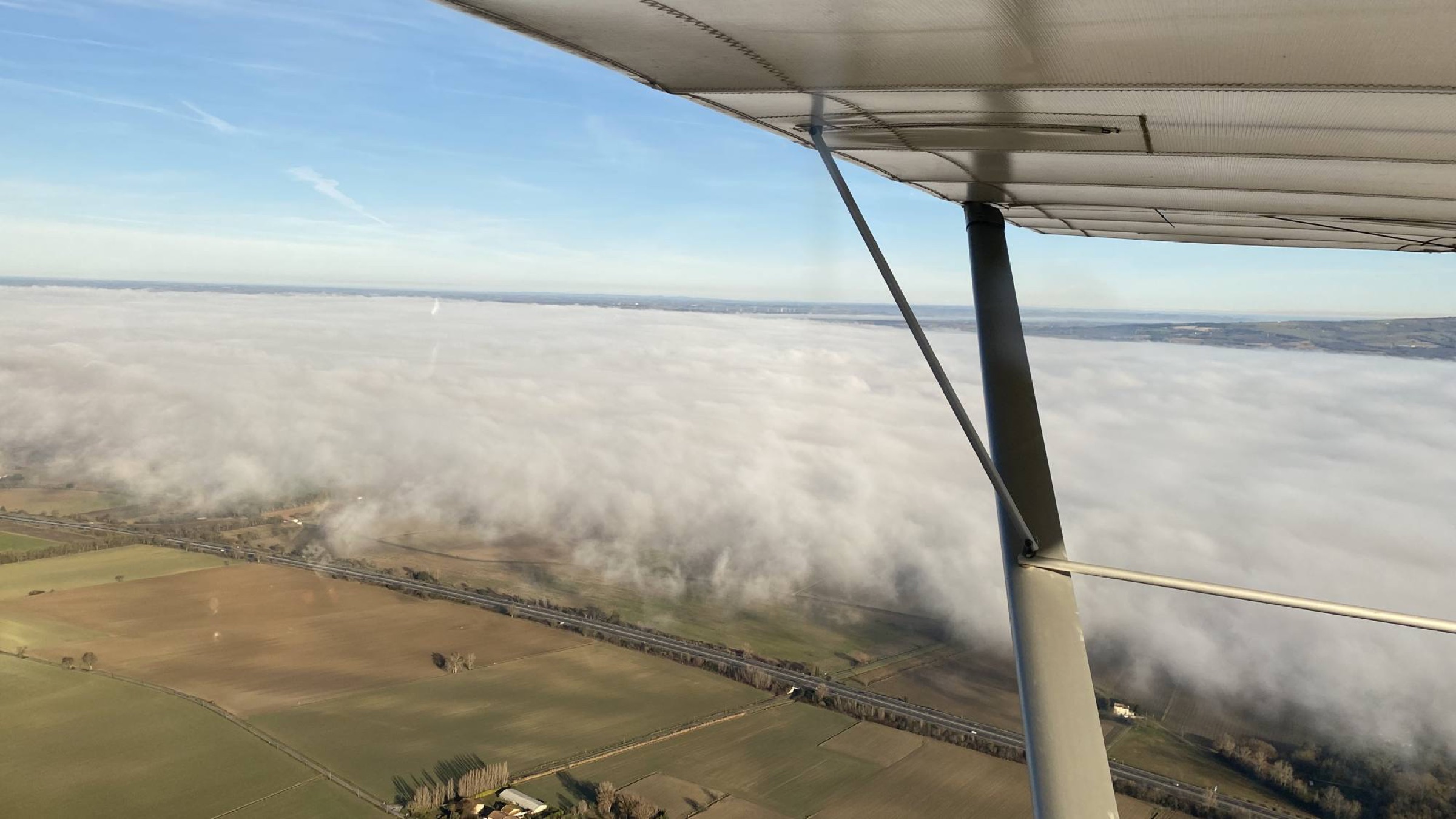
Hello, I am on a north-south navigation flight between two aerodromes in the West. I settle at level 105. After a while, the controller I am in contact with asks me to descend to level 80.I am on top, normal. There is no cumulonimbus (no anvil).
I settle at -1000 ft min, right wing down, and descend straight ahead. Then a surprise: the cloud is not white but grey-black, I am hit by a downdraught that makes me jump out of my seat, and in the suddenness and violence of the downward turbulence, I let go of the stick and the throttle.
But I quickly regain my wits, look at my artificial horizon, I cannot climb back up, but I turn left. In the end I find myself in a pronounced left turn with the ground in sight. I recover, resume my heading, I have a curtain of rain, and after a 360 of delay I am cleared to cross the runway intersection at 2500 ft at a large airfield, then manage to resume my route to the destination. There I am hit by another gust, and the landing is hard.
Pilot's comments
So there you are: I flew into a towering cumulus. I won't do it again – I could have torn a wing off.Lessons learned:
MODERATOR'S COMMENT: If we understand this REX correctly, we are dealing with a pilot who appears to accept climbing or descending through cloud in a microlight, relying on an artificial horizon. Apart from the clear breach of regulations this implies, such behaviour is technically completely incompatible with microlight flying, even if the pilot is otherwise experienced in IFR flight and the aircraft has the necessary equipment. Fitted to a microlight, such instruments can be neither certified nor calibrated to serve as a reliable reference for flight without visibility. This type of aircraft is too light to offer a sufficiently stable platform, and its controls are designed to offer neither the precision nor the damping compatible with instrument flying. Under no circumstances should a microlight flight manual give operating instructions for instrument flight. In a microlight, any risk of facing weather conditions other than day VFR must lead to the flight being postponed or diverted, with no compromise whatsoever.