
What happened
The return flight was made on a south-west / north-east diagonal in an aircraft I had just acquired. I had carefully studied the weather in the preceding days; the outbound flight in another aircraft had gone well, with better weather than forecast. On site, 99% of my attention was focused on getting to grips with the new aircraft. Before leaving I looked at the TAFs & METARs along the route plus the wintems: CAVOK everywhere with a little wind aloft. We left a little hurriedly in the early afternoon with the other aircraft so as not to be caught out by the curfew, which was at 6 pm.
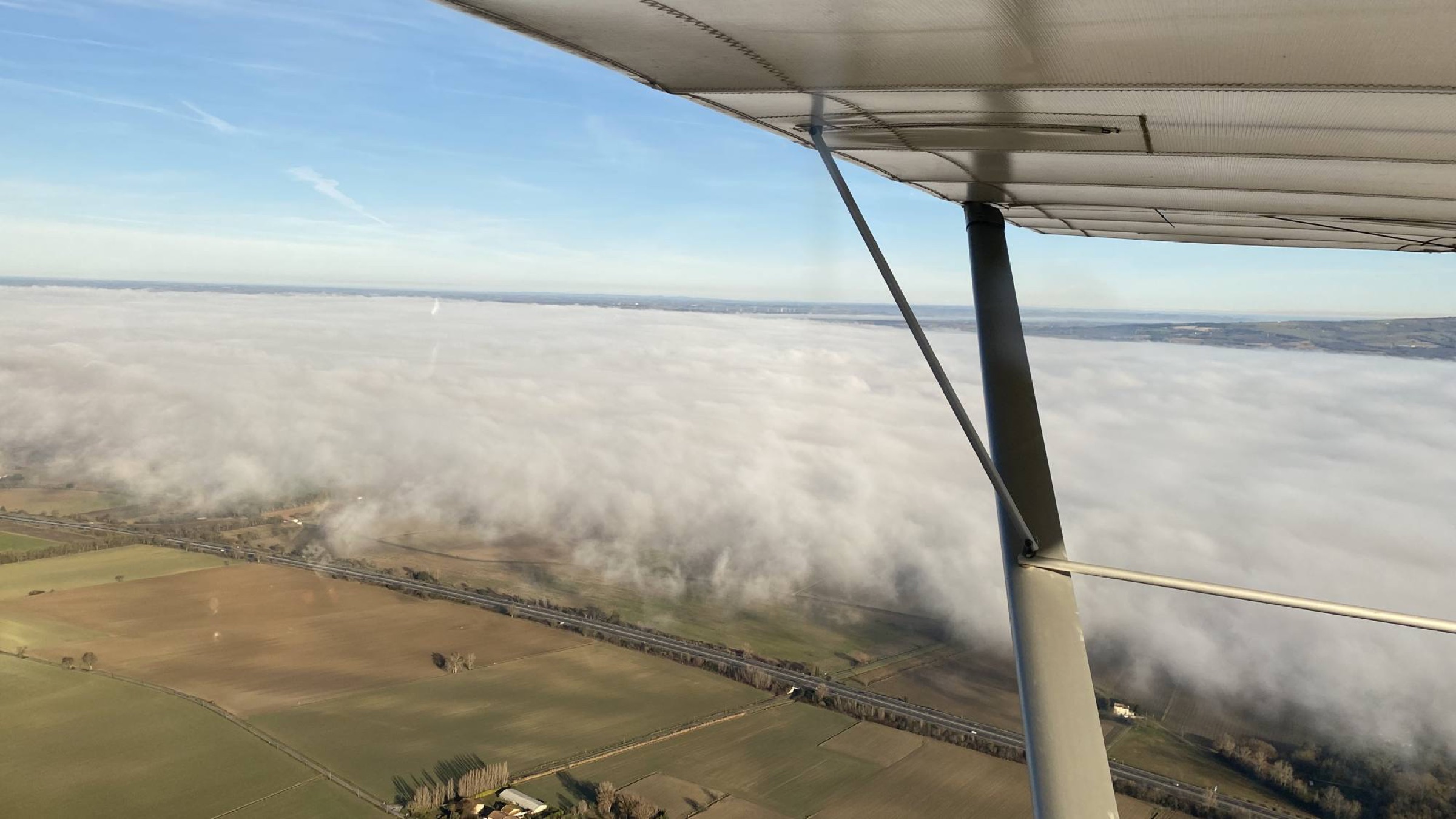
Except that on approaching the Massif Central we saw a layer aloft coming from the south that thickened quickly. The other aircraft hesitated to go under it, but I did not want to be trapped between the layer and the terrain (BEA reports in support!), so I went over the top. We decided to climb, but for lack of power the other aircraft finally went north (good choice!), while I climbed to level 95 to keep a good separation, but after a while the layer slowly drew closer. I have no oxygen and, not having foreseen this layer, which was not on the TAFs/METARs, I did not want to climb too high because I did not know how long it would last or whether the maximum 30 min between level 100 and 130 would be enough. While I hesitated the layer kept getting closer, with clouds sometimes poking through, and after a while a big cumulus was building ahead. I did not want to make a steep turn and found myself inside it. I told control I was in IMC and was making a 180° turn to get out of the cloud. I continued my turn at standard rate and after a few seconds I saw my leading edge turn all white, and the windscreen too. I threw myself at the carburettor heat and pitot heat, and remembered that icing = ice on the propeller, which will vibrate, so I reduced to 2000 rpm to protect the engine and announced that I was descending towards Bergerac (because I remembered it was fairly clear, to get away from the terrain, and it is an airport with a controller who might be able to help me; I put the frequency on standby but stayed on the frequency with the traffic information controller). Finally, after barely a few minutes, though they felt very long, I came out of the layer at about level 55 and continued my descent to 4000 feet to get back into positive temperatures. My windscreen was all white (and no doubt so was I!); fortunately the ice disappeared quickly and I set course north towards Montluçon-Guéret, leaving the layer to the south, and then continued my route eastwards.
Once on the ground I called my instructor to debrief: the result was unequivocal; I had not prepared my navigation enough, and I had not consulted the TEMSI. It forecast a risk of broken-overcast cumulus from level 60 up to level 100, with a risk of moderate icing. TAFs and METARs are only valid up to 1500 m above airfield altitude, which is no doubt why the layer was not reported… or perhaps it was at the aerodromes further south, since the layer was moving north. By analysing the shape of the layer on the TEMSI I could have climbed to level 115 and descended after Clermont, but the route north to go round the layer remained the safest solution.
Pilot's comments
Yet I knew you must always take the time to prepare your navigation, neglecting no source of information. I left in a bit of a rush (with 99% of my attention on getting to grips with the aircraft) and I was convinced that all the signals were green for the rest. I put unnecessary pressure on myself by seeing the other aircraft in a hurry to take off to arrive before the curfew. Taking the time to consult the TEMSI would not have taken me more than 5 min, and incidentally the risk needs to be put in perspective: a €135 fine is nothing compared with having to fly on instruments in IMC for long minutes in the layer with icing… and the consequences that could have had. Fortunately I was lucky to have an instructor who had trained me well in blind flying (VSV) and the aircraft was equipped with an horizon, a directional gyro and a turn-and-slip indicator.
Federation analysis
A very fine after-the-fact analysis of this flight, which could have had very serious consequences: flight in cloud and in icing conditions. Good flight preparation promotes good execution. Knowing when to give up continuing in deteriorating weather is a decision that is sometimes difficult but necessary.