
What happened
Seen from the right seat:
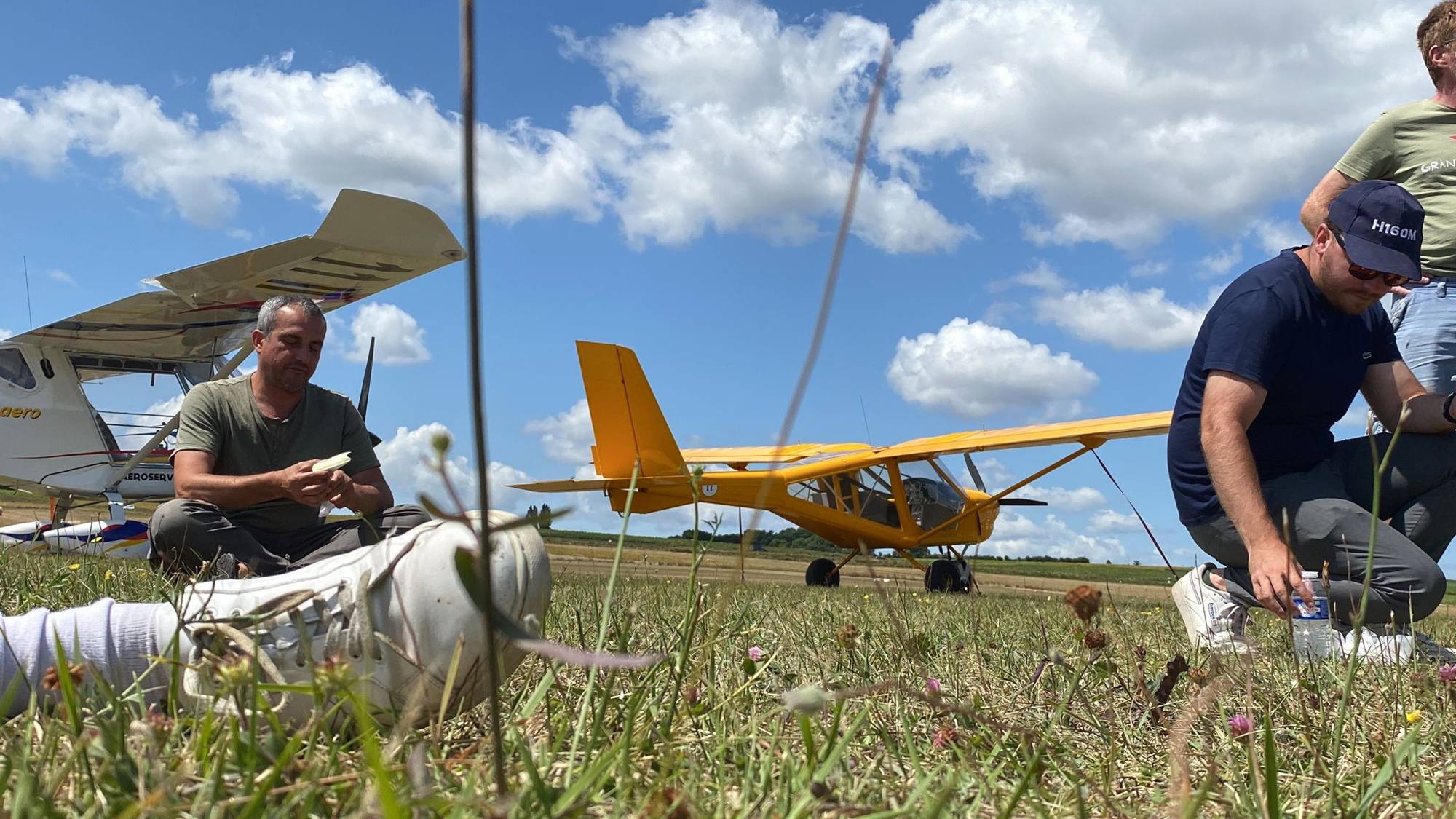
Return to flying for an aeroplane pilot (300+ hours as pilot-in-command) on the club's 3-axis microlight. He has not flown this aircraft (a modern all-composite three-axis microlight) for several years.
I am a microlight instructor at the club and I am sitting in the right seat.
I expect the pilot to get to grips with the machine fairly quickly, so I suggest slow flight and stalls right from the start. I am very confident.
We climb to 2000 feet QNH.
We start slow flight and the pilot does not really stall the aircraft. I let him get on with it and then at one point I say, "You know, this aircraft is very forgiving. You can really stall it safely."
I notice that the speed is still 100 km/h. I grab the throttle lever and set it carelessly, even brutally, all the way to idle. I lower my head slightly, then raise it again: we are in a spin.
I take the controls. I try to put the stick neutral for the ailerons, but I am unable to act on the rudder pedals; I am completely overwhelmed.
The rotations are fast.
I tell myself I am not going to be able to get the aircraft out of the spin.
I grab the parachute handle and pull. The Velcro holding the handle resists too much: I lose my grip on it.
I am about to try again when the aircraft stops rotating and even starts to pull out.
We levelled off and by mutual agreement decided to land quickly.
According to my companion in the left seat, we did 3 turns of spin.
We levelled off and by mutual agreement decided to land quickly.
Federation analysis
Thank you for this strong, sincere and deeply useful account. This is a major REX that deserves our full attention: it is not a simple incident but a serious event narrowly avoided, with considerable educational value. Situation: return-to-flying flight for an experienced aeroplane pilot who had not flown the three-axis microlight recently. High confidence on the part of the instructor. Exercise started quickly: slow flight and stall. Abrupt action on the throttle during slow flight led to a dynamic stall followed by a spin. Difficulty recovering from the spin, attempt to use the rescue parachute, finally not needed. Return to the ground without injury or damage, but a very critical event. Key points: knowledge of and mental preparation for spins; checking and training in the use of the parachute.