






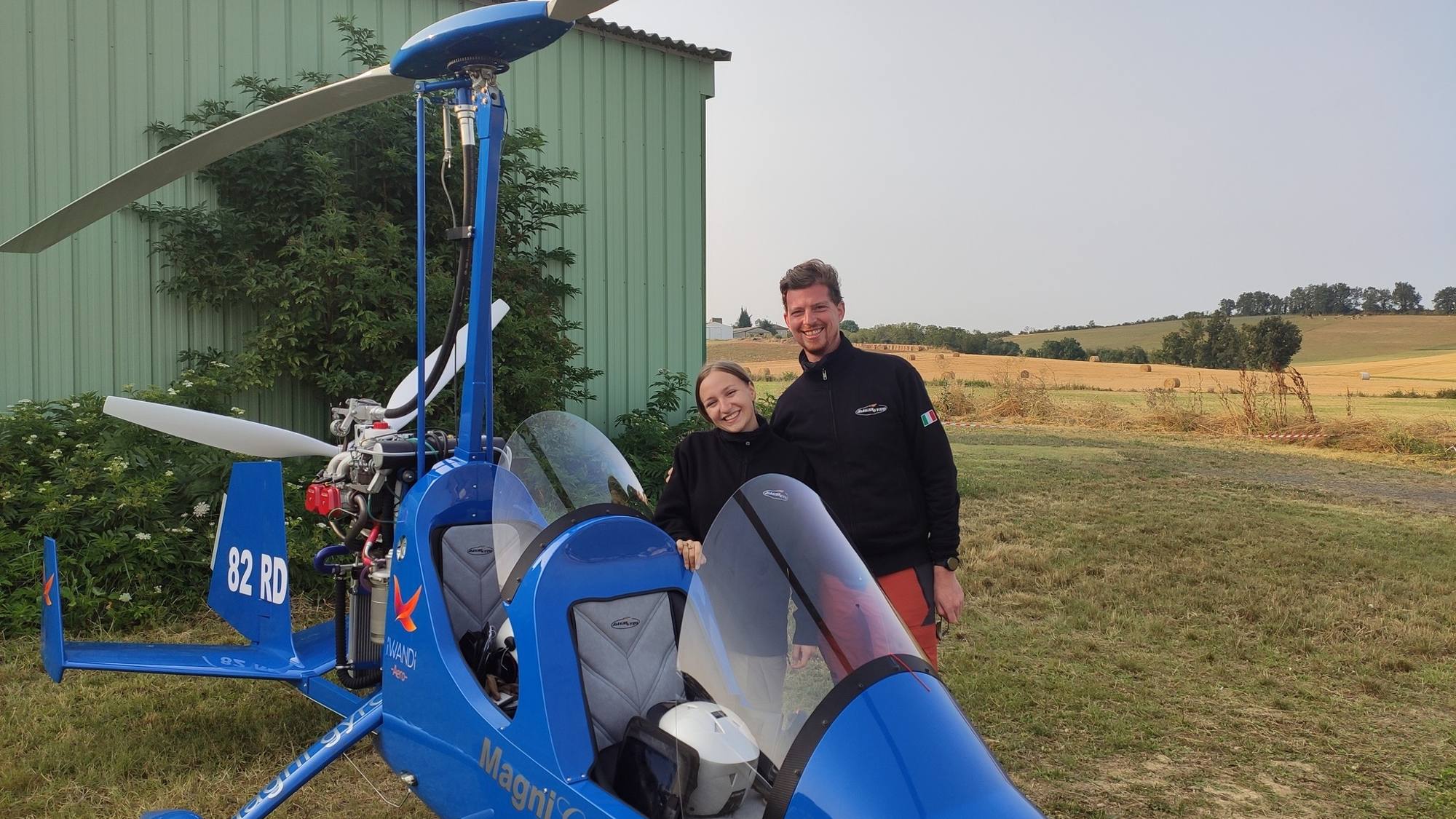
What happened
The flight took place on Friday 3 May 2024, departing from Montaigu LFFW.
We had an appointment at 5 pm with Jean-Pascal for a familiarisation flight on aircraft 85-AWD, newly acquired by the club. The club's pilots are trained on the Nynja with similar fit-outs, the aircraft being standardised so they can easily be interchanged and club pilots can get to grips with them quickly. However, a few particularities (electric flaps, digital instrumentation) had to be presented so that the pilot could become familiar with these differences. The planned flight was also to include a REV (return to flying) under the FFPLUM programme, as Jean-Pascal had not flown since the winter but has considerable experience, being radio-qualified with passenger carrying and, by his own account, over 400 flight hours.
After a cabin briefing and a briefing on the coming flight, we take off at 5:45 pm on runway 25, the wind being south-westerly and moderate. We head towards l'Herbergement, to the south-west, and climb to an altitude of 1600 feet QNH. The idea was to overfly the site of the Logis de la Chaboterie (south-west of l'Herbergement), in preparation for an important event (the Floralies), combining business with pleasure.
After a few exercises in turning at constant altitude (1600 feet), we climb to 2000 feet QNH to carry out the stall exercises set out in the REV programme.
Back at an altitude of 1600 feet, I decide to carry out a simulated engine failure, by pulling the throttle handle to full idle and clearly announcing the exercise to the pilot. After a few seconds of hesitation, Jean-Pascal asks me the wind direction and points north. I give him the right direction (south-west), which allows him to choose the field for the field landing after another moment of hesitation. Our altitude was then 700 feet when he told me of his intentions, without however influencing the path of the aircraft, which was still descending at a speed close to the aircraft's best glide speed (100 km/h). The target field was acceptable to me, in terms of area and length but also possible clearance. I had clearly identified a road and a low-voltage line at the end of the field but did not see the high-voltage line in the next field, which was hidden behind the screen of trees. A last turn on this long base leg, with no further correction of the flight path, did indeed put us too high on final approach (300 feet estimated at the start of the first field). The pilot tells me it is not working.
Faced with the pilot's passivity and the sense that he had given up, I check our height and speed and decide to continue the exercise. My idea at that moment was to show him that we could work on best glide to clear the low-voltage line at the end of the field at a good height and reach the next field, and that we could have made a hard landing on a ploughed surface that would have saved our lives. The aim was to test him and to show him that one always fights on an engine failure to save one's own life and that of one's passenger, and that even when it seems lost in advance, you try to minimise the damage.
We cross the LV line at a height I estimate to be 10 m higher and pass through a gap in the line of trees at the entrance to the second field, at treetop height. My eyes are fixed on the LV line to make sure we are high enough; I look up, saying "you see, it works", and am about to tell him to go around; I never intended to touch down. I then see an electricity pole in my right field of view and have no time to react before we hit the HV line. The aircraft decelerates abruptly and rolls violently onto the left wing. I kick the left rudder pedal as if to prevent a spin, fearing it would go inverted. The aircraft then falls to the ground, nose first and slightly skewed to the right.
The impact is violent but I do not lose consciousness. I immediately check on my passenger, make sure he is conscious and can move, and we quickly evacuate the aircraft. The fuel tank (we had 30 L on board) was emptying, so I switch off the ignition, remove the aircraft's battery cut-off and keep the local residents who had stopped from approaching, while reassuring them. I call the emergency services to come and help us, as a power line had been cut and the wires were hanging in the field. After being treated by the fire brigade, we were both taken to the emergency department at La Roche-sur-Yon for check-ups. As these were reassuring regarding the risk of internal injuries, I left at 10:30 pm and Jean-Pascal a little later.
Pilot's comments
This accident allowed us to identify several causal factors and draw several conclusions.
Firstly, the succession of flights during the day (8th flight) since the morning, with few breaks, certainly contributed to a state of fatigue that affected clarity of mind and the decision to do a low-height exercise in a poorly known area. Following this, the club and I decided to limit instruction flights to 5 students per day, and I am now much more sensitive to physical and psychological condition before undertaking any flight, even under pressure from club members.
Secondly, engine failure exercises now take place strictly within the regulations and never below 150 feet AGL, even if the exercise can then be considered incomplete as regards handling a field final (without touching down).
Following this accident, a hearing took place at the BGTA in Nantes, but no civil or criminal proceedings were brought.
Finally, thirdly, this accident gave us the opportunity to meet the prevention and safety contacts at ENEDIS. Although this type of accident is rare, there are regular collisions between aircraft and power lines, while air sports are little known to Enedis. A safety exchange day was organised in September 2024. Work is currently under way to raise awareness of electrical risks in this type of accident (what to do in the event of a collision to avoid a secondary accident). Enedis is also working to identify lines near aerodromes and microlight strips to improve their visibility, particularly in low-angle light (example: La Planche LF4452). Finally, we are working with ENEDIS on the possibility of a digital tool, such as an app adapted to air sports, to flag the proximity of power lines when flying at low height.
Federation analysis
Thank you for this REX, which is important for instruction. Your approach is understandable from a teaching point of view, but the minimum height rules also demonstrate their usefulness and must not be overstepped.









