






Safety Flash: Safety... a freedom that has no price
News from 9 October 2023. Last updated on 10 October 2023: some information may have changed. Latest news
The federal team is sadly obliged to send you this safety letter without delay.
Several recent fatal accidents, easily avoidable, have once again worsened the flight safety record.
Our favourite activity, flying motorised ultralight aircraft, is a recreational and leisure activity. It is extremely demanding in terms of training, practice and keeping knowledge up to date. This is the only way to guarantee a high level of flight safety when practising it.
However, without prejudging all the circumstances that led to the latest most serious accidents, we are obliged to note several extremely worrying signs with regard to behavioural rigour:
- An evening flight, at the limit of aeronautical night, probably even after the end of twilight.
- Flights below the minimum authorised heights that led to a collision with a power line.
COMPLIANCE WITH THE RULES:
- For example, 30 minutes after sunset is the legal limit of daytime flight. And at this time of year, when mist can be slow to lift, when the wind, if there is any, is slow to drop and when the sun sets early, it is sometimes tempting to wait for the evening to try to enjoy the last rays.
But does compliance with this legal limit, even strict, suffice to ensure the pilot’s safety? Certainly not.
First of all, keep in mind the classic trap of the short evening flight. It may still be light enough to feel at ease, when darkness has already settled on the ground. The difference is only a few minutes, but it is enough to give a feeling of entering the dark on the descent.
Thus when the sun is already low on the horizon long before twilight, the ground you are flying over is quickly obscured by lengthening shadows and the onset of night.
At the same time, the sun can be very dazzling at flying height since its disc is roughly at eye level, which stops the pilot from seeing a possible obstacle or judging height above the ground.
Moreover, the higher you are, the farther away the horizon, so the sun will still be visible in flight when it has already set as seen from the ground. In any case, the technical limit of daytime visual flight can be well short of 30 minutes, especially in autumn and winter, even in ideal weather conditions.
A pilot with situational awareness should land and answer the question: “if I were in a car underneath, would I turn on my headlights?” If the answer is “yes, perhaps”, I should already no longer be in the air.
- Another example is the overflight rules, which protect people and property.
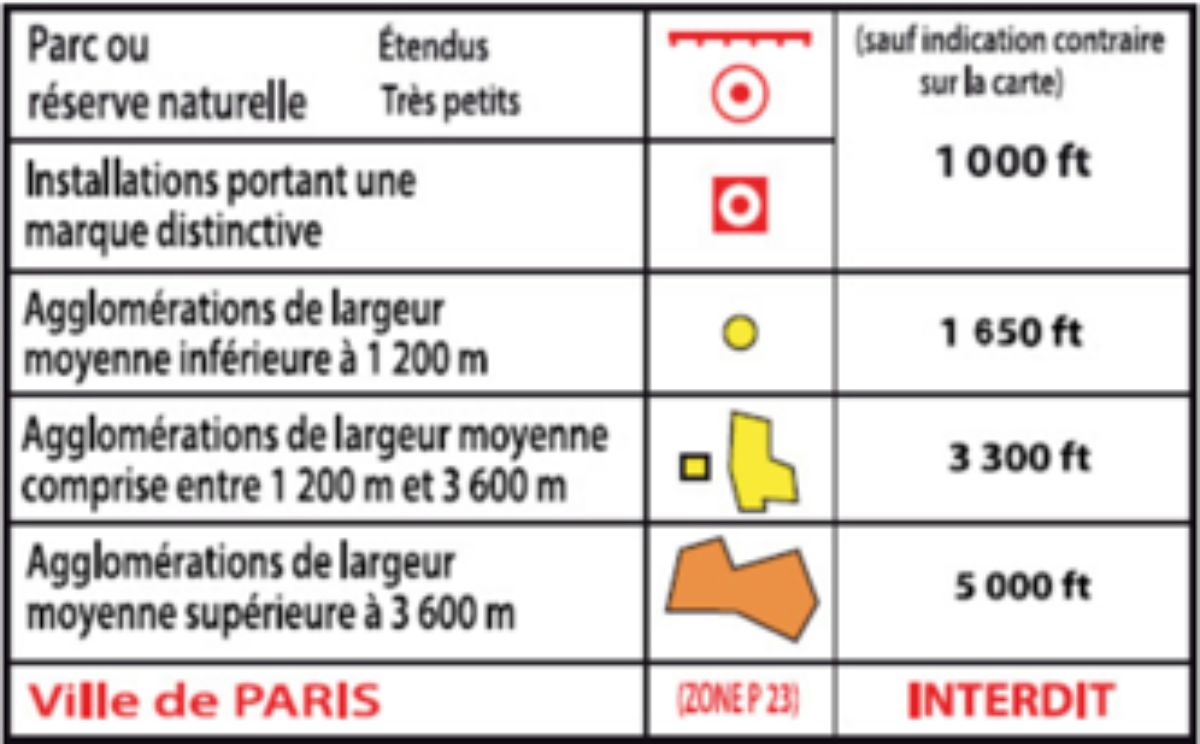
The regulations state that, except as necessary for take-off and landing, aircraft shall not fly below the minimum level:
- At a height of less than 150 m (500 ft) above the ground or water.
- Over densely populated areas of towns or other built-up areas or open-air gatherings of people, less than 300 m (1 000 ft) above the highest obstacle within a radius of 600 m around the aircraft; however, gliders doing slope soaring, as well as balloons and PULs (ultralight gliders), may be exempted from this rule provided they pose no risk to people or property on the surface.
- In an instructional flight, this height is reduced to 50 m (150 ft) for forced-landing training, an up-to-date IULM instructor being required on board for this kind of exercise.
- Below the minimum level set by order for flying over towns or other built-up areas, or open-air gatherings of people or animals, and over certain installations or establishments.
In all cases aircraft must fly at a height sufficient to allow, in an emergency, a landing when flying over towns or other built-up areas without unduly endangering people or property on the surface, observing the principle of the safety cone.
To preserve and safeguard our freedom, let us keep in mind that the basic principle of the microlight movement is to leave each pilot responsible for managing their own safety.
In our practice of recreational and sporting ultralight aviation, there are golden rules to be followed.
These rules often come from the experience gained by various people over time (REX).
We will never stop reminding you of the value of cultivating both technical and non-technical skills.
Faced with these examples, each person will judge how microlight flying can be carried out.
A serious microlight pilot is one who sets out to take off while stacking “every chance” on their side during the flight in order to land safely again!!!
Let us keep enjoying these fine late-season days, and keep taking pleasure in flying over our
beautiful regions in our beautiful ultralight machines, safely.
Contact your instructor with any questions or queries.
Safety is everyone’s business, and each person’s









