High-speed pass and aeroelastic resonance
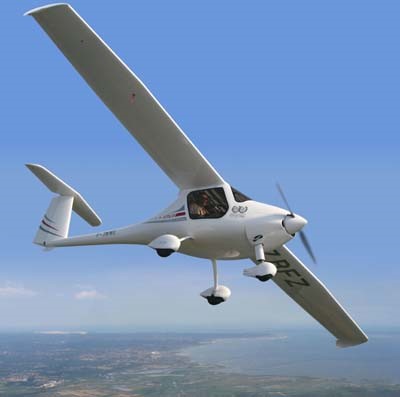 On 7 August 2017, the pilot of a 3-axis Pipistrel Virus 912SW, with a female passenger, took off from the Saint-Estèphe microlight airfield for a flight to La Rochelle Île de Ré aerodrome.
After take-off, the pilot made a high-speed level pass over runway 12 at low height. The machine entered destructive aeroelastic resonance, loss of control was unavoidable, and the Virus hit the runway hard and caught fire, leaving the occupants no chance.
The pilot, aged 70, had held a three-axis licence with passenger carrying since 2013. He was also a professional aeroplane pilot (PPL(A) since 2001). On 2 June 2017 he had 970 flight hours, of which 900 as pilot in command. The weather conditions at the time were good: visibility over 10 km, temperature 27°, variable north-easterly wind at 4 to 5 kt, with no turbulence.
A pilot witness on the ground stated that the height of the pass was less than 10 metres above ground. Just before impact, significant oscillations between the wing and the tail unit were visible. This witness stated that the oscillations were about the roll axis: the microlight twisted, with the wings banking to the right and the tail unit to the left.
The speed estimated by the witness was around 300 km/h…
Several cases of flutter were observed on the Virus and Sinus in 2002 and 2003, and the importer warned the owners of these machines and temporarily limited their VNE as a precaution. The problem was therefore known.
This tragedy once again highlights the failure to respect the flight envelope parameters, which directly affects the structural strength of the microlight. Knowingly exceeding the recommended VNE, even in calm air, risks an unexpected onset of aeroelastic resonance and structural breakup in flight.
Aeroelastic resonance, or in English, "flutter ".
An aircraft is by definition a flexible structure, and its natural frequencies can be altered by the aerodynamic load applied to the lifting surfaces. If a torsion frequency and a bending frequency come close enough together, what is known as coupling resonance can occur between the two modes, making the system unstable.
It is a dangerous mechanism that generally leads to the rapid destruction of the structure or of part of a flight control.
The critical speed is calculated by the microlight manufacturer and is determined by the onset of torsional flutter for wings of low or medium aspect ratio. A safety margin is built in, and this gives the VNE, which must not be exceeded or reinterpreted.
An inappropriate input on the flight controls at the limit of the VNE can trigger aeroelastic resonance.
The way out of the onset of flutter is to apply a positive aerodynamic load (G+) to the profile to stop the coupling phenomenon. This is what the pilot of this microlight tried to do, but too late.
Let us keep in mind that published limits are not set at random, even on a microlight. Flirting with the VNE close to the ground is no way forward, because in the event of an aerodynamic imbalance it is almost impossible to regain control of the aircraft. The ballistic parachute could not save the situation here.
A search for sensation that costs dearly…