






Mechanics

The CNFTE carries on, more than ever
The federation's mechanical training and testing centre (CNFTE) has been part of the Federation's history almost from the start. But behind the acronym and the institution there is a man, Pierre Pouchès, known as "Peyo", who, beyond being an outstanding technician with unique experience, has always been something of the "shaman" of microlight mechanics.
Our dear Peyo has decided to stop and take a well-deserved retirement. The CNFTE, which has been an association independent of the federation for 20 years, will be dissolved by the end of the year in favour of the federation, transferring all its assets to it. This is an opportunity for the federation because, more than ever, we need to ensure independent expertise in the interest of all pilots. The microlight regulations we have always defended assume that the owner-pilot is responsible for maintaining their aircraft. They can of course call on professionals, but they must be able to carry out most of the maintenance on their aircraft themselves.
The current trend in mechanics, which gives ever more room to IT, the commercial concentration of the players and the scheduled, though very vague, end of carbon-based energy are all worrying issues. More than ever, they require the federation to take charge of all these questions with all the players and in its proper role: serving the general interest, in the interest of all pilots.
In practical terms, most of the equipment will be brought back to the Valenton premises while a lasting solution is put in place. From the end of the year, a new specification for federation mechanics will be introduced. Pilots can be reassured from now on: all mechanics professionals have realised the need to preserve our freedom, which is also the guarantee of their own development, and everything will be done to give every pilot a quality mechanical training framework.
40 years of “Peyo” at the FFPLUM
In 40 years with the Federation, Pierre Pouchès has seen plenty of machines come and go. From 2-stroke engines, tubes and fabric, to the new generations of Rotax engines, he tells us his story and his vision of 40 years of microlighting.
Arriving at the Federation
On 8 March 1989 Philippe Boucherat, well known to microlight pilots, took me to 24 rue du plateau in Maisons-Alfort, which was then the headquarters of FFPLUM.
"Tomorrow is the Federation's General Assembly. You have to come and help us." I left, and I'm still here.
The General Assembly is chaired by Alain Dreyer, founding president. I am one of the candidates. I don't know anyone, it's impressive. The presidents vote and here I am elected to the new Board of Directors! In my head, I wonder: "Peyo, what are you getting yourself into this time?"
President Dreyer asks each person which post they would like to take. Being the new boy, I go first; knowing nothing about how things work, I pass. My turn comes round again and I suggest running a mechanics school. Alain Dreyer asks me to elaborate: with 11 years of mechanics training behind me (Diesel, Hydraulics, Grinding), I sketch out a quick plan. The curious and interested assembly is won over.
I stayed on the Board of Directors for 12 years. On the executive board I held the posts of general secretary, then vice-president. I then left the Board of Directors to devote myself to the mechanics school, which had grown to a significant size.
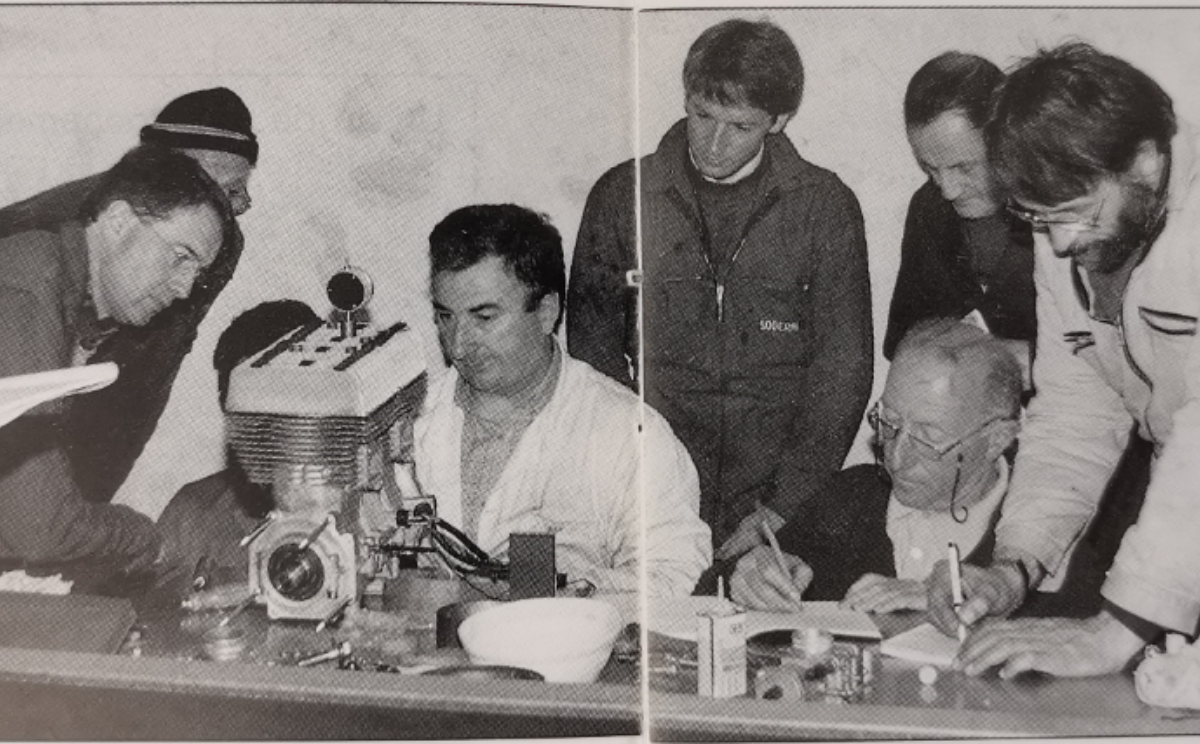
Pierre Pouchès "Peyo" (centre) in his workshop surrounded by attentive students
Mechanics and FFPLUM
Without imagining it for a second, a large-scale adventure had just begun. In 1989, here I am as the federal hardware man. I draw up a table of the engines of the day and find there were engines whose names I did not even know!
No matter, it was a mechanic's paradise. As summer approached, Jean-Pierre Pouleau, in charge of competition, asked me to join the French team staff as a mechanic. What a job! There were very few Rotaxes at the time but a rather mixed bag of engines (Cuyana, Fuji Robin Hirtz, VW, Hiro, Solo, JLO etc.) that kept me busy for 15 days. My few basics served me well.
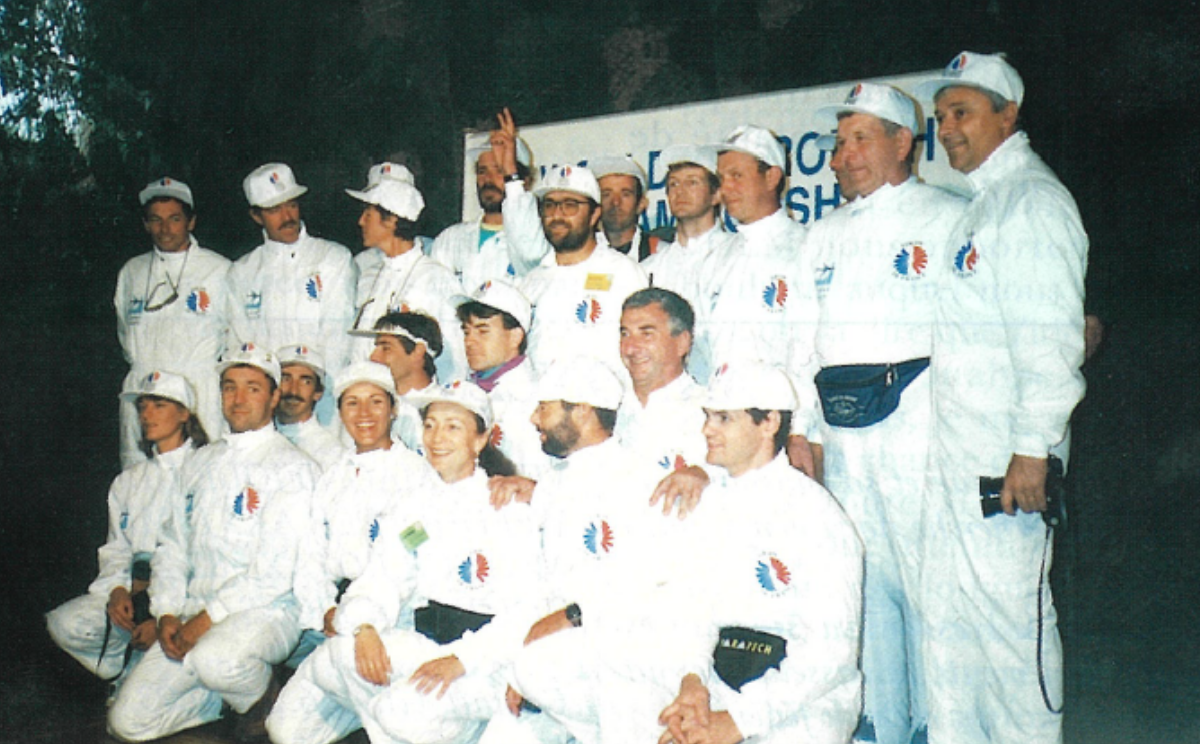
Peyo with the French team (2nd row, crouching, right)
Then I had the idea of setting up a telephone helpline for those with mechanical problems, and it was no small thing, as many machines were amateur-built. It was also the period when we were moving from mineral oils to synthetics. So going from 6% to 2% in oil and petrol mixes was not simple.
For those who remember, the 05 62 68 82 64, (which still works), on Wednesdays from 20 to 10:30 pm, was quite a success. The stories of all kinds I heard!
The number still exists and I still answer it, but no longer after 20 pm since the advent of mobile phones. The questions are just as numerous.
For 28 years I have been the French team's mechanic. Dominique Méreuze asked me 20 years ago to join the Tour ULM adventure.
Mechanic at many international rallies, doing training, expert assessments and assistance for civilians, government departments and the military in many European and African countries, in the Indian and Pacific Oceans, and 4 times providing assistance after major flooding disasters (Fréjus and, very recently, Fourques in Lot-et-Garonne)… I have never been bored in 32 years of federal volunteering.
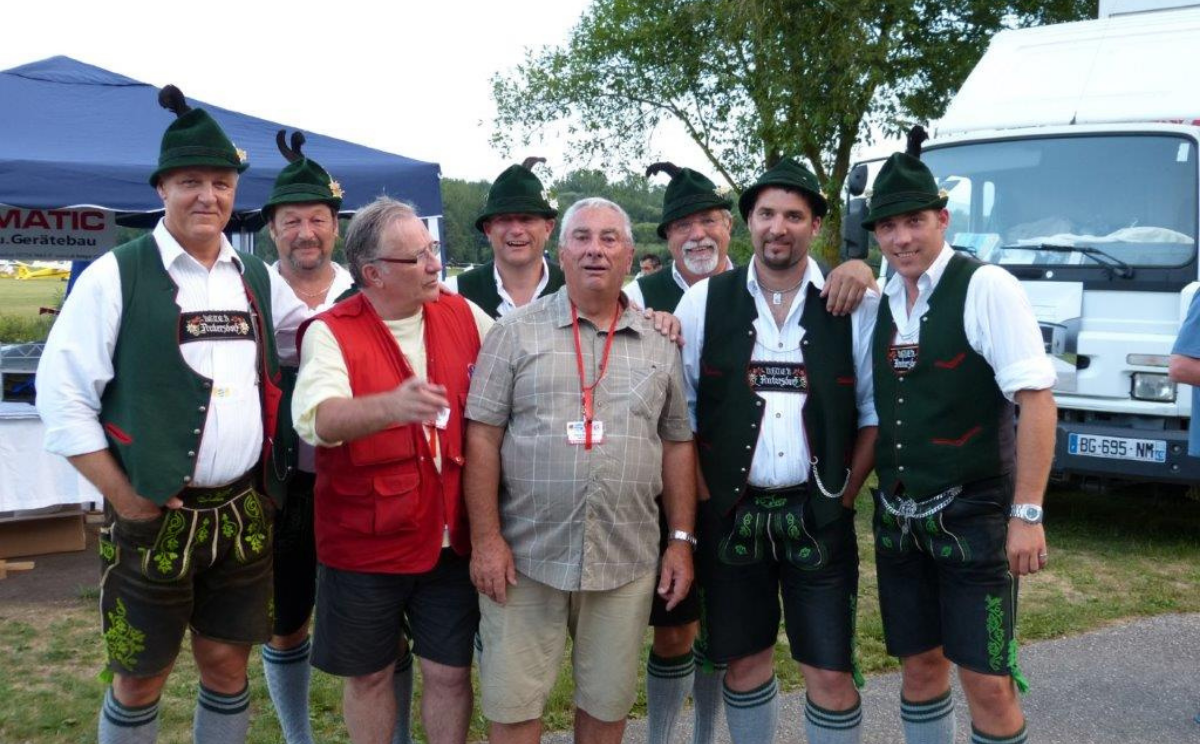
Peyo (centre) at the Tour ULM
What stories and adventures you have given me, some hilarious, some less funny, some not funny at all, and so many others that come back to me from time to time.
How many colourful characters have I met? How many emotions, thrills, bouts of laughter or tears? And always ready to set off again… !
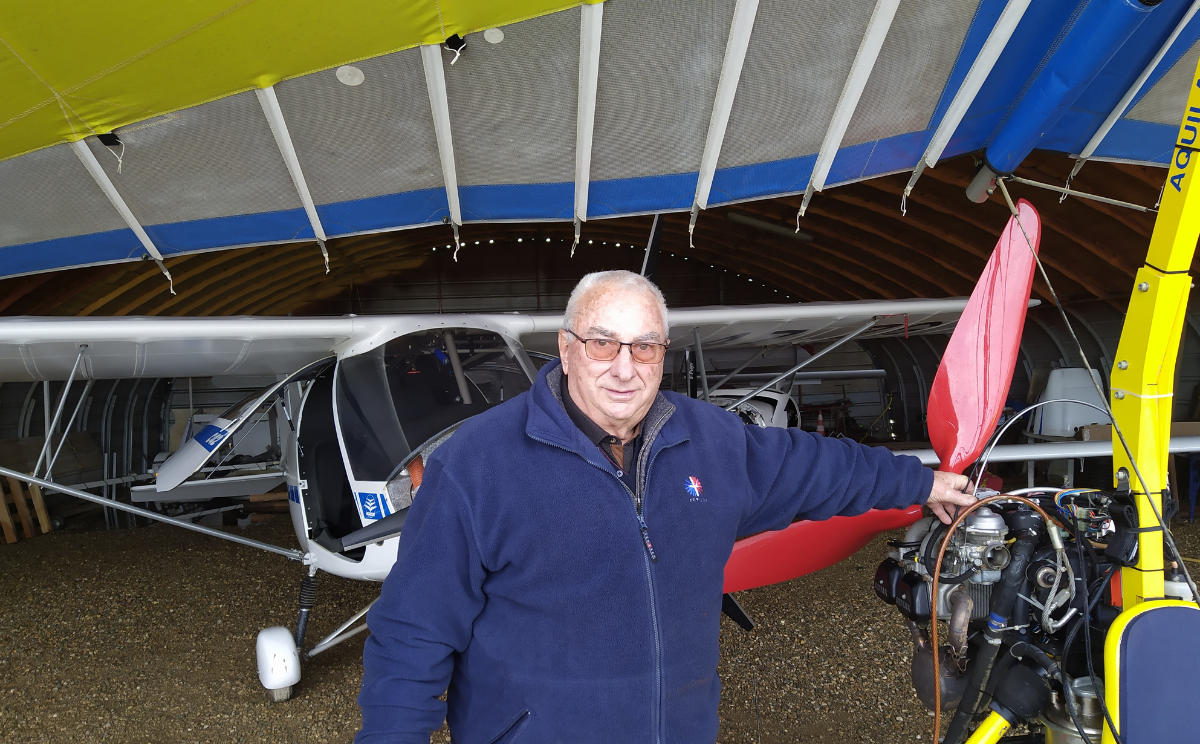
Pierre Pouchès went to Fourques after the floods of February 2021 © Fourques Microlight Strip
The CNFTE
The CNFTE mechanics school is still running, and its success has never wavered. Covid slowed the pace briefly but as soon as possible we start again.
Under the old format of courses, either fixed at Marsolan or travelling around France, I have met more than 8 500 trainees.
How many course meals at Marsolan, how many mussels with pastis, baked oysters or even rib steaks depending on the venue. After the day's course I did the cooking.
How many heart-warming moments I have experienced and shared. Microlighting must be friendly and within everyone's reach.
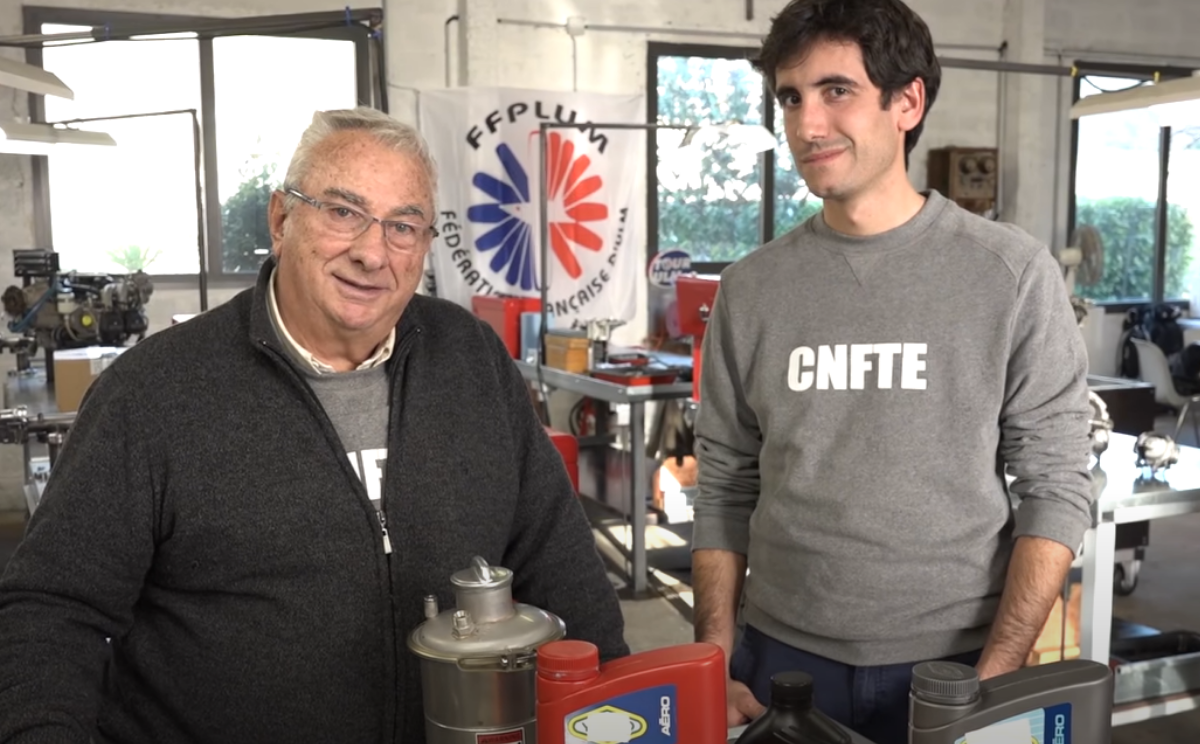
Peyo and Thomas have filmed several mechanics tutorials
The CNFTE will soon be moving to Blois. I hope the adventure continues and is just as lively and beneficial for you. For a long time yet for whoever takes over from me.
The CNFTE's mission will be to train pilots and the mechanics in charge of maintenance and repair, because the complexity of our engines, and those to come, will not be a matter of intuition.
Electric power will not escape this rule. It will take an important share, and much faster than we imagine. Here again the CNFTE and the FD will have a particularly important role to play for pilots and mechanics, because these are new trades that are about to emerge and that need to be created. He who does not move forward falls behind, as is well known.
That is 32 years of volunteering in the service of FFPLUM; I am reaching the end of the adventure with no regrets, except that it went by so quickly. I would have plenty more to tell, but I am being rushed and must hand in my copy.
I worked with all the presidents: 1 day with Alain Dreyer, Jean-François Lemouton (1989-1994), Jean-Pierre Dutoit (1994-1998), Dominique Méreuze (1998-2015), Pierre-Henri Lopez (2015-2017) and Sébastien Perrot (2017-).
I would again like to thank presidents Dominique Méreuze and Pierre-Henri Lopez for honouring me with the Federation medal, and then the Aeronautics medal presented by the Director of Civil Aviation.
To finish, my warmest wishes go to you, former trainee, to you whom I met along my path, at the end of a phone call, to you whom I sorted out at the corner of an airfield or elsewhere.
Keep flying and remember: if you know, you do. If you don't know, you don't do it, but ask.
Pierre Pouchès "Peyo"









