






Lithium batteries: anticipating the risk of fire on board!
The risk of fire on board from lithium batteries was the subject of a safety symposium organised by the DSAC in December 2020, and you can find the summary booklet at the link below:
https://www.ecologie.gouv.fr/sites/default/files/Synthese_sympo_2020_DSAC.pdf
In this BSV we offer a summary of the risks more specific to our light aviation activities, and of recommendations worth knowing.
The Flight Safety Division
Two major events recently experienced by pilots remind us that the risk of electrical fire on our aircraft is real.
We all know the race to cut the empty mass of our flying machines, which sometimes leads to fitting lithium-type batteries that are lighter than conventional ones.
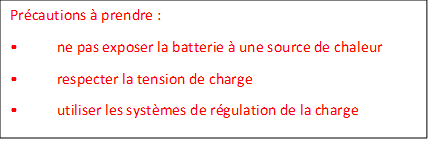
LiFePO4 batteries seem preferable because they are more stable and most have a built-in BMS (Battery Management System). They must be suited to current engines, with in particular a specific regulator, so as to meet the characteristics of this type of battery.
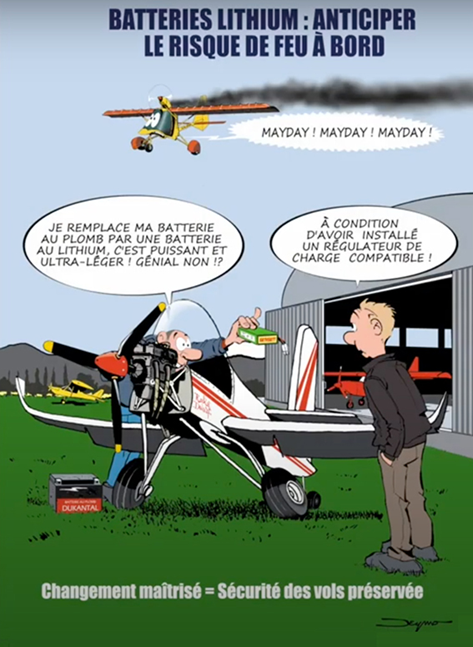
A probable risk of the battery being overcharged, in the event of a design fault or the absence of an electronic battery management system, must be considered.
In this case, the cathode can be destroyed or altered and cause a thermal runaway.
We count three major effects:
- The thermal effect, with a rise in the battery's internal temperature; the heat produced by the electrochemical reaction will spread through the electronic device.
- Gas release: the liquid electrolyte will gradually vaporise and produce toxic gases and fumes. The battery will then swell until its outer casing ruptures. Hydrogen, highly flammable and explosive, is released, along with toxic and corrosive vapours containing phosphorus, fluorine and lithium from the electrolyte salts.
- Fire and a possible explosion: the gases generated by the thermal runaway are highly flammable. A simple spark from a short circuit is enough to ignite them. If the venting is too slow, the overpressure inside the battery can lead to an explosion, throwing out burning material.
The runaway of the internal chemical reaction in batteries that are short-circuited or damaged by an impact is also a risk to be taken into account.
Batteries are also sensitive to temperature. If it overheats, the tablet (or smartphone, or handheld radio) may also switch itself off to protect itself.
And it is essential that this safeguard works properly, because fire, even explosion, is what is to be feared.
The results of the examinations carried out show that smoke in the cockpit, caused by an electrical short circuit or by overheating of the lithium battery in the pilot's mobile phone, may have occurred during the flight. Such a situation may have troubled the pilot, or even caused the pilot or the passenger, both of whom had heart problems, to feel unwell.
By entering the daily lives of millions of consumers, smartphones and other rechargeable equipment, along with the batteries that power them, have become companions for travel and communication.
Most of these electronic products pose no danger, as they are developed rigorously and in line with demanding quality standards. However, a few news stories periodically remind us that "improbable" does not mean the same as "impossible": just search for "lithium battery fire" in a search engine to be flooded with newspaper articles or often striking videos describing a few unusual events.
But what would happen in an environment as confined and complex as an aircraft?
Carrying mobile, sophisticated devices that give off heat creates a not insignificant risk for the occupants of our microlights.
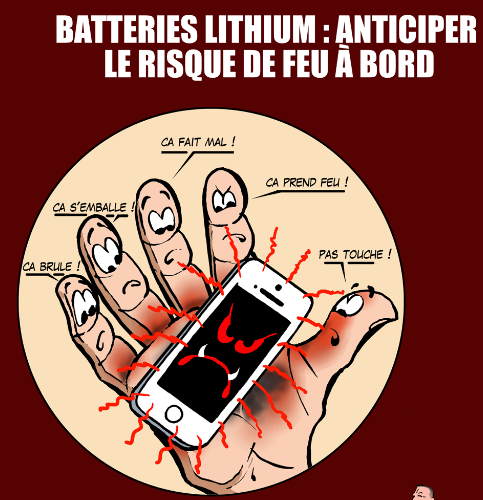
The thermal runaway of an electronic device can also have consequences through its sheer spectacle.
Containment kits for portable lithium-battery electronic devices have recently appeared on the market. Using them is supposed to contain the flames.
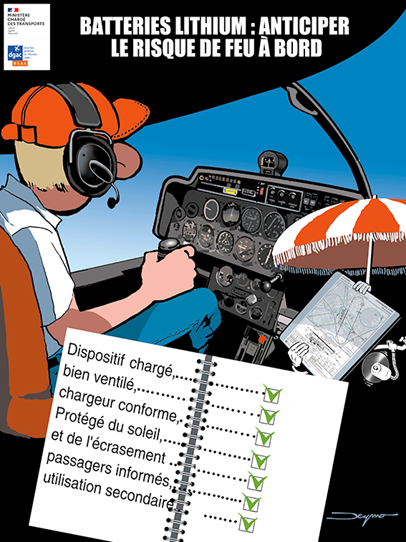
Warn our passenger of the risk of carrying electronic equipment, especially when it is plugged in to charge!
To limit the effects of a thermal runaway and control its consequences, it is important to know how to react and to remember a few simple rules:
- Putting out the flames with an extinguisher (powder or halon) can only act on the flames for a moment and will not stop the thermal runaway.
- Cool the battery by pouring water on it, then immersing the battery or the electronic device in a large quantity of water!
- Where possible, quickly remove the faulty battery from the cockpit and end the flight as soon as it is safe to do so.









