







The right temperature?

What is the right temperature?
"Too hot, too cold?..." These questions arise above all in winter, no doubt because we have more time to devote to our machines. Our engines like neither heat nor cold, and this affects not only how they run but also how long they last. For these reasons, and as the cold of winter sets in, I will try to set out here what our engines like and what they don't.
The Rotax 9-- series uses three fluids to stabilise its temperatures: coolant for the parts close to the combustion chambers (cylinder heads, valves...), oil for the moving parts (crankshaft, connecting rods, camshaft, tappets...), and air for the cylinders.
So we have to talk about the right temperatures once we have understood this multiplicity of fluids; knowing their respective physical and chemical characteristics helps us to understand how they interact. The impact that pilots have on each of them, both through the modifications made to their aircraft and through the way they fly them, then becomes clearer.
On start-up, the combustion temperature instantly heats the metal of the cylinder heads in which combustion takes place; these are washed by the coolant, so this is the temperature that naturally rises fastest. Its rise helps the engine run better (removing the choke, or the automatic enrichment on fuel-injected engines at about 50° for the latter). Unlike engine blocks that are entirely washed by this fluid, as is the case with almost all car engines, only radiation passes the temperature on to the other components, unless the engine is fitted with a device that promotes heat exchange between the fluids (the exchanger).
If the engine has no exchanger, it can be fitted with a thermostat whose job is to speed up the rise in coolant temperature. Depending on the layout under the cowling (or lack of it!) of the machine concerned, this solution may be appropriate and/or sufficient, for example on a motor glider where you want a quick temperature recovery after a long period with the engine off in flight and do not want to add weight.
On some machines, the CHT rises so quickly, because of the small air intake areas, that the upper limit (120°) is exceeded before the minimum oil temperature has been reached. This is admittedly not the most common case, but it highlights the difference in heat capacity between the fluids.
While the engine is running, the friction of the mechanical parts produces heat, part of which is absorbed and carried away by the oil. This is what is called the oil's heat-carrying function, and this fluid is the most important in temperature management because, as it circulates, it evens out the temperature of the moving parts and components, harmonising their expansion in order to limit wear, which rises exponentially in the marginal phases of start-up and shut-down (60 %). There are also thermostats for the oil, whose purpose is to limit the volume of fluid passing through the oil cooler until the target temperature (about 85°) is reached; once it is, the thermostatic valve opens the circuit "wide" so that the whole volume of oil flows through the cooler, which then dissipates the excess heat and stabilises the temperature.
And in flight? If there is one fluid we are never short of in aviation, it is air. But it is particularly hard to manage: in flow, where extraction solutions are complex (low pressure under the fuselage, ducting by the propeller...), in volume (shape and area of the air intakes), and in temperature (measurement in the metal...). It requires bulky large-section ducts which, added together, add a significant amount of weight. On top of that, stabilising its temperature is a headache; pilots who fly aeroplanes (with mostly air-cooled engines) know what I am talking about, particularly during long taxiing in summer...
There are temperature-regulation solutions that manage the flow of air channelled to the radiator(s) by means of flaps. These solutions are often very (too?) effective, are mostly manual and add to the pilot's workload, and forgetting to open them can be destructive.
On the ground, air does not have a first-order influence on the Rotax 9-- series, but in flight it is another matter altogether: it is plentiful because of airspeed, and its temperature falls with altitude, which promotes heat dispersal. This last point can help to improve internal operating temperatures (intake air for combustion) and to stabilise external temperatures as it passes through the radiators. Large swings in temperature, however, make it hard to keep the right temperature parameters in flight.
On most long flights, the only times when temperatures rise are the climbs; conversely, descents cause cooling because of the lower demands on the engine.
Effect on the oil: to improve starting and running, multigrade oils are used, whose viscosity changes with their temperature. For these reasons, the minimum oil temperature of 50° recommended by Rotax is the same as for most engines used on land, at sea or in the air.
With these few reminders of thermodynamics, of how the Rotax 9-- series works, and of the use of an internal combustion engine in the air, I will try to summarise the needs and the solutions.
For warming up, depending on the machine.
The thermostat(s) are surely the most efficient solution, both in effectiveness and because they need no action from the pilot.
For the coolant, there are many variants.
Single-way: simple and light (0,150 to 0.300 kg), it is easy to fit in the engine bay. This technology may seem daunting, but failures (a stuck valve) are almost non-existent on these devices, which are made by the million, have been used for more than 50 years and include bypasses; moreover, the ability of the Rotax 9-- series to withstand high temperatures largely covers this kind of eventuality.
Multi-way: it adds an extra margin of safety and optimises the flow of coolant; these are heavy (0,5 to 1 kg) and in my view should be fixed-mounted directly on the water pump, which is the best position for reducing the number and length of hoses and limiting stress on the pipework, the downside of multi-way units.
For the oil, given that its primary lubrication function is vital to the engine in the (very) short term, the thermostat must have a large bypass. For the same reasons as for the cooling-circuit thermostat, with the added difficulty of sealing, mounting it directly on the oil pump is a significant safety factor.
Exchangers
They are not all equal and must not be confused with one another, nor given functions they do not have or should not have...
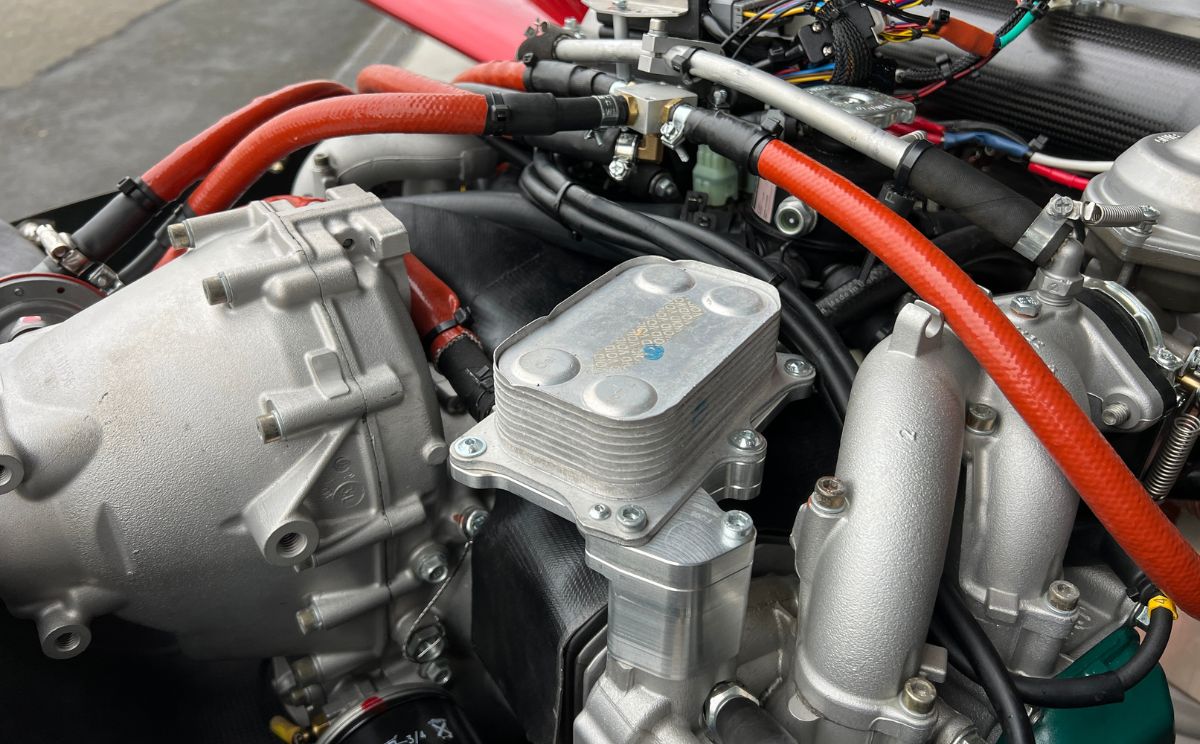
As their name suggests, they rely on heat exchange between the fluids. The coolant temperature rises faster but is less stable than that of the oil, and the following happens: during warm-up, the coolant, circulating in a bundle around an oil pipe, passes its heat to the oil and so raises its temperature. When hot, the oil, a more fluid and better heat carrier regulated by a thermostat and/or its cooler, reduces the coolant's temperature peaks.
There are "plate exchangers", which come from industry and were adopted by the car industry some twenty years ago, and which are so efficient that they could allow you to do without an oil cooler. Even if this is possible, such extreme use of the system takes definite risks at high temperatures, because there is no longer any surface to dissipate the excess heat and, in addition, it reduces the volume of oil, so the remaining fluid is stressed more heavily. Removing the cooler is strongly discouraged and contradicts the Rotax 9-- series Installation Manual.
"The microlight touch"
Here I am talking about the simple, inexpensive solution of masking the radiators, most often with strips of tape. This practice is very effective if done properly, masking the cores in the direction of fluid flow so as to optimise the temperature rise and avoid the flashing effect (hot / cold / hot /...).
The limits of this solution are that it is totally impossible to intervene if temperatures vary significantly during the flight, and the risk of forgetting to remove it when the seasons change should not be overlooked either.
At our latitudes, engines do not refuse to start or run as they can in very cold countries, and the dry sump avoids the drag on rotation when starting in oil thickened by the cold. But we must be aware that operating outside the engine manufacturer's recommendations is detrimental to smooth running and to resistance to wear.
I am often asked why the pilot has to find solutions himself to achieve the temperatures recommended by the engine manufacturer. The answer is simple: Rotax sells "all in box" engines (ready to fit). It does not know where the aircraft will be operated, and climatic conditions differ greatly from one country or region to another. It makes available on (www.flyrotax.com) a specification (the IM), leaving it to the manufacturer, industrial or amateur, to adapt it to the aircraft model and to the part of the world where it is operated. This so-called integration phase is, for information, one of the most expensive in designing a model for car manufacturers, whose production volumes have nothing in common with those of our microlight manufacturers. So let's make the best of a bad job, adapt our own operating temperatures and above all respect them; our safety depends on it (and our wallet too, as Régis reminds me!)
To conclude, I think it is important to appreciate that warm-up times are easy to quantify. For example, with an outside temperature of 6° and no device, it takes about 12 minutes to reach the 50° essential for applying power for take-off; when the microlight is fitted with a thermostat, it takes only about 6 minutes. What is hard to measure over time is the operating temperatures in flight (unless you have an EMS that records this data).
The differences in time are not huge, although they should be included in the calculation of hourly costs for flying clubs; the impact on longevity and operating safety, however, is very significant.
Did you enjoy this article? Want to know more? Come on a course!
Basic winter rule: wrap up well!
Tip: to reach operating temperature, nothing beats making the most of the initial climb at full power, possibly unloading the engine by easing the stick forward a few degrees. Once the target temperature is reached, it will be easier to maintain it in cruise.
Christophe Huchet









