






Editorial - BSV no.58

QUIZ-ULM
The last 15 days have allowed a rapid resumption of flying that few were expecting.
As we have often reminded you, our leisure activity does not tolerate a lack of preparation or rigour, and requires us to keep our performance and knowledge permanently at levels compatible with our types of flying.
This year, we will focus our flight safety improvement policy on preventing loss of control in flight, rigorous application of procedures and keeping theoretical knowledge up to date. This last point is essential for flying safely and is something to work on throughout the year.
That is why we are offering you this 40-question QUIZ so you can test your knowledge.
Do not hesitate to reread your theory manuals and the Microlight Pilot Safety Memo (to download at https://www.ffplum.fr/securite/memo-securite) if in doubt.
In 2020, the FFPLUM will become the delegated body for the microlight theory exam, which will give us the chance to regularly offer you opportunities to maintain, revise or update your knowledge.
Enjoy the quiz!!!
Question 1 : On board a 3-axis microlight, while taxiing in a straight line in a crosswind, the control stick must be:
a- pushed in the direction the wind is blowing towards, to help hold the heading
b- held neutral because the microlight is not flying
c- pushed against the direction the wind is coming from, to help hold the heading
d- held neutral so as not to damage the ailerons
Question 2: A parcel of air is said to be unstable if:
a- during lifting, it cools more slowly than the surrounding air
b- during lifting, it cools faster than the surrounding air
c- it is saturated
d- its temperature is positive
Question 3: On a weight-shift microlight in steady flight:
a- the wing tips have a higher angle of attack than the central part
b- the wing tips have a lower angle of attack than the central part
c- the wing tips always have the same angle of attack as the central part
d- the wing tips are always at an angle of attack below the zero-lift angle
Question 4: On the half-wing whose aileron is raised, the lift:
a- increases, drag increases
b- does not change, drag decreases
c- does not change, drag does not change
d- decreases, drag decreases
Question 5: On a three-axis microlight, moving the stick forward or back has the effect of:
a- a change in the wing's incidence setting
b- a change in the angle of attack
c- a decrease in thrust
d- no change in angle of attack because the relative wind remains constant in strength and direction
Question 6: When the flight is slipping, the ball is:
a- opposite to the direction the relative wind is coming from
b- on the side the relative wind is coming from
c- in the middle
d- on the same side as the yaw string
Question 7: On a 3-axis microlight in gliding flight, when the bank angle of the turn is increased while keeping the same airspeed, the absolute value of the flight path slope:
a- decreases and the rate of descent increases
b- and the rate of descent increases
c- and the rate of descent decreases
d- remains constant and the rate of descent increases
Question 8: The presence of cloud cover:
a- increases energy exchange by convection
b- increases energy exchange by radiation
c- has no influence on energy exchange
d- decreases energy exchange by radiation
Question 9: Ground effect is shown by:
a- a soft feel on the control surfaces
b- an increase in glide ratio
c- rapid deceleration of the microlight near the ground
d- a decrease in glide ratio
Question 10: Within the meaning of the regulations, a “special activity” means:
a- flying over water
b- flight instruction
c- carrying a passenger
d- an activity subject to the filing with the authorities of a manual specific to the practice of that activity
Question 11: The lift and drag of a wing depend on:
1- the air density
2- the speed of the relative wind
3- the wing area
4- the angle of attack of the wing
5- the shape of the wing profile
The combination containing all the correct statements is:
a- 1, 2, 4
b- 2, 3, 5
c- 3, 4, 5
d- 1, 2, 3, 4, 5
Question 12: In the standard atmosphere, the temperature at sea level is:
a- +20°C
b- +15°C
c- +25°C
d- 0°C
Question 13: At constant flight path slope, a decrease in speed implies:
a- a decrease in the angle of attack
b- a decrease in pitch attitude
c- no change in the angle of attack
d- an increase in the angle of attack
Question 14: You are at the holding point of an uncontrolled aerodrome, a microlight is on final:
a- you line up for take-off, because you have priority
b- you line up for take-off, because you think you have time to take off before it lands
c- you wait until the microlight has landed, because it has priority
d- you line up for take-off, because only gliders have priority when landing
Question 15: Exceeding the limit load factor can:
1- deform the structure
2- deform the wing
3- break components of the microlight
a- 2, 3
b- 1, 2
c- 3
d- 1, 2, 3
Question 16: A yellow cross in a red square placed in the signals area means:
a- airfield reserved for gliders
b- landings prohibited
c- special precautions during approach or landing
d- helicopter flying
Question 17: The spark plug caps of internal combustion engines are fitted with an interference suppression system.
This system makes it possible to:
a- increase the efficiency of the plug by increasing the intensity of the sparks at its terminals
b- increase the efficiency of the plug by increasing the number of sparks at its terminals
c- avoid interference with ground installations and the malfunctioning of any radio equipment fitted to the microlight
d- avoid losses caused by sparks between the cap and the engine cylinder head
Question 18: On 4-stroke engines, a carburettor heating system is sometimes found.
This system is used:
a- to make it easier to hold idle when the engine is cold
b- to make starting easier in cold weather
c- to improve engine efficiency by heating the intake gases
d- to de-ice the carburettor, which can be blocked by ice forming at the fuel jet
Question 19: The rotational speed of a fixed-pitch propeller:
a- depends on the speed of the microlight only
b- depends on engine power only
c- is constant
d- depends on engine power and the speed of the microlight
Question 20: French airspace is divided into several flight information regions, known as “FIR” (Flight Information Region).
The number of these regions is:
a- 5
b- 3
c- 2
d- 4
Question 21: Lift and drag vary as:
a- the inverse of the speed
b- twice the speed
c- the square of the speed
d- the square root of the speed
Question 22: On an ICAO chart at 1/500.000, 10 cm represent:
a- 10 km
b- 5 km
c- 1 km
d- 50 km
Question 23: Flight is said to be symmetrical when:
a- the airflow strikes the aircraft head-on, parallel to the plane of symmetry
b- drift is correctly corrected by the pilot
c- the flight is made directly into the wind, without drift
d- the microlight has zero bank
Question 24: In navigation, pilotage by landmarks consists of:
a- following characteristic natural lines
b- altering your route to join a natural line that will lead you to your destination
c- flying a given heading for a given time to reach a characteristic point
d- using radio navigation aids to reach a characteristic point
Question 25: On a 3-axis microlight with a cruciform tail, the factors ensuring longitudinal stability are:
a- the vertical tail and the position of the centre of gravity
b- the ailerons, which must have sufficient deflection
c- a large dihedral angle
d- the horizontal tail and the position of the centre of gravity
Question 26: You are flying on magnetic heading Cm=010°, your drift is 10° right (X=10) and the QNH is 1017 hPa.
The first flight level (FL) usable outside controlled airspace will be:
a- FL 45
b- FL 30
c- FL 25
d- FL 35
Question 27: You are flying a microlight on a magnetic track of 270°.
A usable flight level is FL:
a- 035
b- 450
c- 040
d- 045
Question 28: At constant speed, an increase in the angle of attack will have the effect of:
a- a decrease in lift, then an increase in it when the stall angle of attack is reached
b- a decrease in drag, then an increase in it when the stall angle of attack is reached
c- an increase in lift whatever angle of attack is reached
d- an increase in lift then a decrease in it when the stall angle of attack is reached
Question 29: To enter an airway (AWY), the minimum vertical separation to be maintained from clouds is:
a- 1 000 m
b- 500 m
c- 1 500 m
d- 300 m
Question 30: In winter, in anticyclonic conditions, the power delivered by your engine, compared with low-pressure conditions in mid-summer, is:
a- roughly equivalent
b- higher
c- lower
d- higher at low rpm, and lower at high rpm
Question 31: In the absence of different provisions shown on the aerodrome chart, the aerodrome circuit must be flown with turns in a defined direction, and the downwind leg must be flown at a defined height above the aerodrome, namely respectively:
a- to the left and 1 000 ft
b- to the right and 300 ft
c- to the right and 1 000 ft
d- to the left and 300 ft
Question 32: In 2-stroke engines, when the quantity of oil mixed with the fuel is too high, the consequences to be feared are as follows:
1- the engine becomes fouled
2- the engine overheats
3- piston ring wear increases rapidly through gumming
4- engine efficiency increases
5- starting may be difficult or even impossible
The combination containing all the correct statements is:
a- 1, 2 and 4
b- 2, 3 and 5
c- 1, 3 and 5
d- 1, 2 and 3
Question 33: In gliding flight, lift:
a- balances the component of weight perpendicular to the relative wind
b- is zero, the microlight is no longer in equilibrium
c- is zero, because the microlight is no longer flying
d- balances the weight
Question 34: To act on the ailerons, you move:
a- the stick, fore and aft
b- the rudder pedals
c- the stick, sideways
d- the throttle lever
Question 35: With cumulus clouds lined up in parallel bands, you expect a wind that is:
a- light or nil with variable direction
b- perpendicular to the lines of cloud
c- strong or turbulent with variable direction
d- in the same direction as the lines of cloud
Question 36: You are on final at a controlled aerodrome when you see a red firework above the control tower.
This means:
a- dangerous aerodrome, do not land
b- whatever the earlier instructions, do not land for the moment
c- come back to land
d- give way to another aircraft and come back to land
Question 37: The mistral is a wind:
a- from the south associated with an anticyclone over Italy and a depression over Spain
b- from the north, associated with a depression over Italy and an anticyclone over Spain
c- from the south, associated with a depression over Italy and an anticyclone over Spain
d- from the north, associated with an anticyclone over Italy and a depression over Spain
Question 38: To fly in Class E airspace:
a- it is enough to monitor the radio after obtaining entry clearance
b- you must comply with minimum flight weather conditions
c- you must comply with minimum flight weather conditions, and obtain entry clearance
d- you must obtain clearance to enter this airspace
Question 39: Aspect ratio is:
1- the square of the wingspan multiplied by the wing area
2- the square of the wingspan divided by the wing area
3- the square of the wingspan divided by the mean chord of the wing
4- the wingspan divided by the mean chord of the wing
a- 1 and 4
b- 3 and 4
c- 2 and 4
d- 1 and 2
Question 40: Several units can be used to measure wind speed.
The one used in observation messages for aeronautical use issued by the meteorological services is:
a- the kilometre per hour (km/h)
b- the knot (kt)
c- the metre per second (m/s)
d- the mile per hour (mph)
(Answers: 1c 2a 3b 4d 5b 6b 7b 8d 9b 10d 11d 12b 13d 14c 15d 16b 17c 18d 19d 20a 21c 22d 23a 24a 25d 26d 27d 28d 29d 30b 31a 32c 33a 34c 35d 36b 37b 38b 39c 40b)

Eric Galvagno
Head of the Flight Safety Committee
Training corner
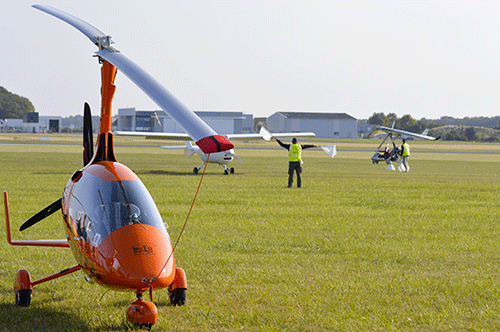
Every month we publish the accident figures. Some of these are, sadly, harder to read: those that represent our fellow microlight pilots who are no longer with us and those who have been seriously injured. For these, our figures are about 100% reliable, as the data is passed to us by the DGAC and the BGTA.
The Analyst's analysis
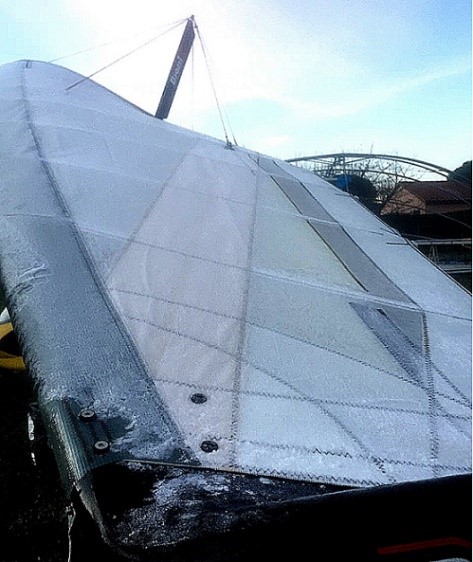
REX - Contamination by white frost
At the end of 2017, a weight-shift microlight pilot decides to make an early-morning flight to Bagnères-de-Luchon. The weather is very good and the day looks promising. For technical reasons, the machine had been left stored outside, though protected, because the cover of the AéroBulle that normally shelters this microlight was being replaced. During the morning pre-flight check, the pilot notices a thin film of white frost over the whole upper surface of the wing, particularly on the right wing.
Safety in figures
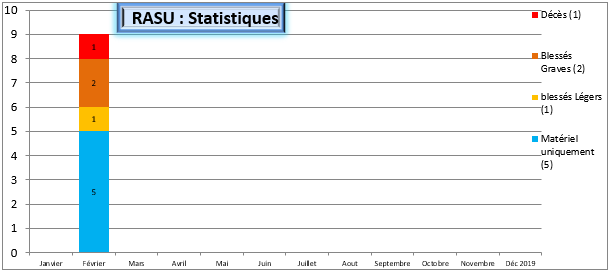
The season is under way again and we have sadly had to record the first fatal accident of the year. The circumstances are not yet clearly known, but according to initial information it is possible that reduced visibility may have contributed to this accident.
What about doing a REV? > video guide
A question about the REV programme? > see our dedicated FAQ









