






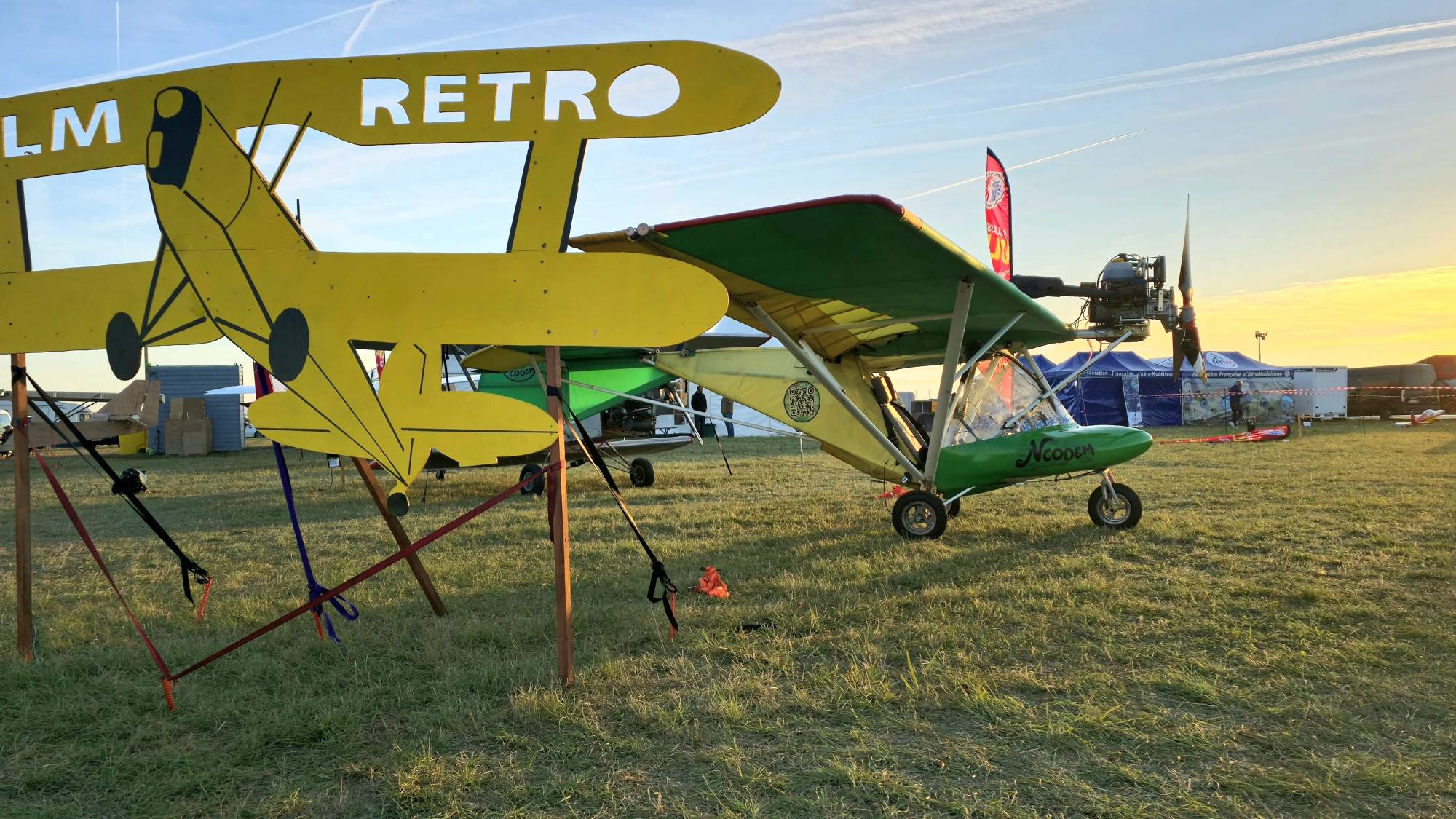
Flying abroad
Travelling by microlight is:
-
Technically possible because microlights are reliable today,
-
Economically possible because the running costs are affordable for many,
-
A unique experience because the microlight offers the greatest freedom and mobility possible on the planet, and gives us an exceptional view of our world.
The difficulty of travelling by microlight is above all administrative. Microlights are not governed by ICAO international regulations. They have no certificate of airworthiness but documents specific to their country.
- Licences are also specific to each country,
- There are no international technical agreements on their approval.
In practice:
- Countries do as they please, so there are significant variations from one country to another,
- As few machines make such trips, many countries turn a blind eye, treating microlights as aeroplanes, or do not want to deal with them or even hear about them, which means that letters often go unanswered,
- Some countries are particularly sensitive about the maximum freedom microlights offer and the difficulty of controlling them, such as Spain, which has suffered imports of certain herbs and aromatic concentrates from North Africa.
The general rule is therefore to ask for, and obtain, permission to fly from the civil aviation authority of the countries concerned.
Also be sure to carry a certificate of insurance (preferably in English), which you should request from your insurer before leaving, as some countries require it to be attached to the overflight authorisation request or kept with the papers on board your machine.
To obtain information, you can consult the official aeronautical information published by each country. The list of AIS: http://www.eurocontrol.int/articles/ais-online
The EMF has also put country-by-country information online, which you can consult here.
Below you will find country sheets giving information. Do not hesitate to send us your comments and experience to complete this page.
News flash - Reintroduction of border controls in the Schengen area

(updated 10 October 2022)
In view of the current geopolitical tensions within the European Union, some countries have reintroduced border controls in the SCHENGEN Area.
This means that before undertaking a flight from or to another country, in addition to the usual flight plan (FPL) and compliance with that country's microlight flying rules, you will also again need to plan a stop at a customs aerodrome (see VAC chart) on entry after crossing the border, if the national regulations of the destination country require it.
As this information is generally not included in aeronautical documentation, to prepare your flight you can find this list of customs provisions, regularly updated by each country, on the European Commission website via the following link: https://home-affairs.ec.europa.eu/policies/schengen-borders-and-visa/schengen-area/temporary-reintroduction-border-control_en
Belgium

Flying a microlight in Belgium
(updated June 2019)
1. Regulations
Microlights registered in a country other than Belgium must apply to the DGTA for permission to fly over Belgian territory, whether to stop there or simply to transit. The formalities differ depending on whether or not the machine in question is approved in Belgium.
- Approved microlights can obtain a "permanent authorisation". The procedure is set out in the "information note" issued by the DGTA.
- Non-approved microlights can obtain a "temporary authorisation", the procedure for which is set out in the same "information note". A one-month temporary authorisation can be requested, downloadable here (price €103 in 2024).
Important note: pilots wishing to apply for one of these authorisations must comply scrupulously with the formalities described in the note and send the DGTA all the documents requested. The administration takes no action on an incomplete application and the file will be closed without further action.
Radio is in English (8.33 radio since 1st January 2018).
Paramotors are not considered microlights. Air sports were legalised in Belgium by a royal decree (RD of 10/06/2014). Paramotor flying is now completely legal.
2. Entry
A flight plan must be filed and closed by telephone if you take off and land at microlight airfields.
3. Navigation
Standard ICAO procedures.
Above 4500 ft, the airspace is classified C throughout the kingdom.
4. Authorised airfields
Microlight airfields or aerodromes: http://bulmf.be/index.php/fr/liste
List of microlight airfields: https://mobilit.belgium.be/sites/default/files/downloads/lijst%20ULM%20terreinen.pdf
5. Useful addresses
AIS: https://www.belgocontrol.be/html/belgocontrol_static/eaip/eAIP_Product/index.html
Directorate General Air Transport (DGTA):
Website: https://mobilit.belgium.be/fr/transport_aerien
Postal address: Directorate General Air Transport, Airports Department, Rue du Progrès 80 box 5, 1030 Brussels
Email: BCAA.Airports@mobilit.fgov.be
Website of the Belgian microlight federation: http://www.bulmf.be
Postal address: BULMF ASBL, Rue Montoyer 1 box 23, 1000 Brussels
Website of the Belgian paramotor federation: http://www.federationparamoteur.be/accueil/
Postal address: FBPM-BPMF, Eric Dargent, Rue de Linsmeau 12, 4287 Lincent (Racour)
6. Miscellaneous practical information
Aeronautical chart on sale at PilotShop: https://www.pilotshop.biz/carte-vfr-ign-belgique-luxembourg,fr,4,940.cfm
Spain

Flying a microlight in Spain
(updated February 2023)
1. Regulations
Microlight flights are permitted in Spain subject to the following restrictions:
- maximum flight altitude: 3000 metres (10 000 feet) above ground or water. It is possible to exceed 3000 metres and climb to 4,000 m (13 000 feet AMSL) for a maximum of 30 non-continuous minutes.
- do not fly in controlled, restricted or prohibited airspace, or over areas with dangerous activity, urban areas and gatherings of people.
- flights must always be made in daytime visual meteorological conditions.
- take-offs and landings must be made on authorised land areas (microlight flying centre or private aerodrome) and with the landowner's permission.
In Spain, paramotors are not considered microlights but come under separate regulations.
Given that microlights have a certificate of airworthiness applicable to their own country and that there are no international agreements on technical approvals, foreign-registered microlights must file a declaration to fly in Spain. The procedure starts on the page
https://sede.seguridadaerea.gob.es/oficina/tramites/altaSolicitud.do?id=155&codArea=SOLGEN
You must choose the "e4F" mode (eSignature for Foreigners) and click on registrarse to register before your first login.
A guide (in English) can be downloaded here.
For further details, see the AEPAL website: http://www.aepal.aero/flying-in-spain/
2. Entering Spain
Both France and Spain require a flight plan to be filed to cross the border. It must be filed and closed by telephone (ARO BARCELONA +34 93 298 37 98, ARO MADRID +34 913 936 560) if you take off and land at microlight airfields. To enter Spain, you will need to request authorisation as described in the paragraph above.
For flights outside the Schengen area (Morocco, for example), you should contact the Ministry of the Interior well in advance for an exceptional authorisation, because customs airports are controlled and therefore closed to microlights under the law of 24 April 1986 governing microlights in Spain. However, some microlights have been able to leave after a customs check from Malaga (LEAX), where customs can travel to the airport, or Jerez de la Frontera (LEMG), where transponders are not required, from Granada or Córdoba (after requesting permission to land a week in advance), and from the Medina Sidonia microlight strip.
3. Navigating in Spain
In practical terms, you can therefore fly freely and legally throughout Spain if you do not exceed 10000 feet above ground and avoid every airport and controlled area. You need up-to-date charts. The database in your GPS, if you have one, must be complete and up to date. Radio, although not compulsory, seems to me indispensable for any long-distance trip. You can ask for weather information in flight; there are frequencies at microlight strips, which are often deserted during the week. Procedures are in Spanish or English, though at uncontrolled airfields many pilots understand only Spanish.
WARNING: the MADRID and BARCELONA FIRs have been in 8.33 since 1st January 2018.
4. Authorised airfields
Spain has many microlight airfields, private strips and aerodromes with ICAO codes, most of the major ones of which are not open to microlights. Find out about this when planning your navigation. The civil aviation official website www.aena.es (in Spanish and English) lets you consult Spanish aeronautical documentation after registering online (free of charge).
5. Useful addresses
- AIS: www.enaire.es
- Catalonia Air Federation: +34 93 457 24 54
- To file or close a flight plan: +34 93 298 37 98 / +34 913 936 560
- Microlight federation: AEPAL - Asociacion Española Pilotos Aeronaves Ligeras, Aeródromo de Matilla de los Caños, Autovia Valladolid-Tordesillas, Salida 145 47114 Matilla de los Caños, Valladolid, Spain
Email: Yago.osset@aepal.aero or info@aepal.aero
Website: http://www.aepal.aero/flying-in-spain/
6. Miscellaneous practical information
Charts: they can be bought at
https://www.enaire.es/servicios/ais/distribucion_y_venta
Aeronautical charts of Spain are also on sale at La Boutique Aéro, 6 allée Henry Potez, Zone d'Aviation d'Affaires et de Fret, 31700 BLAGNAC – France. Tel: +33 (0) 534 605 604, Fax: +33 (0) 534 605 606, website https://www.boutique.aero/marques-92-rogers_data.aero
Microlight gathering: Aerosport, early May at Igualada (LEIG), in the hinterland of Barcelona.
Tour of Spain in the first half of August and tour of Catalonia and Aragon, a weekend in May.
France

Flying a microlight in France
(Flying a microlight in France)
(updated May 2025)
1. Regulations
A European microlight that complies with the regulations of its own country and meets the French definition of a microlight, with a pilot holding the corresponding licence, may fly in France on non-commercial flights, provided it respects the air regulations.
If the aircraft does not meet the French definition of a microlight, a permit is required (the application form can be downloaded here).
To fly a French-registered microlight, a pilot must hold a French certificate.
- If he holds a pilot licence for aircraft issued by a member state of the European Community, another state party to the European Economic Area, or by the Swiss Confederation, in accordance with the standards of the Convention on International Civil Aviation, he can obtain the French licence by equivalence by passing a specific ground test and a flight test with an instructor (civil aviation regulations dated 4 May 2000).
- If his licence is not recognised by ICAO, he must retake all the tests for the French microlight pilot.
Any European microlight with a valid registration, which corresponds to the French definition of a microlight, operated by a pilot with a valid license, may fly in France for non-commercial flights under the Visual Flight Rules and under the conditions indicated in the following sections.
If the microlight does not correspond to the French definition, a permit-to-fly is requested (the application form can be downloaded here).
To fly a French registered microlight, un pilot must have a French license.
- If he is the holder of an ICAO license, delivered by a Member State of the European Community, another State part of the European Economic Area, or by the Swiss Confederation, in accordance with the standards of the Convention on International Civil Aviation, he only have to pass a ground test and a flight test with a French instructor in order to be awarded a French license by equivalence.
- If he is not the holder of an ICAO license, he must complete the full French microlight instruction course and theoretical exam.
The new microlight regulations have just been published in the Official Journal:
The Federation has designed a resource that summarises all the important information. It has just appeared in ULM-Info and is available below as a PDF in French and English.
| New Microlight Regulations as a PDF |
New Microlight reglementation in pdf |
|---|---|
| 600 kg microlights in France | DGAC form |
2. Leaving and entering France
For microlights from Schengen area countries, a simple flight plan must be filed 1 hour before the flight.
Radio contact must be established when crossing the border.
In France, the flight plan can be closed by telephone: +33 (0)1 56 301 301 option 2.
For microlights registered in the Shengen Area, the only requirement is to file a flight plan commencing the cross border flight. Radio contact is compulsory when crossing the border. FPL can be closed by phone +33 (0)1 56 301 301 choice 2.
Outside the Schengen area, such as England, you must also make a stop at a customs aerodrome on entering and before leaving.
Microlights coming from outside the Shengen Area, for example the U.K, must file a flight plan and also enter or leave France by a customs airfield, having given the required notice to the customs authorities.
3. Flying within France
An increasing number of restricted areas occupy French airspace, and you need up-to-date charts or a complete database in your GPS. Radio, although not compulsory, is required at most aerodromes where microlights are permitted. Procedures are in French or English, though at uncontrolled airfields many pilots do not understand English.
Do not forget also to check NOTAMs and SUP AIPs on the SIA website, as many temporary areas are created to protect military exercises.
Download the leaflet here: Crossing to Corsica.
It is obligatory to fly with a current map for the area in which you are flying, and due to the changing nature of controlled airspace, if you have a GPS, it should have a current database. Radio is not obligatory but most of the general aviation airfields require it. You may use French or English on the radio, unless otherwise indicated on the airfields Visual Approach Chart, but be aware that at non controlled airfields, many pilots don’t speak or understand English.
Don’t forget to consult the SIA website (https://www.sia.aviation-civile.gouv.fr/default_uk.htm) where you can check NOTAMS and obtain current airfield information and arrival charts. This is particularly important due to the creation of temporary areas to protect military exercises.
4. Authorised airfields
France has about 600 microlight airfields and private aerodromes and 424 aerodromes with ICAO codes, some of which are not open to microlights. Find out about this when planning your navigation.
There are about 600 ULM fields and private airports in France and 424 registered ICAO airports. Some are not open to microlights, and this fact is notified on the Visual Approach Chart for those airfields. Be sure to check while planning your journey.
5. Useful addresses
FFPLUM, French Microlight Federation (Fédération Française de Planeur Ultra-léger Motorisé)
96bis rue Marc Sangnier, 94700 MAISONS ALFORT
fax 01 49 81 74 51
email ffplum@ffplum.org
President Christian Santini
DGAC, Directorate General for Civil Aviation (Civil aviation authority),
Light aviation, general aviation and helicopters mission
50 rue Henri Farman, 75720 PARIS Cedex 15
FFA, French Aeronautical Federation (Fédération Française Aéronautique)
155 rue de Wagram, 75017 Paris
Telephone: (+33) (0)1 44 29 92 00
Fax: (+33) (0)1 44 29 92 01
RSA, Air Sports Network, amateur aircraft builders (Home built aircraft association)
46 rue Sauffroy 75017 PARIS
Telephone: (+33) (0)1 42 28 25 52
Fax: (+33) (0)1 42 29 86 53
DIRCAM, information provider for the armed forces
http://www.dircam.dsae.defense.gouv.fr/
6. Miscellaneous practical information
French AIS
The official provider is the SIA (Aeronautical Information Service), 8 av Roland Garros, BP 40245, F 33698 MERIGNAC. Telephone +33 (0)5 57 92 55 55, fax +33 (0)5 57 92 55 10.
You can buy all French aeronautical documentation there, including ICAO charts for planning your flight or navigating (charts at 1 million, 1/500000 or 1/250000 scale).
Its website www.sia.aviation-civile.gouv.fr lets you download all French aviation regulations free of charge, as well as the VAC charts for ICAO aerodromes.
Charts of aeroplane runways can be obtained from various French suppliers, for example (you can find maps in different places as):
- La boutique aéro, 6 allée Henry Potez, Zone d'Aviation d'Affaires et de Fret, 31700 BLAGNAC – France. Tel: +33 (0) 534 605 604, Fax: +33 (0) 534 605 606, website boutique.aero
- PilotShop: Postal address: 617 Rue de Neudorf, 2220 Luxembourg, website https://www.pilotshop.biz/index.cfm
Useful telephone numbers:
For weather information: 08 99 70 12 15 or on your mobile https://aviation-pda.meteo.fr To file or close a flight plan: 01 56 301 301
BRIA Telephone Fax
BORDEAUX 05 57 92 60 84 05 57 92 83 34
LE BOURGET 01 48 62 53 14 01 48 62 65 04
MARSEILLE 04 42 31 15 65 04 42 31 15 69
AJACCIO 04 95 22 61 85 04 95 23 59 69
Order of 7 January 2015 on the conditions for European motorised ultralight aircraft to fly over French territory
Article 1
For the purposes of this order, a "European microlight" means an aircraft identified or registered in a state party to the Agreement on the European Economic Area or in Switzerland, and meeting one of the class definitions given in Article 2 of the above-mentioned amended order of 23 September 1998.
Article 2
A European microlight is authorised to fly over French territory on non-commercial flights, without prior agreement from the Directorate General for Civil Aviation on the airworthiness of the aircraft and the pilots' qualifications, under the following conditions:
- it has a valid flight authorisation issued by that state or by a body to which that state has delegated authority; - and, as regards the pilot:
- he holds a qualification allowing him to fly this microlight, either issued by that state or by a body to which that state has delegated authority, or validated or recognised by that state; or
- he holds a microlight pilot certificate and licence issued by the DGAC where that state does not require a qualification to be held.
Article 3
In the case of a European microlight that corresponds neither to class 1 (paramotors) nor to class 5 (ultralight airships) and for which the state that issued the flight authorisation does not require identification or registration marks, the applicant requests provisional identification marks from the interregional civil aviation safety directorate in whose territorial jurisdiction the applicant has chosen residence or the one whose territory he plans to overfly first.
The application submitted by the applicant includes his address and a copy of the flight authorisation.
Identification marks are issued for a period that may not exceed the validity of the flight authorisation. Their allocation is renewable under the same conditions. These marks are applied under the wing of the aircraft or on the structure if this is not possible. They are plain, easily legible and at least fifty centimetres high. However, where the dimensions of the microlight do not allow the minimum size of fifty centimetres to be respected, these marks are as large as possible and at least 20 centimetres.
Italy

Flying a microlight in Italy
(Updated August 2018)
1. Regulations
There is no obligation to request prior authorisation to fly in Italy with a microlight registered in France.
Microlights are under the responsibility of the Aero Club of Italy.
2. Entry
Flight plan compulsory. To close a flight plan (or file it for the return):
- Northern Italy, ARO MILAN +39 02 71 02 00 19,
- Southern Italy, ARO ROME +39 06 79 81 10 11.
3. Navigation
In line with ICAO, but limited in altitude to 1000' and no flying in controlled airspace except for "AVANZATO" microlights (equipped with 8.33 radio, transponder, parachute and distress beacon). During radio communications, pilots must say the word "ULTRALIGHT" after the call sign. The call sign must always be given in full and cannot be abbreviated.
Pilots of "AVANZATO" microlights who file a flight plan must specify in box 9: ULAC or GYRO or UHEL, and in box 18: 'RMK/ULAC ADVANCED' or 'RMK/GYRO ADVANCED' or 'RMK/UHEL ADVANCED'.
4. Authorised airfields
In general, aeroplane airfields are not open to microlights, except for some that are open to "AVANZATO" microlights.
List of airfields: http://www.aeci.it/upload/files/aeroporti-aperti-%20VDS.Avanzato-AD-1-3.pdf
The list of microlight airfields is available on the microlight federation website www.ulm.it and can be downloaded in various formats.
An app available on the App Store or Google Play (Avioportolano) lets you consult the microlight airfield sheets.
5. Useful addresses
AIS: https://www.enav.it/
Postal address: Via Appia Nuova, 1491 - 00178 Roma
Telephone: +39 06 81661
Fax: +39 06 81662 016
Email: aip@enav.it
Useful websites (registration required):
https://www.enav.it/sites/private/it/ServiziOnline/FPL-Form-Sottomissione.html: Flight plan filing
https://www.enav.it/enavWebPortalStatic/AIP/AIP/publications/SOM_NTM.pdf: NOTAMs
https://www.enav.it/enavWebPortalStatic/AIP/AIP/publications/AIC.html: AICs in bulk
Website of the Italian microlight federation: http://www.ulm.it
Aero Club of Italy: http://www.aeci.it/
Postal address: Via Cesare Beccaria 35 / A - 00196 ROMA
Telephone: +39 06 36 08 461
Fax: +39 06 32 60 92 26
Email: dir.gen@aeroclubitalia.it
Civil aviation: Ente Nazionale per l’Aviazione Civile
Presidency and Directorate General
Viale del Castro Pretorio, 118
00185 ROMA
6. Miscellaneous practical information
Charts are on sale here: https://sae-aero.fr/
Other aeronautical charts of Italy are also on sale at La Boutique Aéro, 6 allée Henry Potez, Zone d'Aviation d'Affaires et de Fret, 31700 BLAGNAC – France. Tel: +33 (0) 534 605 604, Fax: +33 (0) 534 605 606, website https://www.boutique.aero/marques-92-rogers_data.aero
A few websites:
http://avioportolano.it/it/: almost everything on this site, airfields, charts…
http://ultraleggero.it/: another site with plenty of information.
Portugal

Flying a microlight in Portugal
(Updated August 2018)
1. Regulations
Since November 2017, microlights used for leisure flights and registered in an intra-Schengen EU country or in Switzerland have been allowed without prior formalities.
2. Entry
A flight plan and radio contact are compulsory to enter Portugal. Before flying, check the NOTAMs to verify the activation status of military areas.
When crossing the border, in class G airspace below 5,500 ft, contact Lisboa Militar on 130.90 MHz (North sector), 123.750 MHz (Centre sector) or 131.050 MHz (South sector).
3. Navigation
In line with ICAO. Microlights are allowed below FL095. Flight information services in class G airspace are provided by:
- Lisboa Militar from the ground to 5,500 ft,
- Lisbon Control from 5,500 ft to FL095.
Access to class C and D airspace is permitted (with radio and transponder) except for the CTRs of major airports.
The cavok.pt website lets you consult NOTAMs, which are georeferenced and plotted on a map, the activation status of military areas…
4. Authorised airfields
Microlights are accepted at most aerodromes.
The map of aerodromes, heliports and microlight strips: https://www.nav.pt/docs/AIS/vfr-manual-ii/index-de-aer%C3%B3dromos-heliportos-e-pistas-ul.pdf?sfvrsn=22
Microlight strips and aerodromes are also listed on the cavok.pt website, where you will find the aeronautical information for them (runways, radio, procedures…)
5. Useful addresses
AERO CLUB DE PORTUGAL
Postal address: Rua General Pimenta de Castro 4C, 1700-218 LISBOA, Portugal
Telephone: +351 21 840 53 17 or +351 21 840 53 67
Fax: +351 21 840 55 72
Email: aecp@aecp.pt
Website: www.aecp.pt
ANAC - Autoridade Nacional da Aviação Civil
Rua B, Edifício 4 – Aeroporto Humberto Delgado
1749-034 Lisboa
Telephone: +351 21 284 22 26
Fax: +351 21 840 23 98
Email: geral@anac.pt
Website: www.anac.pt
Microlight federation:
Associação Portuguesa De Aviação Ultraleve
Rua Frei Tomé de Jesus,8
1700-215 Lisboa
Telephone: +351 93 272 80 02
Fax: +351 217 936 815
Email: geral@apau.org
Website: www.apau.org
6. Miscellaneous practical information
Rua D - Edifício 121, Aeroporto de Lisboa, 1700-008 Lisboa, Portugal
Telephone: +351 21 855 3100
Email: gabcim@nav.pt
Facebook: NAV Portugal
VFR charts can be bought at:
https://www.nav.pt/ais/subscription/cartas-aeronauticas-(anc)
An essential website: cavok.pt
Aeronautical charts of Portugal are also on sale at La Boutique Aéro, 6 allée Henry Potez, Zone d'Aviation d'Affaires et de Fret, 31700 BLAGNAC – France. Tel: +33 (0) 534 605 604, Fax: +33 (0) 534 605 606, website https://www.boutique.aero/marques-92-rogers_data.aero
Switzerland

Flying a microlight in Switzerland
(Updated November 2021)
1. Regulations
The following are permitted in Switzerland:
- Three-axis microlights (ecolight),
- Gyroplanes,
- Electric weight-shift microlights,
- Electric paramotors.
Prior authorisation (for a fee) is required to fly in Switzerland with a microlight registered in France. It is limited to two months per year. See the page:
to download the forms to be returned to permittofly@bazl.admin.ch
Regarding pilots:
- Comply with the requirements of your home country,
- Pilots who hold only a microlight certificate may fly only in class E and G airspace; pilots holding a JAR or ICAO licence may fly under the same conditions as pilots of certified aircraft. Flights in control zones (CTR) for landing or take-off require prior permission (PPR) from the local air traffic control unit. In this case, pilots must hold a valid radiotelephony operator's licence.
2. Entry
Flight plan and stop at a customs airfield. Zurich and Geneva are not open to microlights.
3. Navigation
Switzerland consists of a single FIR, divided into two territorial areas of responsibility, Zurich and Geneva. On the GLDC chart, the line separating them runs from Chasseral to Fiesch via the Bernese Oberland and is marked CTA Zurich / CTA Geneva. This line matters only to pilots who want to obtain clearance or information by radio from the DELTA or FIC flight information centres.
The SKYBRIEFING website https://www.skybriefing.com/fr/home lets you consult the documentation (eAIP and SUP AIP, NOTAM, AIC) and keeps a map of active airspace up to date ("Services" tab, "DABS (CH)" page).
4. Authorised airfields
The list of airfields is on the website http://www.orix.ch/aviation/a_page_1.html
Zurich and Geneva airports are not open to Ecolights.
5. Useful addresses
AIS: www.skyguide.ch/fr/
Website of the Swiss microlight federation: www.swissmicrolight.ch
Postal address: Swiss Microlight Federation (SMF), Anton Landolt, Mittlere Allmeind 17, CH-8773 Haslen, Switzerland
Federal Office of Civil Aviation (FOCA): https://www.bazl.admin.ch/bazl/fr/home.html
6. Miscellaneous practical information
The official aeronautical chart of Switzerland is published by the Federal Office of Topography and skyguide, and is on sale at https://www.aimshop-skyguide.ch/fran%C3%A7ais/charts/
Postal address: Skyguide Swiss Air Navigation Services ltd, Route de Pré-Bois 15/17, PO Box 796, CH 1215 Geneva 15
Telephone: +41 22 417 41 11 – Fax: +41 22 417 45 47
The ICAO aeronautical chart 1/500 000 2253-B Switzerland is offered as digital data for use in dedicated software applications. It can be bought on the website https://www.kniebrett.ch/
There is also a gliding chart at 1/300 000.
Aeronautical charts of Switzerland are also on sale at La Boutique Aéro, 6 allée Henry Potez, Zone d'Aviation d'Affaires et de Fret, 31700 BLAGNAC – France. Tel: +33 (0) 534 605 604, Fax: +33 (0) 534 605 606, website https://boutique.aero/66-cartes-de-navigation-etrangeres
United Kingdom

Flying a microlight in the United Kingdom
(Updated 4 October 2022)
1 - Regulations
Before travelling to the United Kingdom, you must obtain an electronic travel authorisation (ETA), which is compulsory and chargeable (cost €19 from 9 April 2025, valid for two years). To obtain it, you need to download a dedicated app, "UK ETA", or otherwise go to the British government website, gov.uk (page https://www.gov.uk/guidance/apply-for-an-electronic-travel-authorisation-eta#apply-for-an-eta (at least 3 days before travel).
An authorisation (for a fee) is required to enter the United Kingdom. This application can be made online at: https://applications.caa.co.uk/CAAPortal/servlet/SmartForm.html?formCode=AEA
However, microlights registered in France are exempt from this application for leisure flights and if they stay less than 28 days in the United Kingdom (ORS4 texts No 1249 and 1524 available here: http://publicapps.caa.co.uk/modalapplication.aspx?catid=1&pagetype=65&appid=11&mode=list&type=sercat&id=17 ).
2 - Entry
Depart from a customs aerodrome in France (Calais, Le Touquet ...). See VAC charts.
The route across the Channel is free.
There is no restriction on arrival. However, all aircraft must report their arrival to the border police at least four hours before their expected arrival by completing and sending a "General Aviation Report (GAR)" form, available at the following address:
A flight plan with radio contact when crossing the coast is compulsory.
3 - Navigation
Communications in English, of course.
The service provided by "London Information" is different from the services provided by the SIVs in France: it is the "Basic Service", which means that the controller (who has no controller rating) does not provide traffic information on other aircraft. They provide the alerting service, will tell you about known activity at aerodromes near your route, the activation of D, R or other areas, and weather information if needed. If you are equipped with a transponder, they will track you and suggest the next sector or controller to contact, with its frequency.
Most aerodromes without a CTR are surrounded by an ATZ. These are class G areas, but radio contact with the ATS officer is compulsory in them. You must therefore announce yourself before entering these zones, whether arriving or simply transiting.
4 - Authorised airfields
You need to look at the VAC chart: http://www.nats-uk.ead-it.com
Read the text part of the chart to check that there is no prohibition for microlights.
All aerodromes have a website that is worth consulting. You will find information or charts there that are not published by NATS.
Some small airfields are not listed by NATS; they have no VAC chart because they do not meet certain regulatory criteria or because they do not want to pay to be certified. You can find information about them on the internet.
5 - Useful addresses
ROYAL AERO CLUB OF THE UNITED KINGDOM
Mr. David Phipp, 31 St. Andrew’s Road Leicester, LE2 8RE, United Kingdom
Telephone: +44 116 244 0182, Fax: +44 116 244 0645
Email: secretary@royalaeroclub.org
Website: http://www.royalaeroclub.org
Civil aviation
Safety Regulation Group, Aviation House, Gatwick Airport South, West Sussex, RH60 YR, United Kingdom
Microlight federation
British Microlight Aircraft Association
The Bullring Deddington, Banbury Oxfordshire, OX15 0TT, United Kingdom
Telephone: +44 (0)1869 338888, Fax +44 (0)1869 337116
Email: general@bmaa.org
Website: http://www.bmaa.org
6 - Other practical information
AIS: http://www.nats-uk.ead-it.com/public/index.php.html
Aeronautical charts of the United Kingdom are also on sale at La Boutique Aéro, 6 allée Henry Potez, Zone d'Aviation d'Affaires et de Fret, 31700 BLAGNAC – France. Tel: +33 (0) 534 605 604, Fax: +33 (0) 534 605 606, website https://www.boutique.aero
Special case of the Channel Islands
The airspace is classified D up to FL080, A above. Mandatory routes are set for getting there.
See the Jersey Aero Club website http://www.cicz.co.uk/standard_routes.php









