






Editorial - BSV no.59
Recovery from unusual attitudes: Clarifications
The Federation has received a few requests for explanations from pilots following the article "Unusual attitudes: how to get out of them?" published in the latest ULM Info.
So that no doubt can remain on this subject, here are some clarifications on the chapter dealing with recovery from an unusual "NOSE HIGH" attitude.
First of all, it must be understood that the notion of “nose high” is meant here in the context where the microlight's flight path is disturbed by an external condition, such as turbulence, for example, the angle of attack being initially low, the speed correct, and therefore well away from the stall speed. In this case, the priority is for the aircraft to regain a descending flight path as soon as possible, to prevent the high pitch attitude from causing a loss of speed and an increase in the angle of attack.
That is why, in these conditions, banking combined with a push on the stick will allow the microlight's nose to drop quickly below the horizon, without risk of stalling. This is faster than if only the pitch push is applied.
Here is a short reminder of flight mechanics to illustrate this:
In a steady turn, the vertical component of lift must equal the force represented by the weight of the aircraft. So an aircraft entering a turn, without any major action on the angle of attack or speed, will have insufficient lift to maintain level flight.
Consequently, banking an aircraft in an unusual nose-high position, without increasing the angle of attack, will allow it to quickly regain a descending flight path. As the vertical component of lift is thus reduced, the nose of the aircraft will drop quickly below the horizon and allow a rapid recovery of speed.
In other words, banking reduces the vertical component to stop the climbing flight path and limit the loss of speed.
On the other hand, if the nose-high position is maintained without rapid corrections, or if it results from an unintended nose-up input by the pilot on the elevator control, the angle of attack will increase sharply, speed will drop and the stall will be inevitable unless you react with a firm push on the stick (it is not enough to release the controls because they are not very effective in this configuration) and without banking.
Whatever the case, and as we recommend in the article: training and a REV flight with an instructor are the best ways to understand this issue and to learn the right reflexes that save lives!!
Safe flying.

Eric Galvagno
Head of the Flight Safety Committee
Click here to read Éric's text for his “Farewell!”
Training corner
Some spring information: Flight Preparation; The Return to Flying programme; Lithium batteries.
The Analyst's analysis
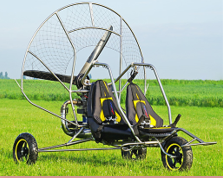
On 15 August 2018, a group of 4 paramotor microlights decided to fly to the Courseulles-sur-mer microlight airfield LF1451 to make local flights.
After a first flight, the group decides to wait for the wind to calm down. Around 17, the 3 foot-launched paramotor pilots, who are more experienced, set off to scout the airflow and decide on the return to their departure base.
West wind at 7kts, so the weather is estimated consistent for the return.*
Safety in figures
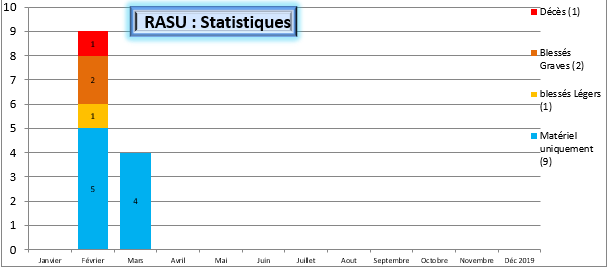
The season is under way again and, fortunately, we have so far recorded no new fatalities in March; the figures are even below the usual values for fatal accidents.
What about doing a REV? > video guide
A question about the REV programme? > see our dedicated FAQ









