






NewsNews
Frequently asked questions
56 questions and answers: discovering microlighting, regulations, training, the BIA, radio, Return to Flying and paramotoring.
News
56 questions and answers: discovering microlighting, regulations, training, the BIA, radio, Return to Flying and paramotoring.
Frequently asked questions
56 questions, the federation's answers
Type a few words or choose a topic. Each question has its own address: copy its link to share it.
Discovering microlighting 8
What defines a microlight?
The French term ULM stands for ''Ultra Light Motorised glider''. It is a single-engine aircraft characterised by:
- a simple design principle;
- proven general robustness;
- enough flight capability with the engine stopped to make a field landing in satisfactory safety conditions;
- easy handling that does not call for exceptional skill from the pilot;
- simple maintenance. All parts of the microlight are easily accessible and visible. Maintenance is normally entrusted to the holder of the identification card, who may call on the manufacturer or a professional if the work goes beyond their competence.
It can be defined by:
- Its maximum take-off mass (MTOM), which varies depending on whether the aircraft is single-seat or two-seat and on its class,
- Its maximum empty mass (MV),
- Its minimum speed (VS0),
- Its maximum engine power,
- Its crew-carrying capacity. It is at most a two-seat aircraft and can carry only one passenger in addition to the pilot.
- Its endurance,
- Its simplicity,
- Its lightness.
Obligations of the microlight manufacturer
The low masses and speeds that characterise this type of aircraft have led the authorities to subject them to suitably adapted regulations.
The manufacturer must comply with certain design rules, check that the aircraft conforms by carrying out a test programme defined by regulation, and file with the Ministry responsible for Transport a technical file describing all the operations and tests carried out.
If necessary, the authorities will refer to the declarative technical file to check that the microlight was properly designed, built and verified in line with the regulatory requirements.
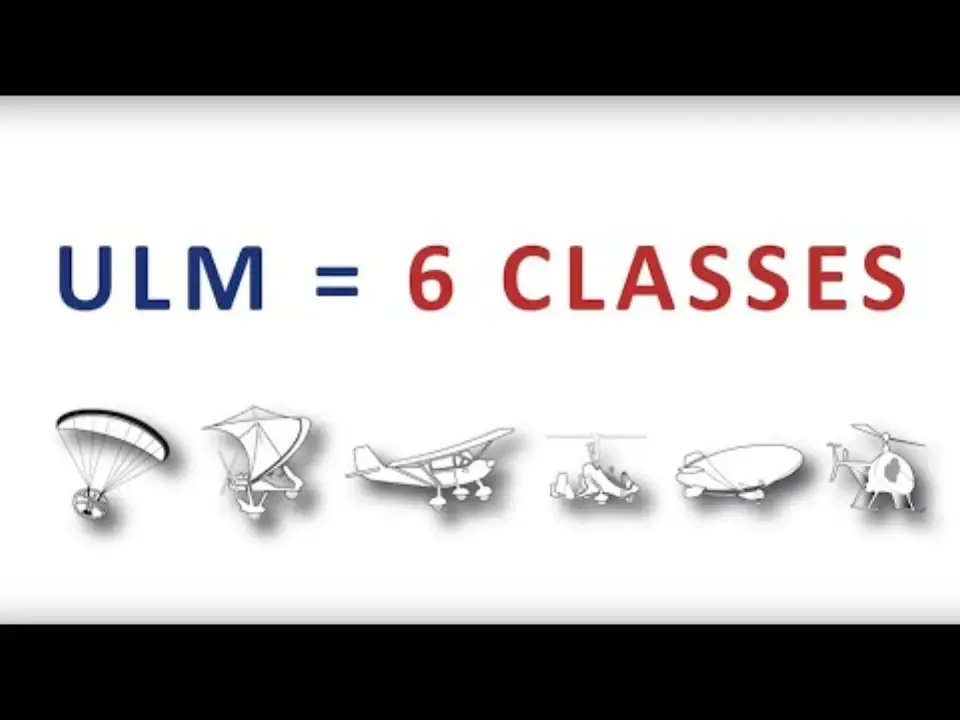
There are 6 classes of microlight, distinguished by their principles of flight (class 5, 'Aerostats', is practically non-existent).
A little technical background…
Microlights are built using different types of technology:
- The simplest are built on a wooden or high-strength aluminium tube structure, covered with a fabric 'skin' often reinforced with glass fibre.
- The most sophisticated use more modern materials (composites, carbon...) which give them better performance, but cost more.
The engines used are either 2-stroke engines of 250 cc to 600 cc, or 4-stroke engines of 1000 to 1600 cc.
Speed and endurance...
A microlight's speed ranges from 30 km/h for a paramotor to nearly 300 km/h for the fastest three-axis microlights!
Most weight-shift microlights fly between 90 and 120 km/h, and three-axis microlights fly between 90 and 200 km/h.
On average, microlights have an endurance of 3 to 5 hours of flight, which makes for some very fine trips!
Do you need a certificate to fly a microlight?
Yes. You must hold a microlight pilot certificate, specific to each class of microlight, issued by the Ministry of Transport after an examination that includes:
* a theory part covering different areas of knowledge such as safety, regulations, navigation, meteorology and aerology, flight mechanics...
* a practical part demonstrating the candidate’s ability to handle a microlight of the class concerned.
Additional experience, checked by a flight test, is needed to obtain a ''passenger-carrying authorisation''.
The minimum age is 15 to fly and 18 to be an instructor.
How long does training take before you get your certificate?
It varies according to the class of microlight... and how easily the student pilot learns.
For example, the training programme set by the FFPLUM is:
* 30 lessons, i.e. about 15 hours of flight training for a 'weight-shift' certificate,
* 40 lessons, i.e. about 20 hours of flight training for a 'paramotor' certificate,
* 50 lessons, i.e. about 25 hours of flight training for a 'three-axis' or 'gyroplane' certificate.
Can a microlight pilot fly wherever they like?
Like all flying machines, a microlight is subject to the “Rules of the Air”.
They are also restricted to what is known as ''Daytime Visual Flight Rules''. This means they can only fly by day (from 30' before sunrise to 30' after sunset), clear of clouds, with a minimum visibility set by the regulations. The pilot must always be able to see the ground.
* They can fly freely in all the airspace known as 'uncontrolled airspace', where there are no specific constraints set by the Air Navigation Services.
* Other areas, known as “controlled airspace”, require clearance to enter. This is the case, for example, of airspace around or near airports, airspace used by airliners, and some military zones...
* Finally, there are areas that may not be entered, temporarily or permanently (some military zones, or nuclear power stations, for example).
All this information is shown on the aeronautical charts that pilots must carry on board when they travel away from their home base.
Can a microlight take off and land anywhere?
Unlike aeroplanes, a microlight can take off and land away from aerodromes. This is one of its main attractions.
- A microlight can take off and land occasionally on a site with suitable characteristics (clear ground, 200 to 300 m long and 20 wide), provided the owner or person entitled gives permission and the mayor of the commune is notified. Such a site is called an "occasional strip".
- If the site is used regularly, it is considered a "permanent strip" and must be covered by a prefectoral order authorising its use.
- Except in special cases, microlights may take off and land freely at "uncontrolled" aerodromes (as at many low-traffic aerodromes) but must meet certain conditions to use "controlled" aerodromes.
Consult the “official” aerodrome charts to find out landing possibilities (VAC charts). Prior permission from the competent authorities is sometimes required. Of course, any special instructions must be followed.
- In an emergency landing, the pilot's priority is to ensure the safety of the flight, including the landing, and so they choose the site that seems best suited to the manoeuvre.
How high can a microlight fly?
Outside take-off and landing procedures, the regulations require a minimum height above the ground, away from any artificial obstacle or gathering of people, of 500 feet (approx. 150 m). The nature of the 'obstacles' overflown (factory, built-up area, gathering of people, etc.) leads to specific minimum overflight heights.
The maximum altitude under the regulations is 19 500 feet (approx. 5 950 m).
In practice, the ceiling depends on the aircraft's qualities: the higher you go, the thinner the air, and so the less able it is to 'carry' the aircraft, which then has to produce more power to keep climbing. Given its power and wing area, every aircraft has a 'theoretical ceiling', often between 4000 m and 5000 m, above which it can no longer climb. This limit is more than enough for our kind of flying.
Most microlights fly between 300 m and 1500 m above the ground, a height that lets you make the most of the scenery.
What happens if the engine stops?
By design, a microlight is an aircraft that can glide.
So if the engine stops, the pilot can manoeuvre the microlight to land in an improvised landing field (a procedure known officially as a ''field landing'', or ''heading for the cows'' in pilots' slang!).
Engine failure is by no means a cause of accidents in microlighting.
It is one of the incidents that can happen at any moment of a flight. That is why every pilot learns, during training, to land with the engine off.
As a safety measure, a pilot must plan the flight so as to always be within reach of a site suitable for an emergency landing, which also means flying high enough (300 to 500 m above ground minimum) to carry out the manoeuvre as safely as possible.
Is a microlight less safe than other light aircraft?
Every form of flying carries some risk, whatever the aircraft. Flying is an activity that must be practised with great discipline, scrupulously following the rules in force and paying extremely close attention to weather conditions.
Statistics today show that microlighting is no more dangerous than other aviation activities. But microlighting still suffers from a negative image inherited from the first steps and approximations of the early 1980s, when the activity is now fully mature.
About 90% of the microlight fleet is produced by professional manufacturers who have a perfect command of the rules of the trade. A modern aircraft, whether of 'tube and fabric' or 'composite' technology, if properly maintained and used according to its manufacturer's instructions, offers a level of safety comparable to that of a light aeroplane.
The ability to land a microlight easily (see §7) makes it an additional safety factor.
Likewise, the low flying mass of a microlight means it can be fitted with a rescue parachute which, in the event of serious difficulty making the aircraft uncontrollable, can bring the whole aircraft and crew safely to the ground.
Analysis of the most frequent causes of accidents shows that, sadly, as with road traffic, it is often the pilot's behaviour that is at fault. Low flying, aerobatics, inadequate weather conditions, fatigue... are often behind accidents that could have been avoided.
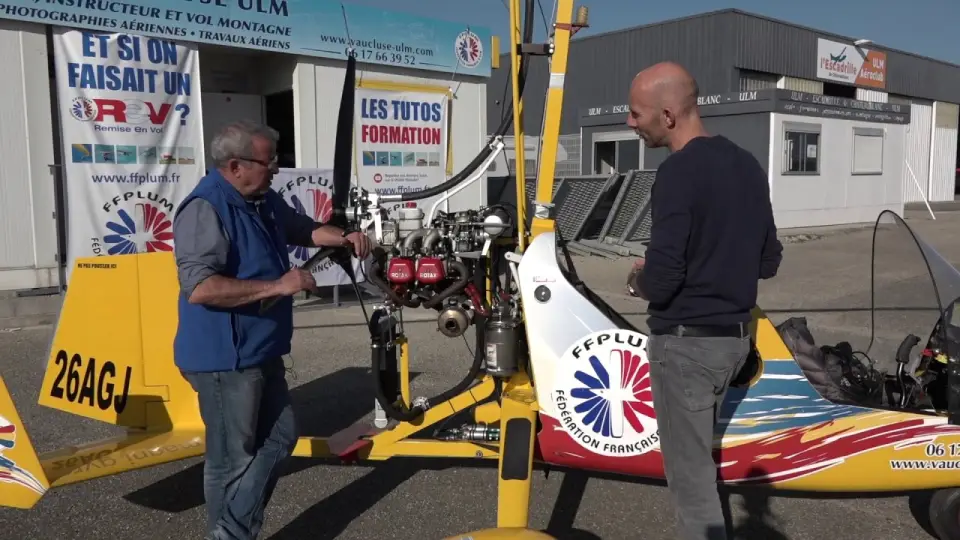
YouTube video: playing it loads it from YouTube (Google), which receives your IP address and sets its trackers. Your consent will apply to YouTube videos on this site for six months. Manage my cookies
Regulations 18
How is the maximum empty mass of a microlight calculated?
Masses are defined in paragraph 2 of the instruction of 21 February 2012 on microlights.
An Annex: notions of mass for microlights sets out the notions of empty mass, reference empty mass, maximum empty mass and maximum mass.
In addition, a document, "Notion of microlight mass", can help you understand the definitions of mass.
Where can I find the lists of approved radio transmitting equipment and approved maintenance workshops?
The list of radio transmitters approved by the DGAC is on the OSAC website.
You can get the address of the approved maintenance workshop nearest to your home by contacting the OSAC for your area.
I would like to fit a rescue parachute to my microlight. Can I increase my microlight's maximum mass?
Adding a rescue parachute to a microlight is authorised as a major modification; it does not automatically increase the aircraft's maximum mass.
An increase of 5% in maximum mass, matching the extra mass added by the parachute and its installation and release system, is allowed provided it is backed by a compliance demonstration programme.
The maximum mass is the limit mass at which the structural strength of every microlight has been tested. Increasing it requires strength tests and calculations.
That is why, before considering fitting a rescue parachute and increasing the maximum mass yourself, it may be worth bearing in mind that alternatives exist, subject of course to the clear, mutual acceptance of the prior conditions agreed between you and the manufacturer:
- if the rescue parachute is provided for by your microlight's manufacturer, you can ask them for the identification sheet corresponding to your microlight type with a rescue parachute (in this case the necessary tests have been carried out by the manufacturer).
- if the rescue parachute is not provided for by the manufacturer, you can try to encourage them to apply for an identification sheet corresponding to your microlight type with a rescue parachute
- if they refuse, you can ask them for advice, or obtain from them the documentation that will, in particular, allow you to settle any doubt about the microlight's strength.
If the manufacturer no longer exists, it will be up to you to demonstrate compliance with the airworthiness conditions set by the minister responsible for civil aviation, within the meaning of point 7 of the instruction of 21 February 2012 on microlights.
With my microlight identified in France, can I fly in Europe outside France?
There is no European regulation for microlights.
Before any departure abroad, you must check with the civil aviation representative of the country you wish to fly over.
For more information, see the page "Flying abroad"
I own a microlight identified in Europe (outside France). Can I fly in France?
The Order of 7 January 2015 on the conditions for European ultralight motorised aircraft to travel over French territory allows certain microlights and their pilots, whose criteria are specified, subject to conditions and limits of use, to fly over national territory for leisure activities without first applying to the French authority to validate their airworthiness document and pilot qualification.
France requires a flight plan to be filed to cross borders, even with Schengen countries.
Filing a flight plan to cross a border is not a French peculiarity; on the contrary, it is an ICAO rule, and so a worldwide one. When SERA was adopted, Europe did not notify ICAO of any difference on this point, and France chose to keep the requirement, like many European countries (SERA 4001.b.5).
Contrary to a widely held belief, the Schengen agreements do not abolish borders, they only make crossing them easier. In practice, this means you can take off from a microlight airfield and land at another microlight airfield in another country, without having to go through a customs aerodrome as you once did.
I have lost my microlight's card or identification sheet. Can I fly without my papers?
On every flight you must have with you the microlight's card and identification sheet and the Aircraft Station Licence (LSA) if the microlight has an on-board radio installation (Conditions of use of civil aircraft in general aviation).
If you have lost one of these documents, see the related administrative procedure to obtain a duplicate.
What are the 6 classes of microlight?
The definition of the microlight classes is found in the Order of 23 September 1998 on ultralight motorised aircraft (article 2)
Class 1 - (known as paramotor)
A paramotor microlight is a single-engine aircraft supported by a flexible, parachute-type wing. It meets the following technical conditions:
- Maximum power is no more than 60 kW for a single-seater and 75 kW for a two-seater;
- maximum mass is no more than 300 kg for a single-seater and 450 kg for a two-seater.
Class 2 - (known as weight-shift)
A weight-shift microlight is a single-engine aircraft supported by a rigid wing, generally with a motorised trike hung beneath it.
Class 3 - (known as three-axis)
A three-axis microlight is a single-engine aircraft supported by a fixed wing.
A class 2 or class 3 microlight (weight-shift or three-axis) meets the following technical conditions:
- maximum power is no more than 60 kW for a single-seater and 75 kW for a two-seater;
- maximum mass is no more than 300 kg for a single-seater and 450 kg for a two-seater; these masses may be increased by 5% for a microlight fitted with a rescue parachute, or by 10% for a floatplane microlight. The parachute and its installation meet technical conditions set by the minister responsible for civil aviation;
- the minimum steady flight speed in landing configuration does not exceed 35 knots (65 km/h) in calibrated airspeed (Vc).
Class 4 - (known as ultralight gyroplane).
An ultralight gyroplane meets the following technical conditions:
- maximum power is no more than 75 kW for a single-seater and 90 kW for a two-seater;
- maximum mass is no more than 300 kg for a single-seater and 450 kg for a two-seater; these masses may be increased by 5% for a gyroplane fitted with a rescue parachute;
- disc loading at maximum mass is between 4,5 and 12 kg per m2.
Class 5 - (known as ultralight dirigible aerostat).
An ultralight dirigible aerostat meets the following technical conditions:
- maximum power is less than 75 kW for a single-seater and 90 kW for a two-seater;
- for a multi-engine aircraft these figures are the combined power;
- the volume of the helium envelope is no more than 900 m3;
- the volume of the hot-air envelope is no more than 2000 m3.
Class 6 (known as "ultralight helicopter")
An ultralight helicopter meets the following technical conditions:
- single-engine, with maximum power of no more than 80 kW for a single-seater and 100 kW for a two-seater;
- maximum mass is no more than 300 kg for a single-seater and 450 kg for a two-seater; these masses may be increased by 10% for a floatplane microlight;
- disc loading at maximum mass is between 8 and 20 kg per m².
Sub-classes 1A, 2A and 3A of classes 1, 2 or 3 (known as auxiliary-powered).
An auxiliary-powered microlight meets the following technical conditions:
- the number of seats is one;
- maximum power is no more than 30 kW;
- maximum mass is no more than 170 kg;
- wing loading at maximum mass is less than 30 kg/m².
YouTube video: playing it loads it from YouTube (Google), which receives your IP address and sets its trackers. Your consent will apply to YouTube videos on this site for six months. Manage my cookies
Can I carry out a special activity with my microlight if its identification sheet does not mention that option?
Special activities means all those listed in the order of 24 July 1991 on the conditions of use of civil aircraft in general aviation (chapter III, special activities)
On your microlight's identification sheet, the special activity shows that the manufacturer has provided a specific option for it (for example: a tripod to mount a camera).
Listing a special activity changes the last letter of the microlight's identification code (L leisure, E leisure and special activities, T special activity).
The special activities provided for are identified as follows:
EA: agricultural spraying,
LP: parachutist dropping,
LC: load dropping,
TC: sling-load transport,
HL: hoist operations,
RB: banner towing,
LI: firefighting,
OA: aerial surveys, photography, observation and surveillance requiring specific equipment,
AU: any other activity requiring a derogation from general air traffic rules, as well as training for these activities.
If you are the builder of a one-off microlight and want to fit it with a particular device, and the identification sheet does not provide for that special activity, you will have to declare a major modification.
To carry out a special activity with a microlight, three conditions must be met:
- The pilot must hold a DNC (declaration of competence level) for the activities planned.
- File a special activities manual (MAP)
- Obtain any overflight derogations (aerial photography...) or low-flying derogations (spraying...).
To get information about these conditions (MAP, DNC, ...), contact the local DGAC office.
What is the definition of the home base?
It is a place in French territory, defined by the applicant, where the microlight is mostly kept: a hangar, airfield, microlight strip, aerodrome or, possibly, the owner's home address.
I have a question about the microlight pilot certificate
For any question about certificates, you can contact the licensing office for your region.
Can I convert my amateur-built aircraft (CNRA) to a microlight?
Converting a CNRA to a microlight is possible provided the aircraft meets all the technical conditions that apply to microlights, in particular the mass limits.
The CNRA aircraft must have been removed from the register of registrations before any identification as a microlight.
NB: converting a microlight back to a CNRA is not possible.
How do I declare a modification to my microlight?
A distinction must be made between a major modification and a minor one.
You are making a major modification when you change an item on the identification sheet or on the reference form in the microlight's technical file. The certificate of conformity after a major modification updates the microlight's definition while keeping its identification code (making airworthiness follow-up easier). You must follow the procedure indicated.
Example: changing the propeller.
Anything other than the items on the identification sheet is a minor modification under article 10 of the order of 23 September 1998 on microlights. A minor modification must be recorded in the usage file.
Example: cutting an access hatch in the canopy, re-covering the fabric.
I would like to buy a microlight abroad. Can I get an identification card in France?
Production microlight: To obtain an identification card for a microlight bought abroad, you will have to provide the microlight's identification sheet issued by the DGAC-France.
You can get this identification sheet from the manufacturer or its French representative, who will certify that your microlight conforms to the technical file covered by that identification sheet.
If your microlight's manufacturer no longer exists, you will not be able to identify your microlight in France.
One-off microlight: The microlight you want to buy abroad was built by an individual. It cannot be identified in France because you are not the builder and cannot prove that the microlight's compliance demonstration programme was actually carried out (article 7 of the instruction of 21 February 2012 on microlights).
A foreign builder can apply for provisional identification in order to put together the technical file for a microlight. Once they have attested that their microlight conforms to the regulatory texts, they can apply for an identification sheet and card to be issued for your microlight.
Where can I find the procedures and forms for mortgaging microlights?
Aircraft are subject to the rules on registration and entry in the registers kept by the DGAC, which then allow a mortgage as on a property (application of articles L. 122-1 et seq. of the Civil Aviation Code)
However, the provisions of Title II of the Civil Aviation Code on the registration, nationality and ownership of aircraft do not apply to microlights.
Article R.133-1-2 provides that certain aircraft, including non-motorised or low-powered single-seat or two-seat aircraft, may be subject to special provisions on their design, conditions of use or the abilities of the people who use them.
The order of 23 September 1998 on microlights sets the special provisions these aircraft must meet to be exempt from the requirement to hold an airworthiness document valid for air traffic.
The microlight identification card is a flight authorisation issued in an applicant's name on the strength of their declarations, and does not have the value of a certificate of registration, an individual certificate of airworthiness or a permit to fly, the only documents acceptable for registration, as provided by article D.121-3 of the Civil Aviation Code.
There is therefore no legal basis for entering this type of aircraft in the register of registrations and, consequently, for taking mortgages on it.
Buying or selling your microlight, applying for or renewing an LSA (Aircraft Station Licence)
All the procedures can be found on the DGAC website https://www.ecologie.gouv.fr/ulm-demarches-particuliers. On that page you can also download the forms to fill in and send to the DGAC.
You can get the address to send your file to from the page "DGAC office contact details " in the left-hand column of the site https://monespaceulm.aviation-civile.gouv.fr.
Renewing your microlight's airworthiness declaration
This is done through the DGAC website https://monespaceulm.aviation-civile.gouv.fr. Once logged in, you can declare your microlight's airworthiness and download the certificate that must accompany your aircraft's identification card (the yellow card).
If you have trouble logging in, contact the DGAC directly. The contact details can be found by clicking on " DGAC office contact details " in the left-hand column.
How do I get a CIME card?
At some airports, people who need to enter certain parts of the aerodrome unaccompanied must hold a Crew Member Identification Card (CIME).
For more details, see https://ffplum.fr/actualites/2023/mise-a-jour-de-la-reglementation-la-carte-cime-devient-obligatoire
The CIME card is issued to microlight pilots who are AOPA members (membership is 50% cheaper for FFPLUM members) and who apply, with justification, on the site https://www.aopa.fr/demande-de-carte-cime/
Training 3
I am a microlight pilot. Do I have to retake the theory exam if I want to be qualified in a new class?
No. A new class does not mean a second microlight pilot certificate, but an extension of the qualification on your existing certificate.
What are the conditions for being exempt from the microlight "Common core" theory exam?
Candidates who meet one of the following conditions hold the common microlight pilot theory certificate by equivalence:
1. Hold a valid aeroplane or helicopter pilot licence issued in accordance with Annex I, Part FCL, of Commission Regulation (EU) No 1178/2011 of 3 November 2011 laying down technical requirements and administrative procedures related to civil aviation aircrew pursuant to Regulation (EC) No 216/2008 of the European Parliament and of the Council, or a theory exam pass certificate less than 24 months old for the issue of one of these licences;
2. Hold a valid aeroplane or helicopter pilot licence issued by a State party to the Agreement on the European Economic Area, by Switzerland or by the United Kingdom, in accordance with the standards of the Convention on International Civil Aviation of 7 December 1944 referred to above.
If I get more than 90% correct answers in the "pilot" theory exam, can I use it to become an instructor?
No. If you choose to register as a pilot, you will have to retake the exam if you want to become an instructor later.
If you choose to register as an instructor, you will automatically fail if your result is below 90% correct answers. The "Pilot" theory will not be credited to you even if you score between 75% and 90% correct answers.
The BIA 13
What is the BIA?
How, when and where do you take the BIA?
The BIA is a National Education diploma, and the exam is a multiple-choice paper. It is generally held on a Wednesday in May. It is organised under the responsibility of each education authority (académie). The BIA gives access to grants from the various aeronautical federations of the CNFAS, which includes the French Microlight Federation.
The BIA is an introduction to the scientific and technical culture of aeronautics and space, and the best way in to discover all the richness of this world, where passion, technique, achievement, rigour, innovation and history meet. (link to BIA order)
The BIA lets you showcase and discover a whole range of knowledge and practices
The BIA also gives access to support for learning to fly through the aeronautical federations that are members of the CNFAS.
It is also useful on a CV for careers in aviation
How do you prepare for the BIA?
The BIA can be prepared for at school, during or outside school hours. To do so, contact the CIRAS (Comité d’Initiation à la Recherche Aéronautique et Spatiale) in your académie.
It can be prepared for through an aero club of a federation that is a member of the CNFAS.
It can also be taken as an independent candidate.
How old do you have to be?
There is no age limit for taking the BIA!
However, the BIA requires some knowledge of mathematics and physics at the level of the French troisième (age 14-15). The main audience is often in Seconde (age 15-16).
The federations offer help to young BIA holders to train as pilots; this help stops at the age of 25 or 21 (for the FFA).
In France you can hold a pilot certificate (aeroplane, microlight, glider, helicopter, parachutist) from the age of 15.
How long does it take to prepare for the BIA?
As a guide, it takes about forty hours to work through the BIA syllabus for an audience at introductory level.
What career opportunities are there in the aerospace sector?
There are many, whatever your qualification and level of study. To appreciate the variety of possible jobs: www.airemploi.org
Does the BIA let you fly?
The BIA is an exam and preparing for it is above all theoretical. But the technical field of aeronautics and space never separates theory from practice. Though not systematic, discovering flight through introductory flights can be part of BIA training.
Once you have the BIA, all the federations encourage pilot training with grants.
So the BIA is a very good way to get into flying!
What are the different types of flying?
Under the word flying we can group a great many activities. Of course everyone thinks of the aeroplane, but is it so simple to define? What does a fighter jet have in common with an airliner or a leisure aircraft? What about helicopters? Gliders? Free flying in paragliders, kites or hang gliders? What about balloons, and the host of drones appearing in different forms?
In short, the world of aeronautics and space is above all rich in the diversity of its activities, all linked by a shared history and shared laws that we need to try to understand.
That is the whole point of an aeronautical and space culture.
What is the CAEA for?
The CAEA, the Certificate of Aptitude for Teaching Aeronautics, qualifies you to teach the BIA in a school setting. This does not prevent a teacher or an outside person without the CAEA, with the head teacher's permission, from teaching within the BIA, provided it is done under the responsibility of a CAEA holder.
How do you set up introductory flights?
The BIA National Agreement offers a model agreement between a school and an aviation body that is a member of the CNFAS.
How do you set up a BIA course in a school?
There is no standard example for setting up BIA teaching, and as much flexibility as possible should be kept in how it is run.
Is flying dangerous?
From myth to our modern perceptions, whatever flies seems sensational. Human flight is not natural, it came late and it defies our instincts. Aviation is therefore always spectacular and accidents stay in the mind. Yet aviation is the safest means of transport, one that systematically takes safety requirements into account. People often remember only the tragedy in the myth of Icarus, but it is important to understand that Daedalus, Icarus's father, did fly, and that the accident was due to a failure to respect the flight parameters. This myth, even as a metaphor, invites us to take aeronautics and space for what they truly are: a sensational and fully rational technique.
What is a CIRAS?
A coordination group is set up in each académie (regional education authority). It is under the authority of the rector. This working group, called the CIRAS (regional committee for introduction to aeronautics and space), develops and coordinates activities introducing aeronautical and space science and technology culture.
It encourages and supports the development of teaching that prepares for the aeronautical initiation certificate (BIA) for the benefit of pupils, and for the certificate of aptitude for teaching aeronautics (CAEA).
The CIRAS is made up of:
- the rector or their representative;
- the academic coordinator for the CIRAS;
- a regional representative of the DGAC;
- a trainer from the académie holding the CAEA, appointed by the rector;
- up to four representatives of the presidents of the regional committees of the aeronautical and sports federations.
The CIRAS may occasionally call on anyone with expertise in one or more areas of aeronautical and space science and technology.
What is the CNFAS?
The Council National des Fédérations Aéronautiques et Sportives (National Council of Aeronautical and Sports Federations) brings together the nine French aeronautical federations, with around 150 000 participants.
Radio 4
Can a microlight pilot take the FCL055?
In France, using a radio is not compulsory in microlighting, and the FCL055 is not compulsory either.
Microlight pilots can perfectly well take the FCL055, which is attached to the person and not to the licence. For more information, see the website
https://www.ecologique-solidaire.gouv.fr/controle-competence-linguistique-fcl055
This exam will not be entered on the pilot certificate. On request, the candidate receives a statement of the language proficiency level achieved.
Do you need the FCL055 to go to a neighbouring foreign country?
Not necessarily, unless you are flying there. If you take your microlight there on a trailer and fly from strips where radio use is not compulsory, staying out of airspace classes A, B, C or D, TMZ and RMZ, you will not need to use the radio. If you fly there, however, you will cross a border. You will therefore have to make radio contact with a flight information centre in the language of the country or in English. You will need a 8.33 radio (European standard since 1st January 2018) and the FCL055. The radio rating on your microlight pilot certificate is valid only in France and for communications in French.
8.33 frequencies
The DGAC is gradually extending the 8.33 frequency plan to the whole of mainland France. To this end, aeronautical information circular (AIC) 03/2018, available on the SIA website, states:
- From 1 September 2018: access to class A, C and D airspace is restricted to aircraft fitted with a 8,33 radio.
- From 1 January 2021: any aircraft with a radio must be fitted with a 8,33 radio.
Frequency changes for air traffic organisations will be announced by NOTAM. To contact an organisation on a 8.33 frequency, a 8.33 radio is required.
Warning: many European countries have been on the 8.33 standard since 1st January 2018. If you want to fly over one of these countries, find out before you leave.
Using an unassigned radio frequency or unapproved equipment
Aeronautical frequencies are managed (and assigned) by the DGAC. Using a frequency not assigned to you, or unapproved equipment, can interfere with frequencies other than the one you are using and endanger safety.
The Code of Postal and Electronic Communications provides, in particular in its article L39-4:
The following is punishable by six months' imprisonment and a fine of €30 000:
2° Disrupting, by using a radio frequency, equipment or installation in a way that does not comply with the provisions of article L. 34-9, or without holding the authorisation provided for in article L. 41-1, or outside the general regulatory conditions provided for in article L. 33-3, the radio transmissions of an authorised service, without prejudice to the application of article 78 of law no. 86-1067 of 30 September 1986 on freedom of communication;
3° Using a radio frequency, equipment or installation in a way that does not comply with the provisions of article L. 34-9, or without holding the authorisation provided for in article L. 41-1, or outside the general regulatory conditions provided for in article L. 33-3;
In addition, the call-out costs caused by using a radio frequency or installation without authorisation where one is required, or outside the legal and regulatory conditions, having caused or being likely to cause interference with a duly assigned frequency, give rise to payment of a flat-rate charge of €450 per call-out. This charge is payable by the person responsible. (art. 45 II of finance law no. 86-1317 for 1987, as amended).
Alongside these criminal provisions, the pilot may also face administrative disciplinary proceedings, which could result in suspension or withdrawal of their licence.
Return to Flying (REV) 6
Why REV?
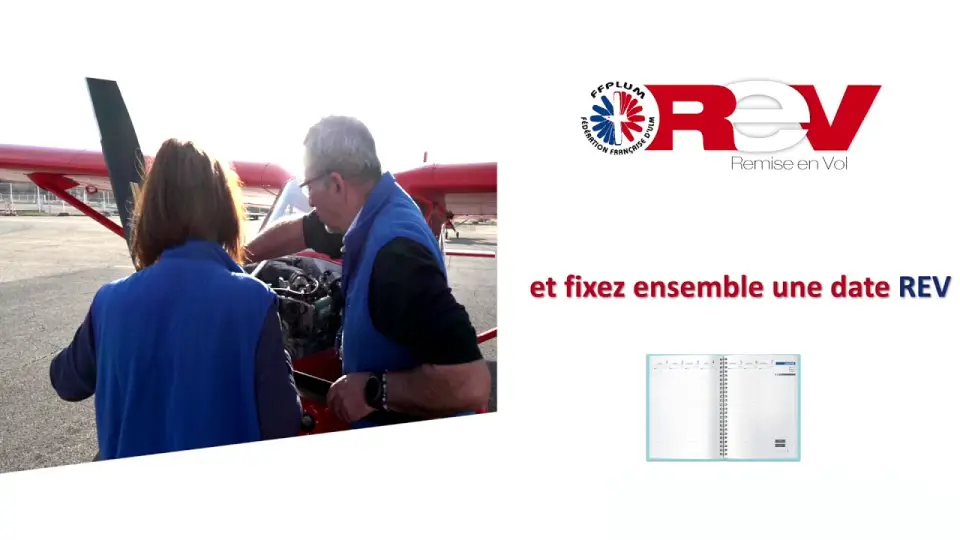
The Return to Flying scheme puts a qualified pilot in touch with an instructor to go back over the safety exercises you do not practise regularly (such as engine failure on take-off, for example), which will make your flights safer. It lets you take stock of your skills by working through these exercises, which tend not to be repeated enough.
It also gives you a fresh opinion on your aircraft.
Who is REV for?
The REV scheme is for any qualified pilot who holds a licence with the French Microlight Federation. The instructor must be affiliated to the FFPLUM.
A federal grant of €60 is paid to pilots who have completed the REV programme.
What are the administrative steps?
To register and receive the €60 bonus, several conditions must be met:
There are 4 conditions for doing your REV as a pilot:
- Be a federation member for the current season
- Hold a certificate and have declared it in your Member area
- Only one REV per pilot per year.
- Providing your bank details in your Member area.
YouTube video: playing it loads it from YouTube (Google), which receives your IP address and sets its trackers. Your consent will apply to YouTube videos on this site for six months. Manage my cookies
What does a Return to Flying involve?
A specific programme has been set up for each class for Return to Flying
REV programme, class 1 - Paramotor
REV programme, class 2 - Weight-shift
REV programme, class 3 - Three-axis
Who chooses the instructor?
The pilot chooses the instructor and negotiates the fees freely with them. The instructor must be affiliated to the FFPLUM.
Return to Flying figures
Since the scheme was introduced in 2018, more than 4500 Returns to Flying have been completed.
Class 1: paramotor 4
Can I identify my paraglider wing to use it as a paramotor?
To identify a paraglider wing and use it as a paramotor, there are two possibilities:
- For production wings, approved and registered with the DGAC by their manufacturer, the manufacturer must give you the production identification sheet and a certificate of conformity when you buy the wing, with the essential references. If the manufacturer has not filed a file with the DGAC and refuses to do so => there is no solution => so it is impossible to identify the wing.
- As an amateur builder, only for orphan wings (wings no longer in production on the day of identification). By derogation from the requirement for a production sheet for any series-built microlight, a class 1 microlight can be classed as "one-off" if the wing was no longer in production on 23 September 2011.
See the DGAC website for more details: https://www.ecologique-solidaire.gouv.fr/ulm-demarches-particuliers
Return to Flying for a paramotor wing
Here are a few tips for getting your paramotor wing flying again properly.
In any case, these points should be repeated regularly throughout the season
Reminder:
A wing must always be stored in a place away from any heat source (boiler),
- away from a source of damp (tap or damp floor)
- above all out of the sun
- if possible in a slightly ventilated place
Best of all, not on the floor but on a shelf
1/ visual and tactile check of the line cone
- Mould on the risers
- Quick links properly closed and not rusty
- Check the stitching of the lines
- Run each line between your thumb and your middle and index fingers to check there is no roughness or sheath slipping on a line
=>if there is a problem on any of these 3 points, do not fly, as it indicates either a problem with how the wing was stored or an incident that was not noticed before storage
2/ visual and tactile check of the wing fabric and cells
- Mould on the stitching or fabric
- Stains on the fabric
- Stitching of the line attachment tabs and the brakes
=>if there is a problem on any of these 3 points, do not fly, as it indicates either a problem with how the wing was stored or an incident that was not noticed before storage
3/ check of the knots and the symmetry of the lengths of the brake lines
In all cases it is advisable to have your wing checked every year by an approved workshop
This makes it possible to check:
- the symmetry and trim of the lines
- the strength of the wing fabric and the lines
- the condition of the stitching
Always inflate the wing before the 1st flight
Towing a trike?
The question of hitching a paramotor (or weight-shift) trike directly behind a vehicle and taking to the road is often asked. It seemed possible if the trike has a number plate with the regulation lights. Didier Eymin, of the Paramotor Committee, asked the Gendarmerie Nationale: the problem lies with the tyres, which must be certified with load and speed ratings, which is not the case on microlight trikes. To tow them, you therefore need to use a trailer or temporarily fit the trike with wheels with approved tyres.
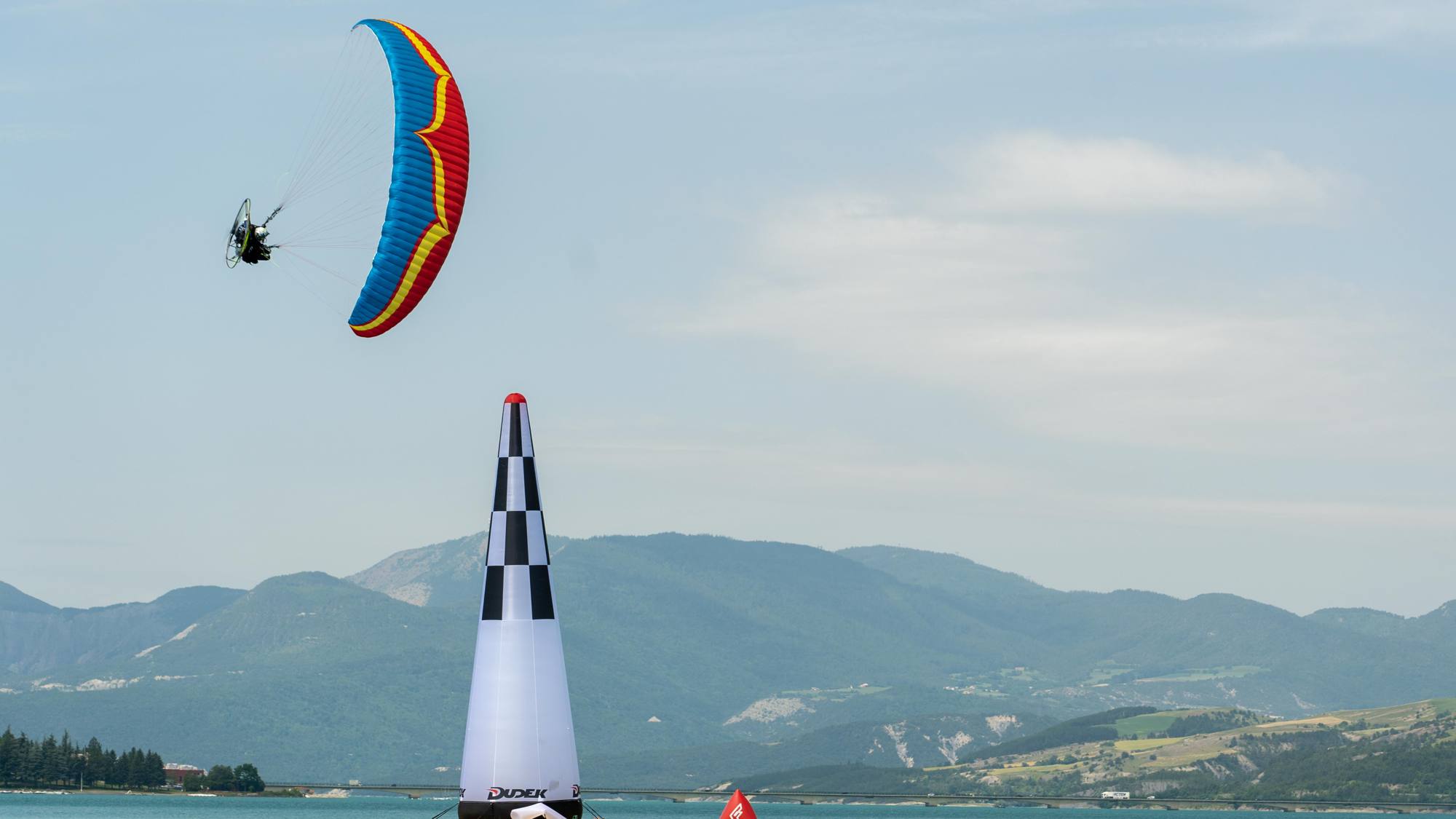
What is Paramotor Slalom?
It means flying, always over water, various timed courses between inflated pylons.
The pylons can be either 8 metres or 12 metres high.
There is always a safety boat ready to step in quickly if someone falls in the water.
Within these courses there may be barefoot events as well as wingtip touch-downs on the water at 360°.
The overall ranking is made by adding up the different rounds.
Alongside these slalom rounds, the competition can be scored on Landing Precision rounds, which involve knocking over bowling pins.
There are 3 categories:
- Single-seat men's foot-launched: PF1m
- Single-seat women's foot-launched: PF1f
- Single-seat trike take-off: PL1
Wing speeds can reach 70 km/h.
To sum up, Paramotor Slalom is geared towards speed and precision.
No question matches this search.
Another question?
The federation answers you
Federation office
A question on this subject?
The federation office answers members, clubs and schools, and the press. The easiest way is the contact form.
They support the federation
All our partners








