






Editorial - BSV no.48
 Smooth flying: knowing how to manage transitions
Whatever the phase of flight, the search for aerodynamic balance is paramount and ensures a flight with stable parameters, a guarantee of safety.
Without sending you back to your flying manuals, it is interesting to find in the pages devoted to the aerodynamics of flight the equations that demonstrate the laws of balance of forces in climb, level flight and descent.
So, while managing the flight path of one's microlight, once it is stabilised, requires few resources and is well done by the great majority of pilots, the same is not true of flying the transitional phases, which are by nature unstable because one breaks one equilibrium to find another.
Indeed, while during training the instructor insists on level flight and holding altitude, the climb and holding speed, and the descent with a stable vario compatible with the adaptability of our ears, it is also essential to explain and show clearly that moving from one state of flight to another is a real flight safety issue at a time when losses of control in flight are multiplying with fatal consequences for the pilot.
That is why, whether you go from straight flight to a turn, from taxiing to take-off, from take-off to climb, from climb to cruise, from cruise to descent, from descent to approach, from approach to final, from final to flare, from flare to taxiing or any other compatible combination, you must always manage the imbalance you have created, by adopting smooth flying, that is, flying that minimises the load factor, large bank angles or high pitch attitudes and abrupt changes of engine speed.
So big blasts of throttle must be avoided: they will strongly destabilise the microlight, add the difficult management of engine effects to the aerodynamic imbalance, and make the return to the new desired equilibrium longer and more delicate.
Likewise, no large rapid bank angles or overly abrupt pitch changes to enter a turn or a climb.
Do not forget that it takes time for the air particle that was gliding quietly over your wing or rotor profile, and which you disturb by wanting to change trajectory, to regain a laminar flow and stick to the profile.
When you manoeuvre or change flight path or configuration, remember not to rush these delicate air particles that ensure the balance of our flight and keep us aloft: adopt smooth flying!!!
Happy flying, I have just done a REV, how about you?

Eric Galvagno
Head of the Flight Safety Committee
The Analyst's analysis
 In October 2017, the BEA published its report on the accident involving the Dyn'Aero MCR01M microlight, registration 84-MP, which occurred on 12 August 2016 at the Col de Bacchus (26). The pilot was killed...
Training Corner
 Questioning ourselves
Questioning ourselves allows us to make progress in life. Those who never question themselves prevent themselves from discovering who they are and from...
Safety in Figures
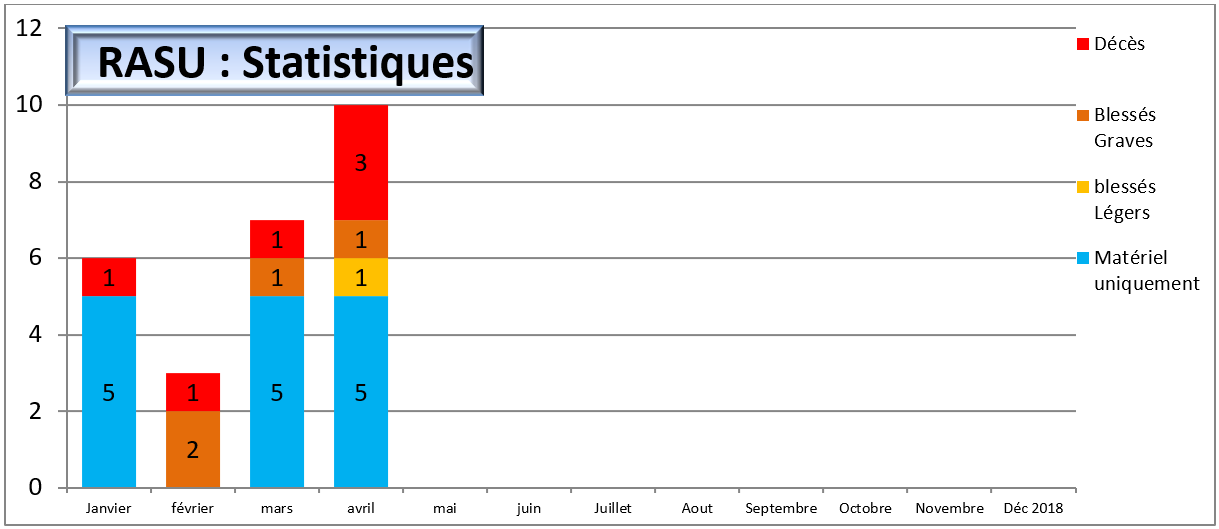
The table below summarises the accident statistics recorded from 1 January to 30 April 2018, ranking casualties by severity and distinguishing purely material-damage accidents...
What about doing a REV? > video guide
A question about the REV programme? > see our dedicated FAQ









