Winter: the risks of icing
By Louis Collardeau, FFPLUM vice-president · Mathieu Farcy, Training division
- −30 °Cpossible temperature drop inside a carburettor
- 30 °Ccarburettor icing possible from 30 °C, with 50 % relative humidity
- +5 to 21 °Cideal icing conditions, with 80 % relative humidity or more
- × 2the water vapour that air can absorb for each rise of 10 °C
The arrival of winter and the associated weather, with heavy precipitation, humidity and cold, are decisive factors that affect our flights. Here are 3 points to help you understand the arrival of winter and its consequences for your flights. There are two types of icing for light aviation: airframe icing and carburettor icing. The two phenomena must not be confused. The risk of icing affects every aircraft to varying degrees, whatever its size, type or how it has been prepared. Airframe icing can be a real danger after being parked on the ground in so-called winter conditions. On take-off as in flight, airframe icing can lead to loss of control of the aircraft. As for carburettor icing, it can occur in any season. Depending on the altitude or the region flown over, carburettor icing can lead to engine stoppage.
So a microlight pilot needs to pay attention not only to the general background knowledge on how icing appears, but also to the threats it poses.
Why does ice form?
Every carburettor behaves like a small refrigerating machine. The air drawn in expands and, for that reason, cools by a few degrees. On top of that, petrol needs heat to evaporate and takes it from the air it mixes with. The result is a considerable drop in temperature, of up to - 30°C. If humid air enters the carburettor, it can easily cool there to below zero and, at the same time, below the sublimation point of water vapour. These are the conditions required for ice to form.
This means you can get carburettor icing at outside air temperatures (OAT) of around + 25°C to + 30°C, or of course below. How intensely ice forms also depends on how much moisture is in the air. It is also worth knowing that the amount of water vapour an air mass can hold depends on its temperature: for every 10°C rise in an air mass, it can absorb roughly twice as much water vapour!
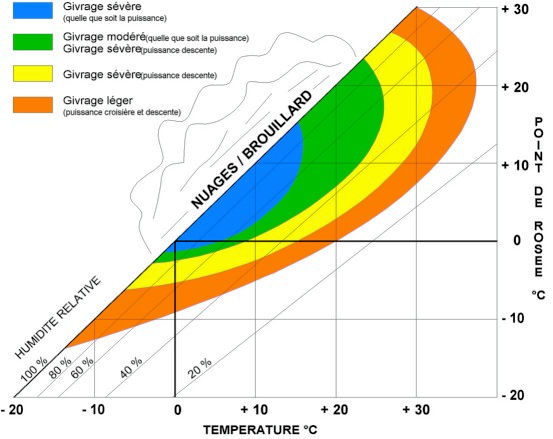
Carburettor icing can occur from a temperature of 30°C with a relative humidity of only 50 %. Ideal icing conditions exist when the outside temperature is between +5°C and 21°C with a relative humidity of around 80 % or more; the possibility of icing decreases from 0°C (OAT).
Your favourite instructor can remind you how to detect and deal with it!
Recognising the threat: what does it feel like?
Carburettor icing
Icing usually shows up as a slight increase in rpm. Very quickly, low-amplitude, harsh vibrations appear, then a loss of rpm or engine stoppage. You may notice a rise in exhaust gas temperature along with the loss of rpm.
A sharp drop in exhaust gas temperature is seen, with engine stoppage in the most severe cases. Ice formation always reduces the intake cross-section of the mixture, which is equivalent to closing the throttle. In other words, engine power will fall. The greatest build-up occurs near the throttle valve, where speed is highest. That is also why it forms most readily with the engine at idle, whether while taxiing, while waiting before take-off or during approaches.
If your microlight has carburettor heat, you should of course use it, anticipating icing and following the recommendations in your aircraft’s user manual.
To assess the carburettor icing risk level, use the chart below, according to temperature and dew point:
Airframe icing
Airframe icing can be found in icing conditions in VFR flight, particularly in areas of supercooled water during supercooling; this dangerous phenomenon significantly alters your aircraft’s aerodynamics, and the mass of ice on the airframe and wings is far from negligible.
In some cases, airframe icing can also cause the controls to stiffen or even jam, particularly after rain that has got into the controls and then froze. Airframe icing can also show up as ice building up on the propeller, causing vibrations and reduced thrust.
On the wing profile, whatever its structure, the accretion of frost / ice leads to:
- A reduced rate of climb;
- A reduced horizontal speed;
- An increased stall speed;
- A lower practical ceiling.
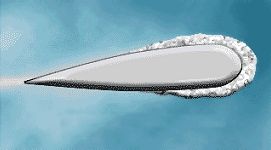
Reduced lift
- A reduction in Rz for a given angle of attack.
- A reduction in maximum Rz.
- A reduction in the angle of maximum Rz.
Increased drag
- An increase in Rx for a given angle of attack.
- An increase in Rx for a given Fz (the best glide ratio is obtained at low Rz)
The build-up of icy contaminants reduces the angle of attack at which the stall occurs. Ice accretion is rarely symmetrical on the two half-wings: this explains why a stall is often accompanied by an uncontrolled roll.
Preparing and deciding whether to fly
Your pre-flight check
It is not easy to carry out your pre-flight check in cold temperatures, sometimes in the wind, and dressing warmly is not enough. Take care in this case not to leave anything out (using a checklist is recommended) during this inspection, as any oversight or omission can have serious consequences. Interruptions to tasks must be avoided during the pre-flight check and you must stay focused.
YouTube video: playing it loads it from YouTube (Google), which receives your IP address and sets its trackers. Your consent will apply to YouTube videos on this site for six months. Manage my cookies
Starting and warming up your microlight’s engine
Your battery’s ability to cope with a cold-weather start is also essential, as is following the cold-weather start items on your checklist.
Letting your engine warm up is a mark of good practice and allows your aircraft’s engine to reach the right operating temperatures first.
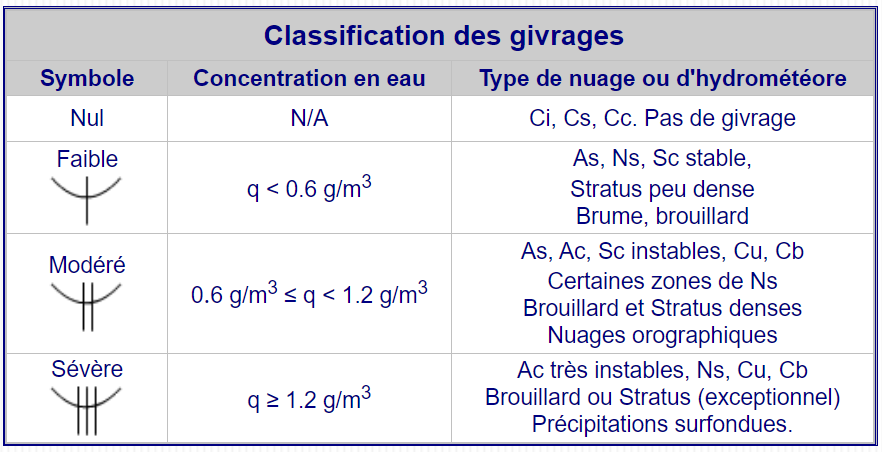
The weather and the length of daylight
There is a specific weather symbol on TEMSI charts to indicate the possibility of airframe icing. Good weather preparation before flying may spare you the worst!
Remember that icing remains likely even beneath a cloud layer, depending on its composition:
- Unstable congestus clouds Cb, Cu…
- Layer clouds Ns, St…
- Orographic icing
- Frontal icing
Gather the most recent data (Temsi, Wintemp, Metar, TAF, Sigmet) and only depart after a detailed analysis of the situation valid for the route and possible diversions, and at the planned times. If in doubt, seek the advice of a forecaster. When flying circuits, it is also advisable to check for any risk of conditions worsening! If conditions deteriorate, I turn back!
Every season has consequences for your flights that must not be overlooked, and winter is no exception. It is up to you, as a pilot, to use the tools at your disposal to:
Understand clearly: how you use your microlight, the weather conditions of the moment, and review your procedures.
Adapt your behaviour as a pilot to the situation, and be aware of the situation of your flight.
If you detect carburettor icing, quickly and smoothly push the throttle fully forward and lower the nose to increase speed to compensate for the loss of lift.
In all cases, speak to your instructor for more detailed explanations.
Happy flying!
Louis Collardeau - Vice President of FFPLUM
Mathieu Farcy - Training division
Read the Safety Memo