Skip to content
French Microlight Federation
Home
Flying Entry to the Flying section

Fly

What is microlighting?Where to fly?Licence and insuranceMedicalHandivolMechanics

Become a pilot

The pilot certificateMicrolight examTrainingTrial flight

Regulations

Regulatory documentsAirspacePlan your flightsAirfieldsOPS ULM — order of 17/02/25

Federation support

Support for young peopleThe BIAGrants
Instruction Entry to the Instruction section

Network

Clubs and schoolsInstructors

Instructors

Microlight instructor trainingList of instructors by départementKnowledge refresherThe teaching programmeTeaching and technical sheets
Sport
Safety Entry to the Safety section

Prevention

DirectivesParachutesFederation prevention

Safety reports

REX — submit and browseFlight Safety BulletinReturn to Flying (REV)ECCAIRSCSV flight safety officersList of REX reports

Alerts

Safety news

Files and quizzes

Good practice
News Entry to the News section

Read

Federation newsULM Info — the magazineClub life

Calendar

EventsSubmit an eventFederation events

Media

Documents to downloadPractical guides

Stay informed

Frequently asked questions
The Federation Entry to the Federation section

The institution

Elected membersThe divisionsRegional committeesThe DTNEthics and professional conductSafeguarding in microlightingThe federation in figuresOfficial textsGeneral Assembly

Federation events

The Youth Microlight Tour (Tour ULM Jeunes)Microlight World ChampionshipsFesti'ULM

Join us

RecruitmentContact
Report Member area Federation shop Site map 2026 Licence

SafetySafety file · Human factors

Forgetting, or the unconscious interruption of a conscious mental process

In aviation, an omission, a lapse or a diversion of attention by someone involved is sometimes the root cause of an accident or an unusual situation.

Safety file · Human factors

In aviation, an omission, an oversight or a lapse in attention by someone involved is sometimes the root cause of an accident or an unusual situation.

Forgetting, or the unconscious interruption of a conscious mental process

Safety file · Human factors2 min read

By Bernard Boudou

Follow-up to the article “In microlight maintenance, error is not inevitable” (ULM Info no. 120).

  • 1conscious, deliberate operation handled at a time by the brain
  • 12risky work situations illustrated by Transport Canada’s “The Dirty Dozen”
Follow-up to the article "In microlight maintenance, error is not inevitable" by Bernard Boudou (ULM Info 120)

In aviation, an omission, a lapse or a diversion of attention by someone involved is sometimes the root cause of an accident or an unusual situation.

Training in certain piloting actions makes it possible to move from a conscious, deliberate mode in the novice to an automatic mode as the person progresses. They can then handle information from several senses without particular effort. The pilot of a three-axis microlight can, for example, watch the attitude while controlling stick force and listening to radio communications (actions Α, Β and Γ in figure A). As experience builds, the pilot becomes free to carry out a new activity that demands mental capacity, such as switching fuel tanks (action Δ). What happens if, at that moment, something else demands their attention, such as a question from an air traffic controller (question ε)?
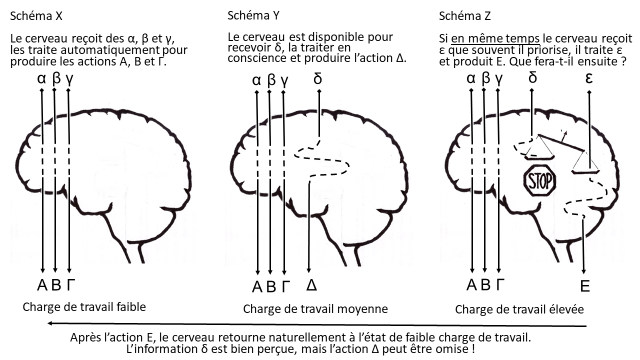
figure A

The brain can only handle one conscious, deliberate operation at any given moment. It must first interpret the additional element, then choose which treatment takes priority, and finally inhibit one operation in order to carry out the other. This inhibition mechanism uses energy to filter out irrelevant information and keep only what is needed for the chosen operation. Once the latter is finished (action Ε in figure A), how can you be sure to return to the previous one (information δ, action Δ)? This arises whenever the pilot feels saturated or distracted. To cope with such situations, several techniques are taught, even though in practice none is infallible. This subject is covered in detail in many books on human factors.

In the 1990s, Transport Canada published “The Dirty Dozen”, a series of posters illustrating twelve of the most common work situations that can lead to an accident. One of these posters was entitled “Distraction”. We reproduce it here. https://tc.canada.ca/en/aviation/general-operating-flight-rules/aviation-safety-poster-gallery
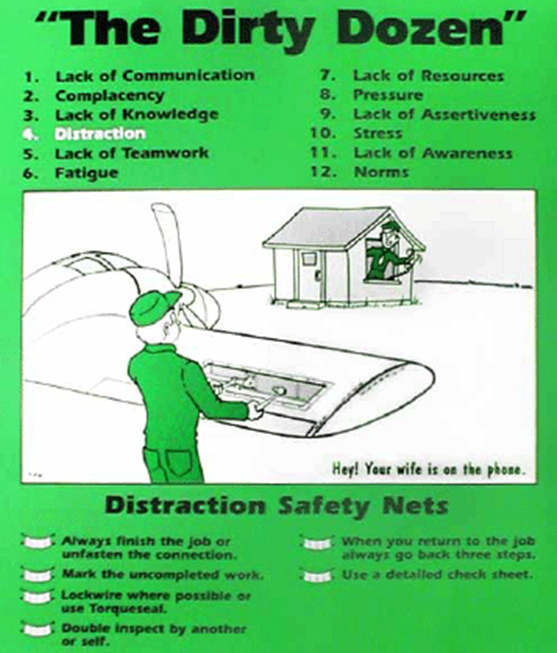
Figure B

Bernard BOUDOU

Federation office

A question on this subject?

The federation office answers members, clubs and schools, and the press. The easiest way is the contact form.

Contact us

They support the federation

All our partners
  • Ministry of Ecological Transition
  • DGAC
  • Ministry of Sport and the Olympic Games
  • National Sports Agency
  • CNFAS
  • FAI
  • Aéro-Club de France
  • CNOSF
  • EMF
  • Air and Space Museum