How can we make the sky safer for everyone?
By Louis Collardeau, 1st Vice-President of FFPLUM, President of the EMF
- 0–5 000 ftGSM coverage observed during the SafeSky trials, where the greatest collision risks lie
- 15 kmrange of direct communication between Flying Neurons units, even without GSM coverage
- 40 gfor the Flying Neurons unit, of 5 cm
In our Newsletter of 26 February 2021 we discussed the value of these new in-flight collision prevention devices that can be used on our aircraft to SEE and be SEEN better, so as to AVOID each other.
Let us make clear at the outset that the purpose of this equipment is in no way to replace the " See and Avoid" of the VFR flight concept; they simply, without any constraint or obligation, help improve safety by assisting pilots who wish to use them. On the one hand, they make you electronically "visible" and, on the other, they give you information on the position of aircraft in your immediate surroundings. Pilots can therefore look in the right direction, with, if needed, an alert (visual and audible) if trajectories converge and present a potential risk of collision, so that they can take avoiding action.
Several devices are currently available and we have tested a few of them to get a better idea of how they work in different flight situations: it works very well!
A particularly innovative solution has just arrived on 28 March 2021 from our microlight pilot friends in Belgium with the development of the SAFESKY application (https://www.safesky.app, downloadable directly and free of charge on your connected iOS or Android smartphones or tablets)
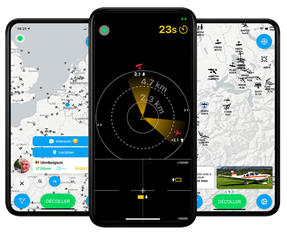
SAFESKY app
The value of this system is, first, that it needs only a simple smartphone, and second, that it is free in its basic version, which makes it accessible to any type of user whatever the aircraft. It is extremely simple to use: it turns your phone into a transmitter visible (3D GPS position) to all other users and vice versa, anonymously or not as you choose. Data are exchanged via the ground GSM network, and the many tests carried out showed excellent coverage between 0 and 5 000 ft, which is where the greatest collision risks lie.
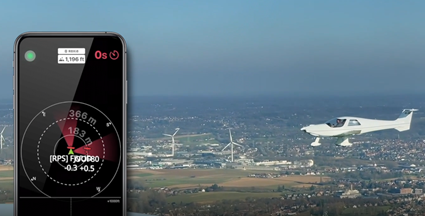
SAFESKY app
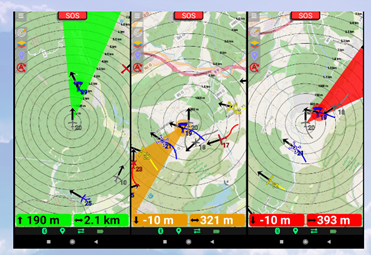
We also tested another particularly accomplished device, the FLYING NEURONS (https://www.flyingneurons.com) developed in the south of France. It is a very small high-tech unit (5 cm/40 g) fitted with a mini-antenna. It connects by Bluetooth to a smartphone using a dedicated application. In this solution, the units talk directly to each other up to 15 km, even without GSM coverage, as with FLARM. However, they can share data through the smartphone connected to the GSM network, which makes it possible to see and be seen by other systems. This device includes other particularly sophisticated features, such as 3D flight tracking in real time or in replay from a PC (very handy for training), and an SOS function that, at the touch of a button, sends a call to all units in flight nearby, automatically giving your position, together with a GSM message if there is GSM network coverage, which also makes it a distress beacon.
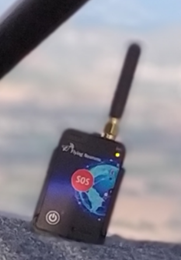
FLYING NEURONS device
Without being exhaustive, several other existing systems can also be mentioned: Power FLARM installed on most gliders, Funk Tm250, Paradar, Rosetta/Pilot Aware, SkyEcho, Stratux, Zaon…
The weakness, and the common point, of all these devices is that they do not talk to each other directly, which means that in general they do not see all the other aircraft in flight around them… so what is to be done?
In the absence of a universal standard to date (which will probably never come!), there is nonetheless a solution that some equipment has started to use: a platform that allows systems to be "interoperable" by sharing their position data. There is no need to invent it, then: this "open collaborative" platform already exists. It is OGN (Open Glider Network), originally developed for sharing FLARM data for gliders, which already integrates 5 other types of data. After talking to those in charge of OGN, they confirm that other shared data sources can be integrated, so that as many aircraft in flight as possible can be seen whichever system is used. Data exchanges "from" and "to" the OGN platform are carried out via the GSM network and/or dedicated antennas, depending on the equipment, so that pilots can see them in flight.
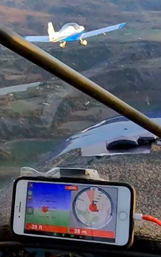
The FLYING NEURONS application in flight
The FFPLUM strongly encourages all developers of these systems to turn to OGN to pool their aircraft position data with mutual reciprocity. The achievable aim would be to have the best possible knowledge of as much traffic as possible in one's immediate surroundings through this data sharing.
As for transponders, you should know that in many countries, including France, only ADS-B out transponders can be seen in flight, because they broadcast their GPS position autonomously, which makes it possible to feed this information in real time to the collision prevention information systems described above.
However, general aviation and recreational aircraft are simply fitted with a Mode S transponder (and Mode C for the oldest), which cannot be seen by other aircraft (only air traffic controllers' radars know their position). But how can we be satisfied, when the technology would allow it at low cost, with not being able to see and use the position of Mode S transponder-equipped aircraft to prevent mid-air collisions? This remains a real difficulty that should be tackled quickly, in the name of safety and the general interest, by opening a discussion with our airspace managers, especially as these data exist.
Demonstration of the FLYING NEURONS device
EASA is showing itself particularly encouraging about the contribution of these devices to general aviation safety, stressing that the lack of certification for these devices stimulates innovation, through rapid development with the best technologies and very affordable costs.
In summary, we invite you to be curious enough to look at the websites presenting these very innovative solutions and above all to test them for yourselves; you will soon be convinced of how much they can bring you in terms of safety, by making the sky safer for everyone.
The more of us who use them, the better our collective safety will be. The risk of mid-air collision remains a major concern for everyone who practises every form of flying, so why do without a simple aid if it can prevent further accidents like the 2020 one that affected us all, the collision between an aeroplane and a microlight that claimed 4 lives? Which pilot has not been surprised one day by the proximity of another aircraft they had not seen?
Of course, no system, however sophisticated, will provide a solution that replaces the pilot's constant visual lookout; the pilot remains the sole master on board in their environment, because the sky is a shared space, including with birds. But there is no doubt that these devices can make the task of observation easier for us, by showing us the aircraft we have not seen and vice versa, because of a blind spot or difficult lighting, to warn us of a risk of collision in flight, without reducing our freedom.
Louis Collardeau
1st Vice-President of FFPLUM
President of the EMF
The devices tested by the federation
- SafeSkyApplication for smartphone or tablet (iOS, Android)Free in its basic version. Turns the phone into a transmitter visible to other users, anonymously or not; data exchanged via the GSM network.safesky.app
- Flying Neurons5 cm, 40 g unit linked to the smartphone by BluetoothThe units talk directly to each other up to 15 km, even without GSM coverage; 3D flight tracking and SOS function.flyingneurons.com
- OGN (Open Glider Network)Open collaborative platformDeveloped to share FLARM data from gliders, it already integrates 5 other types of data and can take in more.
Other systems mentioned: Power FLARM, Funk TM250, Paradar, Rosetta/Pilot Aware, SkyEcho, Stratux, Zaon.