






Editorials
News item of 27 March 2020. Last updated on 10 July 2020: some information may have changed. Latest news
Let's embark together!
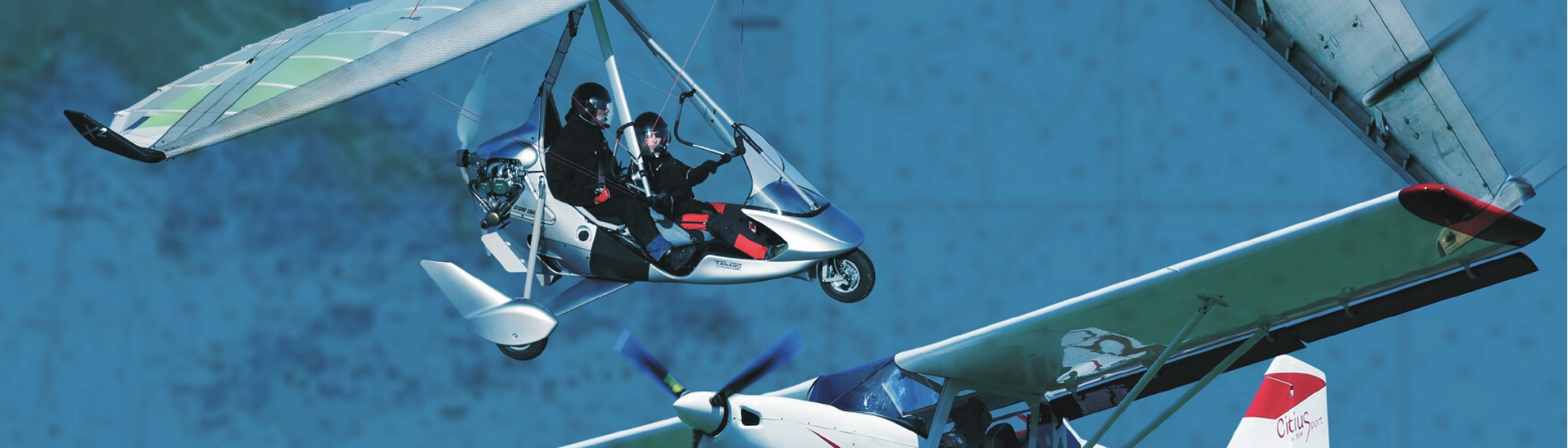
The French Navy and the French Microlight Federation have decided to form a partnership for young people. So that young people in the Navy, who are drawn to naval aviation, can broaden their aeronautical culture through the diversity and novelty of microlight practices. So that the young people of our federation can share the experience of the sailors of the sky. The values shared by the Navy and aviation are old and strong, both technically and humanly. As for microlighting, many of our machines use technologies from the world of the sea, and many of our pilots are passionate about both microlighting and the sea as a magnificent space of freedom, rigour and solidarity.
This partnership between the French Navy and the French Microlight Federation offers a fresh look at the great richness of careers in the Navy on the one hand, and, on the microlight side, a network of practices and personalities full of possible encounters. We need to take the time to discover each other and meet so that our young people find their path, sometimes outside the classic, expected routes. Guidance and personal choices are often a matter of encounters and passion. By joining forces, the Navy and the federation offer new opportunities to our young people, convinced that before know-how, it is personal qualities that allow people to flourish fully in a wide variety of skills. The values of the Navy and those of microlighting form a solid, complementary and structuring foundation for successful career guidance.
We really hope this partnership will last, notably with "sea-air classes" from 2021. To celebrate the agreement that goes with it, we are organising a friendly event with the team, full of energy and enthusiasm, at the Quiberon airfield.
Let's take off together!
Sébastien Perrot
President of FFPLUM
"Freedom is going to become the rule…"
With these words the Prime Minister yesterday announced phase 2 of the easing of lockdown. The CNFAS statement immediately spelled out the consequences for our activities:
From 2 June, all flights are possible, with no distance limit within France but no crossing of borders, in strict compliance with the health rules.
There will be a final phase in three weeks to take stock and adopt new measures. The health emergency now gives way to the social and economic emergency. This crisis will have terrible long-term effects. As we wrote at the very beginning of lockdown, it would be a mistake to neglect leisure activities in this context. A whole economy of clubs, companies, professionals, manufacturers and events is directly affected. The parachuting federation, for example, estimates the loss of activity for its organisations at a minimum of five million euros.
In concrete terms, the Ministry of Transport's aid to all the aeronautical federations is about two million euros a year. That is a very modest sum when set against aeronautical activity as a whole. For several years the federations have had to rely on other resources, and FFPLUM in particular has a low dependence on public money. But a drastic cut in an already tight context would have deep effects on the quality of training, on the level of safety, and on young people's access to our activities, who we know will be hard hit. It is even in this kind of crisis that the State has often pursued a recovery policy that could accelerate the necessary transitions.
As for the image of light aviation in public opinion, the activities grouped within the CNFAS have nothing to be ashamed of: free flight, electric flight, light modern combustion engines gradually replacing an ageing fleet, considerable efforts on noise; widely accessible and popular activities (think of the Coupe Icare). It is often the ageing of infrastructure (largely abandoned abruptly by the State) that conveys an outdated image of certain activities, but the modernity of our host sites is progressing thanks to local players.
The Secretary of State for Transport and trained pilot Jean Baptiste Djebbari has appointed MP Michaël Nogal to propose a recovery plan for aviation. It would be desirable that, like boating, which has a strong bond of solidarity with the merchant navy, "pleasure aviation" not be sidelined in certain decisions, because when we talk about the future, it is very often through our "leisure aviation" that vocations come and the world of tomorrow is built.
The federations' mobilisation continues so that freedom is increasingly the rule!
Have a good weekend
Happy flying!
Sébastien PERROT
President of FFPLUM

Making the restart a success!
The weekends and the fine days ahead mark the real resumption of flying in a quite particular context. If we want to regain a certain normality in the coming months, we have to get this right.
As we announced in the press release of Wednesday 13 May, from a legal standpoint the federation and its lawyer support you, provided you undertake flights that comply with our reading of the decree of 11 May, with our ethics for resuming flying and in particular:
- The health measures
- Local flying
- Excluding trial flights
Rest assured on this point. A protocol covering all transport may perhaps be published by then, but you must understand that it is a text of very general scope in which our activity is marginal. It is also understandable that in such an uncertain context there are publication delays or a lack of synchronisation. That has not stopped driving schools from reopening, or trains from running. So we should blame no one and think about what comes next, that is, after 2 June, being pragmatic and responsible, following the rules, and only the rules, as they are and as they apply. We will do so in a strategy agreed with the CNFAS.

Let's concentrate on the essential: "pleasure flying" for all pilots with our instructors, club managers and company managers. The federation is supporting you with a REV+ grant increased to €60 for a Return to Flying with an instructor. We have produced a whole range of materials to go back over our fundamentals of flying and mechanics. Organisations and instructors will receive headset ear covers ("bonnettes"), which were dispatched yesterday. We will adjust the quantity according to demand.
Since lockdown began, the whole federal team has communicated very intensively to defend and promote our activity as best it can. In this first phase of resumption, we will now communicate every 15 days on a regular basis, and whenever necessary if we have special information.
Take care. Enjoy yourselves, we need it, in strict compliance with the health rules, so that everyone's behaviour benefits everyone.
More than ever, it's simple! It's microlighting!
Sébastien PERROT
President of FFPLUM
FFPLUM PRESS RELEASE - Wednesday 13 May 2020
Dual flying for everyone's safety
Many of you... and quite rightly... have asked the federation whether dual flights have been possible since 11 May. The federation, together with the CNFAS, maintains that the resumption of flying, which is possible solo and is wanted by everyone as part of a careful and reasoned easing of lockdown, must absolutely be possible dual for obvious safety reasons.
The CNFAS has asked the DGAC for clarification of the authorities' strategy. With no reply to date, and while awaiting the planned texts on transport, everyone must take their own responsibility.
As the law currently stands, decree 2020-548 of 11 May 2020 states in annex 1: "Masks must be worn systematically by everyone whenever physical distancing rules cannot be guaranteed."
We therefore consider that dual flights are possible as part of the return to flying, and the federation will defend members, pilots, instructors, club presidents and organisation managers who might be challenged on this point, provided there is strict compliance with:
- The health measures (see Measures)
- Local flying
- Excluding trial flights at first.
You will find attached the opinion of the federation's lawyer, who commits to this position. The Board of Directors has approved this approach. The federation has set up the REV+ scheme to support the return to flying.
We must be pragmatic and responsible. We favour resuming dual flying and in law nothing forbids it, pending broader provisions which we will communicate immediately as soon as we have them.
Sébastien PERROT
President of FFPLUM
OPINION AND POSITION OF MAÎTRE CONTI FOR FFPLUM AND ITS MEMBERS
ON THE APPLICATION OF DECREE No. 2020-548 OF 11 MAY 2020 AND IN PARTICULAR ON THE LEGAL ABILITY TO FLY WITH TWO PEOPLE ON BOARD
It follows from the new decree No. 2020-548 of 11 May 2020 that, evidently, its provisions are intended mainly for the majority of our fellow citizens travelling by traditional road transport and public transport, with an exception for maritime navigation.
Nevertheless, it does apply to the aeronautical field and we must reason on the basis of its provisions, which need to be read and interpreted with a magnifying glass.
Now, a careful reading of article 1 paragraph 2 of the decree unquestionably yields a general rule and, alongside it, a particular alternative provision that applies beyond dispute to all aeronautical activity.
Let us recall the text of article 1 paragraph 2 of the decree of 11 May 2020:
"Gatherings, meetings, activities, receptions and travel, as well as the use of means of transport, which are not prohibited under this decree, shall be organised in strict compliance with these measures."
Now, these "measures" imply compliance with social distancing, including physical distancing of at least one metre between two people.
If one stops at the reading of this text alone, one must conclude that this measure applies to air transport carried out on board a microlight between two people, whether a leisure or professional flight, with or without an instructor, except for the exceptions listed in article 3 (professional activity and business travel, journeys between home and school, health consultations and specialist care, compelling family reasons, appearing before the police or gendarmerie, summonses from an administrative court or judicial authority, public-interest missions).
That is a reading - too hasty and incomplete - which some local authorities have made of this text.
It must therefore be stated that this conclusion is wrong.
Indeed, article 1 paragraph 1 of the decree of 11 May 2020 unquestionably contains an alternative exception to the general provision, expressly referring to its annex 1, which takes precedence over the general provision.
Article 1 paragraph 1 imposes physical distancing measures insofar as they refer to the provisions of annex 1 in these terms:
"In order to slow the spread of the virus, the hygiene measures set out in annex 1 …….. "
Now, annex 1 expressly provides that physical distancing rules may not be observed when they cannot be guaranteed, as this text states:
"[…….] Masks must be worn systematically by everyone whenever physical distancing rules cannot be guaranteed".
Failure to observe physical distancing, in certain cases, has therefore been provided for in law.
It must and should be concluded that any flight whose resumption the law has ordered without reservation, with two people on board (private/private, instructor/private), for which distancing rules cannot be observed and therefore cannot be guaranteed, may be undertaken, which then entails the obligation for both people on board to wear a mask throughout the flight.
This conclusion does not seem open to dispute to me and implies that any organisation and any aircraft owner, notably of microlights of any class, may undertake any flight with at least two people on board.
Naturally, the other provisions of the decree of 11 May 2020 remain applicable, notably those setting limits on travel within the legal radius of 100 km.
Consequently, both the federation and the author of this opinion can only encourage, without reservation, all members of our movement to undertake flights in line with the requirements set out here and, of course, in compliance with the other legal provisions. They will be backed by their federation in all circumstances.
Note written in PARIS, on 13 May 2020
Serge CONTI
FFPLUM lawyer
Clarifications on the gradual easing of lockdown.
A good number of you in the départements provisionally marked red reacted to the federation's recommendations in the last newsletter. We would like to give the following clarifications:
- First of all, as we said, the legal framework is still not known, and it is normally from 7 May that we will know exactly what conditions apply in the départements concerned.
- In law, and as the texts stand, things will be relatively simple from 11 May: all leisure flights, whatever the class of microlight, will be able to resume with no constraint other than not going more than 100 km from home. No travel certificate will be needed as long as you stay within this 100 km radius. As things stand, no legal provision has dealt with the ability or restriction to enter a red zone from a green zone, as long as one remains within 100 km of one's home; overlap is not addressed for the moment.
While awaiting regulatory clarification, the federation, taking a reasoned and responsible approach, is led for the time being to give the following recommendations:
- Overlap between zones will not be advised, so it will be recommended, for now, that each pilot only flies in the zone where their home is located,
- In all cases, it will be recommended to put in place the "Covid-19 FFPLUM" measures, which restrict flying with two people in the same enclosed space.
More generally, it is quite obvious that the forthcoming legal conditions will apply to all aeronautical activities. It is not the federations but the State that makes the rules. As you have seen since the start of the crisis, information is sometimes contradictory and fragmentary. It is therefore very difficult for all of us to navigate injunctions or unspoken points that sometimes lack coherence and... even legality, and that change every week.
We also want to make everyone aware of the psychological effect of the date of 11 May, whose significance needs to be put into perspective. Everything is still possible and precarious, obviously in a more restrictive direction. Under the health state of emergency, prefects could have very extensive powers. The 100 km limit and the explicit bans on certain activities or areas are still in force. We must also bear in mind that small weak signals (an accident, lack of public-spiritedness, etc.) can have a very significant effect on all our activities. We will need to accompany the return to flying with great caution.
As soon as we have more precise information (so normally on the evening of 7 May), in liaison with the authorities and the members of the National Council of Aeronautical and Sports Federations, we will communicate on how the new rules translate to our activities. We have given a general framework, being pragmatic and responsible, involving the whole Board of Directors, our lawyer, the federation doctor and health professionals.
It may change and we hope it will, in a less restrictive direction for the départements in the red zone.
For the départements in the green zone, we defend the framework that has been set out, but we must all remain very vigilant.
We will communicate again on Thursday evening or Friday morning at the latest.
Take care!
Sébastien Perrot
President of FFPLUM
A very gradual easing of lockdown...
The Prime Minister's announcements to the National Assembly on Tuesday 28 April make it possible to clarify the framework for the very gradual easing of lockdown from 11 May. In particular we note:
- The status quo is maintained until 11 May.
- A distinction between green and red départements, updated every day, the first version of which we have had since Thursday evening (provisional orange département).
- The removal of exceptional travel certificates but a limit on travel beyond 100 km except for professional obligations and compelling family reasons.
- A ban on team sports, indoor sports and contact sports.
- A ban on gatherings of more than 10 people.
On the basis of these elements, and subject to their being changed (notably on 7 May), the federation recommends:
- In green départements: flights are possible (solo, two-seat, leisure, trial flights, instruction), essentially local, without exceeding a distance of 100 km (from the home address on which any check would be based), and without entering a red département.
- In red départements, given the strain on the emergency services: no flying.
- In all cases, travel to affiliated clubs and schools will be possible in strict compliance with the health instructions that we have adapted to our activity in the document "FFPLUM Measures - Covid-19 " which you can display on your premises.
Regarding the validation of instructor revalidations, we have obtained an assurance that it will be postponed until 31 December 2020. A first text will be published next week for flight crew licences, which will only concern aeroplanes and helicopters. Texts concerning gliders and microlights will be published later…
As for airfields that are currently closed, there is no reason for them to remain so in the green zone, at least from 11 May.
We will give another full update on Friday 8 May, as every week. This is only a first framework which may change, and everyone must be aware of how fragile the situation is.
Take care of yourselves and your loved ones.
Sébastien Perrot
President of FFPLUM
Preparing our return to flying
We detect in the statements of politicians and scientists a certain glimmer of hope for an easing of lockdown which, everyone agrees on this, will be gradual. But how should we approach this moment that everyone is waiting for so impatiently?
This return to flying after lockdown will be a very clear demonstration of the growing maturity of our movement, recognised by the supervisory authorities, whether the Ministry of Transport or the Ministry of Sports. 2020 got off to a very bad start, with repeated strikes in the 1st quarter, Covid-19 since March, and on top of that very unfavourable weather in many regions, which certainly did not allow the season to start as it does every year. The media flood us with depressing news and the fine weather is setting in over France while we are all confined at home. But let's stay resolutely optimistic and positive!
Being optimistic
 This crisis will leave its mark, let's be certain of that, but let's look at the glass as half full rather than half empty, and stay optimistic! Let's work on positive projects rather than brooding over the current situation. We must all come out of it stronger, even more united than before. Let's start thinking now about meetings and trips we could organise this summer or in autumn, even if our visibility is limited at present, but as when we fly: let's stay ahead of the aircraft and look ahead. The sky will eventually clear. That is what the whole federation team is working on, and even though we have unfortunately been forced to postpone a number of events - the regional and French championships, the General Assembly - everyone involved is working on rescheduling them in the end-of-year calendar.
For two years, the accident statistics in our activity have been improving, and even though the positive results remain fragile, this improvement is now recognised by the whole aeronautical community and the State authorities. It is the work of each and every one: pilots, instructors, presidents of clubs and commercial organisations, flight safety officers, presidents of Regional Committees and division heads.
This return to flying is an enormous challenge for all of us in terms of safety, and it must be approached in a structured and considered way. Let us remember that we are the only masters of our regulations. Microlighting is an activity of freedom and we stand by that, but it relies on the self-responsibility of all who practise it, and that is the price of preserving it.
The ReV+ scheme
 Many pilots have not flown, or have flown very little, since the start of the year, which is why we have decided to introduce ReV + for all those who wish to benefit from it. The federation will contribute €60 towards the cost of this flight.
All pilots of all classes can take part; it is also open to instructors, and we advise them too not to hesitate to do a ReV +.
The lack of training and of flying for at least two months has reduced our circle of competence, our safety zone, and moreover before flying dual again, we will need to make sure tactfully that the pilot in command has made the 3 take-offs and landings in the last 3 months. We will certainly have to respect social distancing rules in our clubs and organisations. That should not be too complicated. Let's plan ahead now for supplies of hand sanitiser, soap, gloves and hair caps for those wearing helmets in weight-shift, gyroplane and paramotor. Let's encourage our pilots and students to equip themselves with a personal radio headset, which will guarantee better hygiene for the ear covers. Quality equipment can now be found for the price of an hour's flying. Wearing a mask is, as of today, left to each person's discretion for the moment, but let's use good old common sense…
Many of us are asking: when will we be able to resume flying and under what conditions?
Very clearly, nothing is defined today. We could assume that if driving schools restart, with certain measures imposed, the same should apply to light and leisure aviation. We will of course come back to you very soon, as soon as we have reliable and precise information on the resumption, its conditions, and the DGAC's position on postponing the dates of instructor ratings and training centre approvals.
Until then, let's keep our spirits up and keep smiling, use the time to revise our theory, and dream a little while preparing some fine navigation for the resumption of flying.
 Jean-Christophe Gibert
Head of the Safety-Training Division
The call of flight, a call to sport!
For once, this editorial is devoted to the federation's sporting mission. The FFPLUM sports division is continuing its work of structuring and organising to increase its capacity to meet one of the federation's key missions: competition and, more broadly, air sport.
We are currently going through difficult times and our strong actions for 2020 are being stopped one by one by this wretched pandemic. Our regional competitions this year looked set to be a resounding success. Our organisational set-up paid off, and an impressive number of regional competitions were ready and in the starting blocks! Competitions were planned in 8 of the 13 regions of France; this is unheard of and very promising for the future.
Our French Championship, scheduled for June, has of course also been postponed and we are working on a possibility in early October. Internationally, competitions are being cancelled one by one. The Paramotor World Championships in Brazil were the first to be postponed, to 2021.
The sports division is making use of this period to improve how it works and start new projects. A videoconference meeting is held every week and a report afterwards makes it possible to follow the progress of actions and the implementation of decisions.
All of this is teamwork. Nothing can be done without everyone's participation and buy-in and the support of the federal leadership. The way of working is participatory and collaborative; in a word, it is co-construction.
The sports policy being rolled out by the sports division, under the impetus of the Executive Board, focuses its action on various areas to improve accessibility to, and promotion of, sport in microlighting across all classes. The events at our meetings are simplified to be within reach of all pilots, and they are a source of improvement for everyone. Join us, you won't regret it!
The Groupe France, from which the French team is selected for international competitions, must keep evolving and bring in new talent. Our ultimate aim is to cultivate excellence in paramotoring and to come back strongly in classes 2, 3 and 4, known as microlights.
All this work will be needed for 2021, a year that promises to be rich in sporting events (barring other disasters…). Notably the Paramotor Slalom World Championships, which will be held in the Paris region and will let us showcase our activities to a wide audience. We are already planning ahead to have a provisional calendar so as to synchronise air events and let everyone plan ahead and fill in their diary.
Sportingly yours,
Noël Mazaudier
Head of the Sports Division
It all starts from the ground!
Project to acquire federal airfields.
This very particular period lets us look differently at the essential things. On the aviation side, being deprived of flying is a chance to remember that it all starts from the ground. France, a pioneer of aeronautics, has always benefited from very high-quality aerodrome infrastructure. The DGAC's heritage committee published a remarkable Atlas of airfields a few years ago, available online. After the very dynamic phases of the pioneers, the Popular Front and then the post-war reconstruction, State policy has taken a completely different turn in the last 20 years.
The transfer of airfields by the State to local authorities from 2007 has generated a great many difficulties, closures, challenges and taxes. The battles over the postponed ADP privatisation project are a recent example. Defending existing airfields seems to be the only "development" policy. It occupies the federation's energy on cases that are always very specific, based on two principles:
- As far as possible, carrying out coordinated action with the other activities and all users (within the CNFAS), on the one hand.
- On the other hand, tackling the problem upstream before the situation becomes deadlocked.
To this end the federation has set up a legal ticket system with the federation's lawyer (maître Serge Conti). Get in touch with us.
But alongside airfields open to public air traffic, the microlight movement can create microlight strips, which are listed on our BASULM site.
The success of our movement owes a great deal to the richness and friendliness of these strips, which have very varied legal statuses: owned by a manager, operated by an association renting agricultural land... However, complex regulations, liability and insurance problems, and uncertainty over the long-term tenure of the land are obstacles to creating or maintaining some strips, notably in regions structured around large metropolitan areas.
In light of this, several federations facing similar problems have launched land acquisition programmes for their activities: the French Free Flight Federation, the French Model Aircraft Federation and the French Motorcycling Federation. The Board of Directors has decided to do the same, and at the next General Assembly we will present acquisition options for a number of projects under way. The aim, to be clear, is not to become “capitalist” but to play an active part in developing and preserving our airfields in the common interest.
Drawing on the experience of other federations and adapting it to our own specific features, the main principles of the federal strip acquisition project are as follows:
- The federation acquires land by whichever means is best suited (outright purchase, long lease, or AOT, a temporary occupation permit for public land, for a maximum of 70 years, etc.).
- Acquisitions will be made in regions where access to flying is difficult, with the aim of bringing areas back to life so that plots of land can be maintained and enhanced, and of contributing to safety through strips that are useful for medical evacuations and fire protection.
- Management will be entrusted to an affiliated association, which will pay no rent but will take charge of maintaining the strip in line with precise specifications; the delegation will be renewable every three years.
- In particular, we will need to promote training, ensure a diversity of practices, meet environmental requirements and protect biodiversity by promoting clean technology: electric paramotors, unleaded petrol, photovoltaic hangar infrastructure and so on. An affiliated company may also be based there, in agreement with the managing association and the federation.
The territorial network of our movement is a real asset and we certainly have opportunities to turn into reality by integrating ourselves into local areas. For municipalities, too, strips are an asset for outdoor sports and agritourism, complementing accommodation providers and the promotion of local produce. If you have ideas or projects, we will study them together with the regional committees.
Contact us: acquisitionbasefederale@ffplum.org
In the meantime, do not forget the safety kit for microlight strips. Now is the perfect time to think about the future.
Let us stay at home and stay responsible.
Take care of yourselves!
Sébastien Perrot
President of FFPLUM
Until we fly again!
If we look at the tragic experiences of the Covid-19 disaster around the world, lockdown will certainly last throughout April and probably a good part of May. Easing the lockdown will also be very slow and gradual, in stages, with social distancing measures of uncertain length and special arrangements for receiving the public.
Since the start of the lockdown, the federation has considered that no flight should be undertaken, whether for leisure or training, by clubs or affiliated companies.
Last week the French Aeronautical Federation (FFA) obtained from the authorities a certificate of participation in missions of general interest. In the interests of equality and consistency, we have obtained a certificate specific to microlighting. We invite you to use this legal tool with great care and restraint. It is valid for clubs. Our affiliated companies already have the possibility of such measures under the general framework of the decree of 23 March 2020. Everything rests on the responsibility of club presidents or company managers. Private owners are invited to turn to clubs or companies. We stress that there is no urgency whatsoever and that all this must remain exceptional at a time when the idea of the general interest and everyone’s sense of civic duty are essential. From a purely technical point of view, our machines can perfectly well remain grounded for many weeks.
For the sake of clarity in a complicated period, we have prepared a Covid-19 Memo which will be updated. Below you will find examples of certificates of participation in missions of general interest issued by some DSACs, to be added to as more become available. If you have any doubt about the scope of this text, please contact the federation.
Despite our requests, we still have no precise answers on licence derogations for non-professionals in general aviation. As the European Agency and the DGAC have ruled for professionals on a period of four months, renewable for a further four months, it would be logical for the derogation to follow at least the same extension. So there is no cause for concern in the short term. In the coming weeks, it would be desirable for both the aeronautical federations and the DGAC to favour simple, common and coordinated decisions.
The main aim is to prepare the return to flying, which will happen in small doses once we are given the green light. To encourage all pilots to get back to basics with our instructors, the federation has decided to raise the Return to Flying (REV) grant from €40 to €60. The application has been simplified further. You can register if you have not already done so. We will devote substantial resources to ensuring the quality of this restart.
Until then, let us stay very vigilant and set a collective example. More than ever, individual lapses in following the rules will have consequences for everyone. We must also bear in mind that public opinion has become quite accustomed to some of the positive environmental effects of this extraordinary period. We will therefore need to be particularly sensitive to this expectation in the way we use our machines, which have many assets in their favour: lightness, modern engines, accessibility compared with conventional aviation, and a resolutely “fun” spirit that comes from the culture of free flight.
But let us take it step by step, week by week. The federation continues its work of contacting and supporting our clubs and companies. One useful reminder: it is FFPLUM that supports, defends and promotes our activity, even though our microlights benefit everyone.
Take care of yourselves and your loved ones!
Sébastien Perrot
President of FFPLUM
Certificate of participation in a mission of general interest signed by DSAC Nord
Certificate of participation in a mission of general interest signed by DSAC Ouest
Certificate of participation in a mission of general interest signed by DSAC Centre-Est
As if...
The federation’s General Assembly should have taken place this Saturday at the headquarters of the Directorate General for Civil Aviation. I thank the DGAC staff and our federation’s employees who prepared this key moment for our movement. It has of course been postponed. We plan to hold the General Assembly on Saturday 29 August, in the late afternoon, during the Blois microlight show, with a big celebration afterwards. All this is naturally subject to how the current crisis develops.
Wall maps, posters and materials intended for clubs and affiliated companies will be distributed to you later. The federation’s physical headquarters has been put on standby but has not come to a halt. The team and employees are working remotely every day on all the projects under way.
For now we are neither receiving nor sending paper mail. All employees are now working from home. I wanted every federation club and company to be contacted by headquarters to take stock. This will soon be the case for everyone.
We all know, in this period, the possibilities and limits of remote working. Nothing beats discussion and physical presence, especially for a General Assembly. I nevertheless wanted you to have the federation’s financial information, and I would like to give a brief progress report “as if” we were opening a General Assembly, around three questions: What objectives? What team? What pace?
What objectives?
You have no doubt received the latest issue of ULM Info (available here), which sets out the 2020 programme of work:
- Preparing the delegation of the microlight theory exam, for implementation at the start of 2021
- Preparing the Microlight World Show in Blois in 2021
- The paramotor world championship in the Paris region
- The new momentum from the creation of the National Sports Agency, which will allow us to develop our activity across the whole country with better-suited resources
These are only the current priorities, and they must not make us forget all the actions undertaken over the past three years, a summary of which, covering safety and training, can be found in the editorial “Flight safety, training and class struggle”. We also wanted to answer certain questions and controversies, hoping to respond argument for argument and action for action (“The federation works for its members!”). All of this policy was launched from the “Générations ULM” programme, which has been updated over the past three years before each General Assembly, and these assemblies have been moments of constructive sharing.
There is one further novelty for 2020, which we discussed last year. We want to create federal microlight strips in regions where access to flying and changes in land use are problematic, along the lines of what the motorcycling, free flight and model aircraft federations do. We will put the principle to a vote at our “real” General Assembly.
If we had to sum up in one sentence everything we have been doing for three years, we could say that the tremendous momentum of the microlight movement has not been matched by the human and financial resources needed to support our activity over the long term, in particular by supporting our instructors and club managers. That is the groundwork we have undertaken. We have done so without comparing ourselves with others, developing our own path, rebuilding our relations with our main partners (the Ministry of Sport, the Ministry for the Ecological Transition and the DGAC, insurers) and creating new ones: ENAC, and soon the French Navy (“Sailors of the sky”).
What team?
These objectives can only be achieved with a fine team, of which I am very proud: a team of employees, a team of elected members, and the support of everyone who wishes to be part of these objectives. You will find an updated organisation chart here. You are welcome to join the work under way. I want the team to keep growing around the divisions and also to be renewed from time to time. If I had to name names, I would particularly like to thank two young members of the Board of Directors: Julien Tourbez, in charge of IT, and Océane Guinard, who leads, with Marie-Françoise Vallée Dubus, the superb youth team with its very varied skills. Broaden and rejuvenate, building on the experience of those with more of it: that is the equation!
What pace?
For those who follow the life of the federations from a distance, which is tied to the Olympic cycle, we are in the final year of a four-year term. This year will obviously be very particular, but we must always prepare for what comes next, mindful of how quickly time passes, even in difficult moments. In the short term, we will need to prepare the restart as well as possible. In the long term, we will certainly need to rethink the broad operating frameworks of traditional aviation. We have tremendous assets for that.
In 2020, the indicators are good if we look at them: a rise in the number of members (over 500), a good trend in flight safety (to be sustained over time), and a financial position in balance despite heavy investment.
From now on we will communicate every week through the newsletter.
Look after yourselves and your loved ones!
Courage to you all. We will have some great celebrations afterwards.
Sébastien Perrot
President of FFPLUM
Please find an extract from the draft financial report for 2019 by clicking here.
Optimists!
Pascal writes in the Pensées:
“When I have occasionally set myself to consider the various distractions of men, the toils and dangers to which they expose themselves (…) from which arise so many quarrels, passions, bold and often wicked enterprises, etc., I have often said that all the unhappiness of men arises from one single fact, that they cannot stay quietly in their own chamber. A man who has enough to live on, if he knew how to stay at home with pleasure, would not leave it to go to sea or to besiege a town.”
For pilots, instructors and club leaders who are drawn to nature and mechanical sports, often passionate about the sea and the mountains, engaged in social life and driven by a love of passing on knowledge and of projects, being confined is therefore a real mental revolution.
The feverishness of social media, the difficulty of working remotely, the cramped conditions of family homes and the loss of the most basic points of contact in daily life do not make things any easier. Yet, more than ever, it is thanks to our sense of civic duty and the support of the emergency services and all health professionals that we will get through this exceptional crisis, which is not a war in the classic sense of the term.
It therefore goes without saying, even if the authorities’ communication may seem uncertain, that flights, even purely private ones, even over one’s own home, must not be undertaken. The federation does not make the regulations, and it is not for us to say that VFR flights are prohibited. A fatal accident, wrongly linked to a microlight by some media (we had this corrected), mobilised 28 firefighters. What more is there to say?
It also goes without saying that all calendar and administrative deadlines, and all the examinations and renewals concerning microlights, will have to be postponed. It is likely that the forthcoming ordinances will clarify this point, which affects all administrations.
It also goes without saying, once again, that this crisis will deeply affect the resources devoted to sports and leisure activities. But it would be a mistake to want to sacrifice them right now. Aviation has always inspired dreams; it is a sensational experience. Young people will need activities full of meaning, sport and culture more than ever, rather than hollow virtual socialising or a sanitised digital workspace.
Despite this exceptional upheaval, we must remain optimistic, because science, which is “without borders” (like aviation), will overcome this pandemic. We must also be optimistic because our humanity will certainly emerge stronger from this painful ordeal.
We must therefore prepare for the way out of the crisis. The federation remains at your service, and headquarters has adapted so as to work normally. We have set up a COVID-19 monitoring unit that supports event organisers, clubs and affiliated companies. The executive board meets every week (remotely). Elected members and managers are listening to you. We will have to hold out over time: this is a marathon, not a hundred-metre sprint. We will communicate every week through the newsletter.
Any initiative or idea that could help the community will be welcome. Playing solo is not the order of the day, nor are side issues.
Take care of your loved ones and of yourselves.
Sébastien Perrot
President of FFPLUM
Postponement of the General Assembly of the French Microlight Federation 2020
The exceptional circumstances of the Covid-19 crisis require us, and allow us legally, to postpone the federation’s General Assembly, which was planned for Saturday 28 March at the DGAC premises. We are considering holding it in September and will let you know as soon as possible, depending on how the pandemic develops, of the new arrangements for holding it.
The activity report and the financial report will be published on 28 March, together with all the documents that were due to inform this non-elective General Assembly.
In the life of our clubs and affiliated companies, we need to relay and apply the barrier measures and hygiene rules that are decisive in containing the virus, while keeping our activities going as normally as possible.
Our outdoor activity is less affected than sports practised in enclosed spaces or geared towards major public events with significant financial stakes. The air transport sector, however, has been directly and dramatically hit. This will have indirect effects on every part of aeronautics.
We must remain united and stand together. It is everyone’s sense of civic duty and responsibility that will allow us to return to a normal social life as soon as possible.
Happy flying to all.
Sébastien Perrot
President of the French Microlight Federation
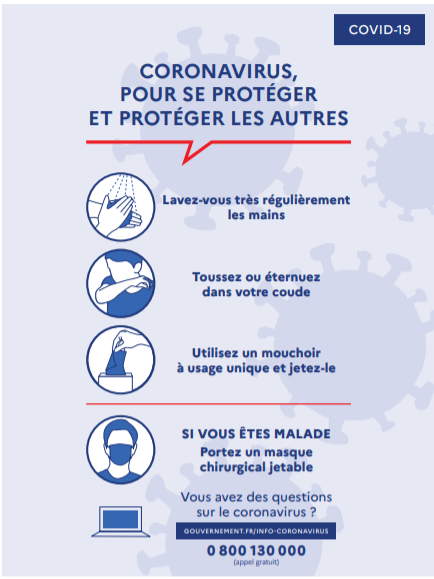
Below is the poster on barrier measures issued by the government:
The federation works for its members!
Reply to the ULMaG editorial “Who is the federation working for?”
https://www.ulmag.fr/index.php?lire=edito/edito_aff.php
Dear Miguel,
In your November editorial, you challenge the reader by asking “who is the federation working for?”. You report on the meeting of the “Vieux Deb’s” association held in November on the theme “Where is the federation heading?”. That meeting brought together around twenty people, including five from the federation and not two (two members of the Board of Directors, a national technical director and two representatives of the regional committees). It produced a largely one-sided account by the association, whose talking points you relay. Perhaps it is time to set the record straight?
Microlight-aeroplanes and regulation
Among the topics you raise in no particular order, you mention the new regulation of July 2018. I do not wish to return in passing to such a complicated subject, which has caused so much ink to flow, but I challenge anyone to show that this regulation infringes our freedoms or penalises any form of flying. Having looked around the European regulatory environment, one realises how fortunate we are to have preserved and encouraged this framework. In two years we have succeeded in securing our regulation for the long term. France’s election to head the EMF is a sign of this new influence. Whether one likes it or not, this regulation is very widely accepted, pragmatic and preserves what is essential. It can still evolve towards greater simplification.
On the “microlight-aeroplane” trend, we must first acknowledge that it does not date from July. Magazine covers and the recent years of the Blois microlight show are not representative of the machines in our hangars. We have 30% paramotors, which feed all forms of flying, a lively second-hand market, and new machines that remain affordable if one wishes; the market depends both on customers and on what they are shown. The lesson of our European experience is that wherever classes have been split, the dynamic is negative. Here again, this remark cannot be developed in three lines. But I am confident that ULMaG will also take its information from the federation, all the more so when it is being called into question. Everyone’s views will then be informed and balanced.
On flight safety, we will see the trend over time, but our principles are simple: no fatalism, no additional regulation. Let us avoid shortcuts and the “someone should just do something” talk of the club bar. The equation “microlight-aeroplanes” = “new regulation” = “accidents” is inaccurate. Conversely, how do we explain that there were sometimes more than 30 deaths a year 20 years ago? If there is a subject that calls for perspective, a cool head and collective work, it is this one. If there is a subject that has mobilised energy and resources over the past two years, it is this one. One example: Return to Flying (REV) in 2018: 180 flights; REV in 2019: 600. The DGAC has agreed to undertake (with the BEA and with us) a study on “20 years of microlight safety”. Nobody has all the answers. Our recent trends are good, and that is not just chance. We will talk about it again, but without shortcuts.
Medical matters
On the medical side, I believe ULMaG has perfectly understood the federation’s policy. The check-up confirming no contraindication when first taking out a licence has long been in place and is well accepted. The introduction of the QM Sport questionnaire at the start of 2019 understandably disoriented some people. But those who have understood the philosophy of this questionnaire have grasped that it not only does not infringe our freedoms but is also cleverly designed. It coherently allows us to avoid the aeronautical medical examination. Had we not taken this approach with the Ministry of Sport, our system would have changed long ago, including for those who strut about outside the federal framework and who have never done anything to preserve our freedoms. Here again, let us look at what has happened in Europe.
It is a mistake to associate the Ministry of Sport with competition alone. Training, health, and the development of flying and airfields are essential issues. The subject is delicate and has required a great deal of collective work over the past two years. This makes it possible to build a strong relationship within the reform of the sports movement. To take account of some people’s remarks about the questionnaire, we have simplified the declaration made when taking out a licence for the coming season as much as possible. For a year now, a passionate microlight enthusiast, a faithful companion in our shared history, has been very active on this subject. Despite hours of explanation, he is not convinced and is very hot-headed online. That is how it is. He has never, however, questioned the quality of the work we have done over the past two years.
Radio
In the editorial, ULMaG also refers to the federation’s “submission” to authority, among other things. It is good to be so nuanced. But it is all wrong. The October editorial refers to the radio text published in July. That text was a complete misjudgement, totally unforeseen, including by most DGAC departments. It is a perfect example of what not to do: no preparation beforehand, and plenty of inconsistencies in its application. The federation said so. What is it doing? We are awaiting the texts of the new microlight theory syllabus for early spring 2020, which will redefine the basics of radio skills. The published text formed part of the effort to give microlights access to controlled airfields, an old subject that ended up being lost over time. In the meantime, you only need to contact the federation if you encounter a shocking, shaky or incomprehensible situation. It is rather crude and easy to talk of submission. Fortunately the world is not so binary. One has to listen, understand, negotiate, propose and report back. That takes time, sometimes fierce conflict, but always respect. So it is not a relationship of domination that shapes our dealings with the DGAC but a clear-eyed partnership. Not to see how fortunate we are in Europe to have such an administration is the blindness of spoilt children. It is historical blindness, too, because it is the DGAC that has made microlighting possible since the very beginning.
The lack of democracy
ULMaG speaks of the Board of Directors being distant from the regional committees. That is very funny. Two years ago we decided to involve the regional committees closely in the federation’s governance, notably through a large joint Board of Directors alongside the usual regional committee meetings and Board of Directors meetings, as well as monthly executive board meetings, which did not exist before. The most recent large joint board took place a fortnight ago and was unanimously appreciated by all for the quality of the work and the choices made.
There is indeed one regional committee president who spends his time running down our work in a style all his own; he is a doctor of discord. I am confident in the long run: nobody listens to him any more. The web is his outlet.
Some people talk about democracy at every turn, but when it comes to counting, there is nobody there! It is not enough to puff yourself up behind a screen or to talk loudly in front of half a coach-load, saying certain clubs “here or there” or “more and more” in order to alter the reality of things, mistaking a trickle for a tsunami. Elections are held regularly, the activity reports are approved by more than 90%, the many clubs and companies present ask questions and we answer them. Some stand for election. Others are elected. Of the 20 members of the Board of Directors, 6 are women and 2 are under thirty. Throughout this year, 2019, there have been many meetings of instructors, club leaders and committees. Where are the divisions? There is debate and discussion, but the feedback is overwhelmingly positive, or else it really is “Tintin in the Land of the Soviets” in lots of corners of France, with an overwhelming majority of members lulled to sleep by the narcotic federal word.
It would also be good to change the old demagogic refrain about the grassroots and the top, the real country and the legal country, the France below and the France above. We are happy to sacrifice our time and energy on plenty of subjects, but we would not have so much support and such momentum if we were just a team of arrogant, pretentious “traitors”. My principle is not to make personal attacks but to try to bring teams together around widely shared projects. That is called uniting people. It takes quite a lot of energy. I do not like testosterone-fuelled governance, nor sterile controversies that lead nowhere.
One is of course entitled to disagree, but a few simple rules should be observed: do not accuse without first checking with the people concerned; do not fall into the easy, sometimes hurtful, way out; accept the rules of democratic life that apply to federations.
I have long appreciated ULMaG, and if I am taking the time to reply, it is because I am fond of it at a time when the aeronautical press is changing a great deal, and when social media gives more weight to a video of a cat falling into a swimming pool than to listening to simple, widely shared principles, expressed publicly and with respect for differences.
The spirit of the age likes easy information and confirmation bias, where you only listen to those who already think like you. By headlining “Who is the federation working for?”, the implication is that we have been bought, but by whom? The DGAC? That shows little knowledge of our relations. By money? One is entitled to laugh. By aeroplanes? Speak about it freely with the president of the FFA, who is also a friend, but with whom we have frank dealings. Who else could we have been sold to? The CIA? Big capital? The Illuminati? Paranoid suspicion always stimulates the imagination, but it rarely gets things moving. By contrast, when one knows a little of the ins and outs of our movement, certain postures are not without irony.
Let us also avoid the crude tricks about the “historic channel” as guardian of the temple. The expression should give pause to those with a sense of history. The history of microlighting belongs to everyone. It is a little sad to appropriate this heritage in a sectarian approach, hitting out at the federation while building a mausoleum to Dominique Méreuze: traitors and the golden age, the true and the false, a B-movie western with its censors and its scapegoats. The script is sometimes baroque when one knows the past of the actors. If we had let people steer the federation after Dominique’s death who were only in it for themselves, we would be on the side of the road with our hazard lights on! And besides, if we were so cut off from the world, why would 5 officials have come to a meeting of 15 people?
So there it is, dear Miguel, a healthy clarification, and I know that on many subjects you are in step with us: Blois in 2021, the delegation of the microlight theory exam, the paramotor world championships in the Paris region, the safety and training policy, and so on, and that we have plenty to do together, each in our own role. I also know that you are not one to attack individuals, but your standing and professionalism sometimes feed debates and invective that are less nuanced. The problem is not to agree but to listen to each other beforehand rather than hurl anathemas afterwards. It was necessary to rebalance things a little so as not to let people say just anything without consequence.
For two years now there has been a whole team, deeply committed, made up of elected members, supporters, employees and committees, at the service of members. There are clubs, commercial organisations, active partners who give their support, and ordinary pilots, generally happy with the policy being pursued. As soon as we identify a problem, we try to solve it or take it into account; there are also plenty of projects and a profound renewal of teams. I believe this is what a very large majority of members appreciate. Many things can be improved, but systematic denigration is flying at the bottom of the power curve.
I will not play ping-pong on social media; I would rather mobilise and build.
Who is the federation working for? For its members! At the beginning of December there are 15 360 of them.
Happy holidays.
Sébastien PERROT
President of the French Microlight Federation, which works for its members
December 2019
France takes over the presidency of the European Microlight Federation (EMF)
At its annual general assembly in Warsaw, the EMF (European Microlight Federation) elected Louis Collardeau, who is also 1st vice-president of the French Microlight Federation, as its president. The situation has changed considerably over the past three years, when France was largely in the minority in confused regulatory discussions.
 This election should not be read as a success for France but for a widely shared vision. It is now well established that the EMF brings together the European aviation movements that have chosen to remain outside the scope of the European Agency under a national regulatory framework. In seeking a unified microlight regulation at European level, one merely levels up, penalising flying and manufacturers. There is a risk of being caught up by regulation that depends directly on the Agency.
The EMF’s priority now is to facilitate bilateral agreements, as has always been the case since the beginning of the microlight adventure. We must also encourage the sharing of good practice in both flight safety and training, making life easier for European pilots. We would also like to organise a “Microlight Erasmus” to show that our light and accessible leisure aviation is the way of the future. We would also like to give the Blois microlight show a more European dimension from 2021.
Fewer regulatory debates played like 18-cushion billiards, and more flying, respecting our differences while promoting what we do best. The next EMF conference will be held in Paris.
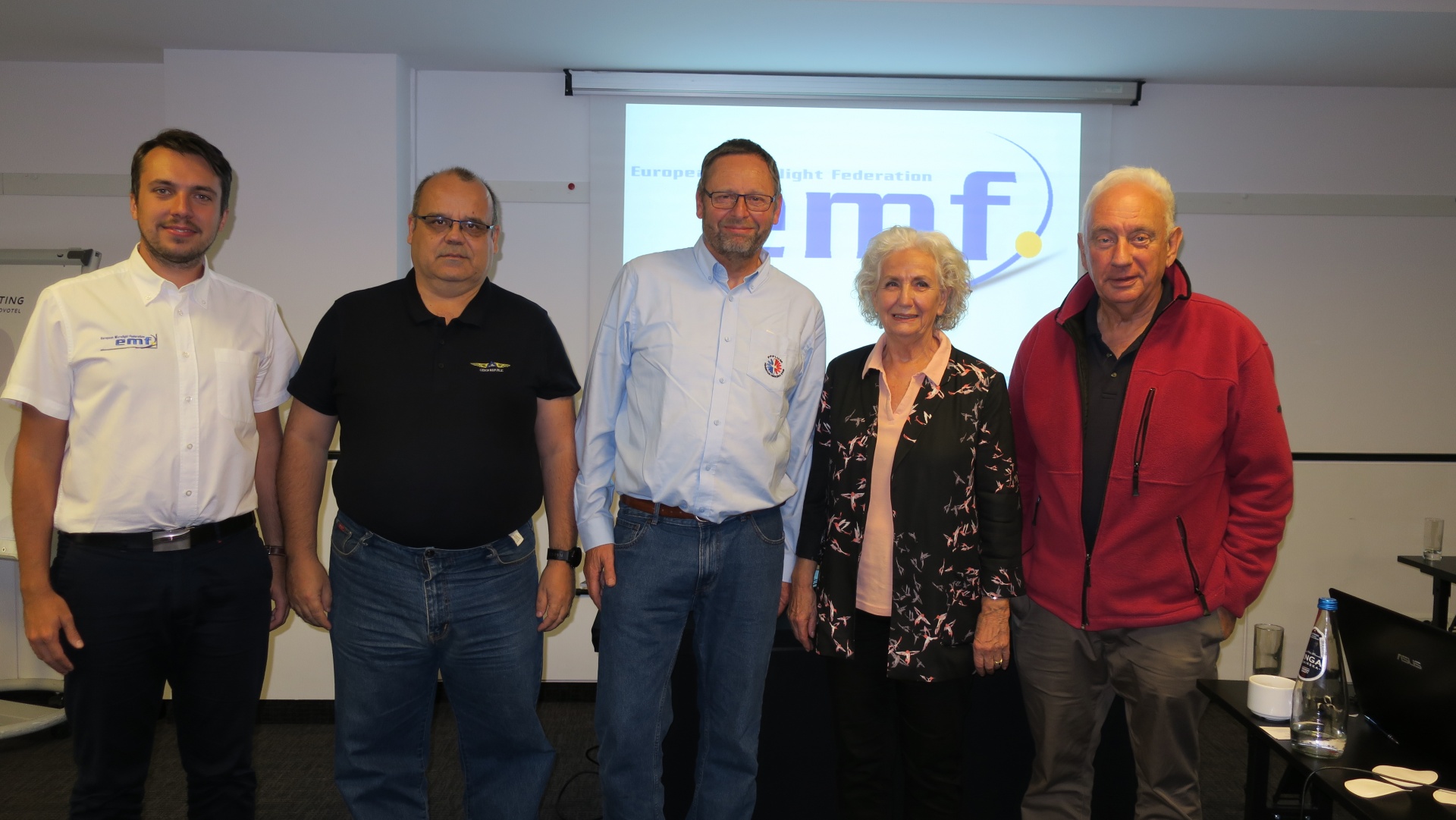
Founded in 2004, notably at the instigation of Dominique Méreuze, the EMF today represents more than 60 000 microlight pilots in 23 European countries. In October 2015, Rieteke Van Luijt succeeded Dominique as president of the EMF. Over the past 4 years, most of the EMF’s activity has focused on the evolution of microlight regulation, which concluded in 2018 with the new Annex 1 to European Regulation 2018/1139, leaving each country the initiative to define its own microlight regulation. Many thanks to Rieteke for leading the EMF through these 4 years, which were rich in debate and sometimes in surprising regulatory twists from the European Union. The new EMF board, formed on 12/10/2019, has 5 members (in the photo from left to right): Dariusz Cymerys (Poland) secretary general, Jan Fridrich (Czechia) vice-president, Louis Collardeau (France) president, Rieteke van Luijt (Netherlands) treasurer and Hans Havager (Denmark) vice-president.
Happy flying!
 The French Microlight Federation
Publication of the New Microlight Regulation!
The new microlight regulation has just been published in the Official Journal:
The federation has produced a document summarising all the important information. It has just appeared in ULM Info and is available below as a PDF in French and English.
| New Microlight Regulation as a PDF |
New Microlight Regulation as a PDF |
Headquarters is on hand to answer your questions.
Happy flying!
The French Microlight Federation
The Air Sports Festival took place from 11 to 19 May!
For the second year running, the National Council of Aeronautical and Sports Federations (CNFAS) coordinated the Air Sports Festival. The aim is to promote every form of flying to the general public: aeroplanes, gliders, free flight, ballooning, helicopters, parachuting, model aircraft, amateur building and, of course, microlighting, showing in practical terms that the dream of flying is within reach.

The week was supported by a television campaign that the FFA (aeroplanes) has run for many years. An interactive map was set up on the CNFAS website (www.cnfas.fr), allowing all clubs and companies to register and show their presence through a wide variety of events, from a simple open day with trial flights to larger-scale events. Everyone does as they see fit, but with shared tools and a bigger media sounding board than usual.
With our 1 000 clubs and companies and 800 airfields, the federation has an exceptional territorial network. Microlighting is an innovative, varied and accessible form of aviation, but it is often too little known or misunderstood. We make films that, each month, help to inform the general public better. In 2019, we also made the first licence free for under-25s and for women. Everything is therefore in place to celebrate! Join us and take part in this edition. We will repeat it every year.
Despite the weather, which was not always on our side during the week, we thank all the clubs and regional committees that helped organise it!
Safe flying to you all
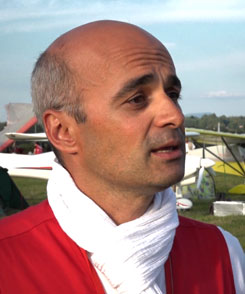
Sébastien PERROT
President of the French Microlight Federation
April - May 2019
A sporting and leisure form of aviation... within reach!
We often picture traditional aviation as ageing (average age across all activities about 50) and less and less accessible. That impression is partly justified, but it masks a more complex reality. At the Federation, we have had on average 800 young people under 25 (pilots or students) for about ten years, even though the number of members has risen significantly.
This does, however, require constant renewal, and we have many young competitors, young people on the Youth Microlight Tour, in our clubs, or in the Youth Committee’s activities that some saw in Blois around the Mini-Explorer, for example. The difficulty is that traditional media are changing, and we need to thoroughly renew the way we introduce an activity that is often little known to the general public or burdened with prejudice.
Even so, there is strong demand, and the incredible success of the BIA (almost 14 000 candidates in 2018, three times as many as 10 years ago) proves that young people want to fly. It is mainly among them that we should promote microlighting. The film we made, “Le BIA, les jeunes…”, gives a broad understanding of the BIA and the federation’s support policy. Registration for the 2019 BIA session opened yesterday and runs until the end of February (www.monbia.fr). The BIA syllabus allows our young pilots, whether qualified or still students, to take it either through a partnership between a microlight club and a school, or even as independent candidates.
But it is not only the pilot certificate that is within reach; so is ownership. The latest article in ULM Info, “Beginners, make your dream come true!”, shows that, with good second-hand deals, our microlights make it possible to enjoy owning your own machine, and not only for those under 25. To make this stepping stone easier still, we will introduce a “microlight passport” through the regional committees, enabling young BIA holders to try at least three of our six classes. Diversity is what makes us rich, and one can fall in love with one type of flying (weight-shift, gyroplane, paramotor…); it is just a matter of creating opportunities to meet and discover them outside the usual channels. To help this transition further, we have decided to offer the first licence to under-25s, and liability insurance rates, for a paramotor for example, are particularly competitive.
The tools are therefore in place, and it is up to all of us to take this step of reaching out and meeting people. For families or young people in the Paris region, this weekend there is the Aeronautical Training and Careers Fair at the Air and Space Museum (https://www.museeairespace.fr/actualites/salon-des-formations-et-metiers-aeronautiques-2019/). The federation will be there through the CNFAS stand for the BIA. A young person with a microlight pilot certificate may seem far removed from the usual professional pathways, which are often tied to the certified world. Yet schools are increasingly receptive to this kind of profile, from the BIA to leisure aviation, because what counts more and more is not titles and diplomas but what is called “soft skills”. A young person who commits passionately to microlighting carries values: a sense of responsibility and freedom, risk management and a desire to fly that go well beyond our activity alone.
Thank you to the whole Youth Committee team for the work done to share our passion. It is up to all of us to pass it on!
Safe flying!
Sébastien Perrot
President of the French Microlight Federation
February 2019
Together, let us prepare 2019!
Our activity is mainly seasonal. For the federation, preparing the year 2019 requires anticipation. In 2018 we gave priority to the triptych of Regulations, Safety and Training. The objectives are clear, some have been partly achieved, and the schedule is moving ahead steadily, with the delegation of the microlight theory exam and the organisation of the paramotor world championships on the horizon for 2020.
For 2019, we wanted to go back to basics: the licence. Why and how should you take out a licence? What does the federation bring to pilots and to the life of clubs, in concrete terms and beyond the commonly identified big issues? How can we promote our activity within a framework that does not distort it?
In parallel but separately, we wanted to redefine our insurance offer, with products that provide ever greater cover at optimised prices. The federation has joined forces within UFEGA with other federations to obtain specific insurance. The insurance offered by the federation is made by pilots for pilots.
We have therefore been working on these two subjects for more than a year. In practical terms, on the licence side, this means:
> A new member area, smoother and more practical. The previous software was almost 15 years old. Switching over is a big job and we will inevitably have a few teething problems. But our partner is very responsive and the product keeps improving. For those who are reluctant, we have reinstated a Licence&Insurance form, available on the website or on simple request to the federation;
> The licence can be taken out from October. The first year is free for women and for those under 25.
On the insurance side:
> Clearer presentation and optimised prices (lower hull insurance, liability rates maintained)
> A special instructor user liability policy, on average €50 cheaper than the standard user liability policy
> The option of insuring your microlight owner liability while parked for €5 when you are not flying, or later in the season
> A new breakage insurance covering damage outside flight operations, anywhere
All of this is sometimes complicated to explain in detail. We will go out into the field with the regional committees to explain, help and support club presidents, as was done with the safety meetings.
We have, however, created three resources to make the basics easier to understand:
> The tutorial “Why and how to take out a licence?”
> The tutorial “Why and how to get insured?”
> The Licence&Insurance guide, available as a PDF
The whole team is working hard so that we can enjoy our passion in the best possible conditions. On its behalf and with the headquarters staff, I would like to wish you and your loved ones an excellent year 2019.
Sébastien Perrot
President of the French Microlight Federation
December 2018

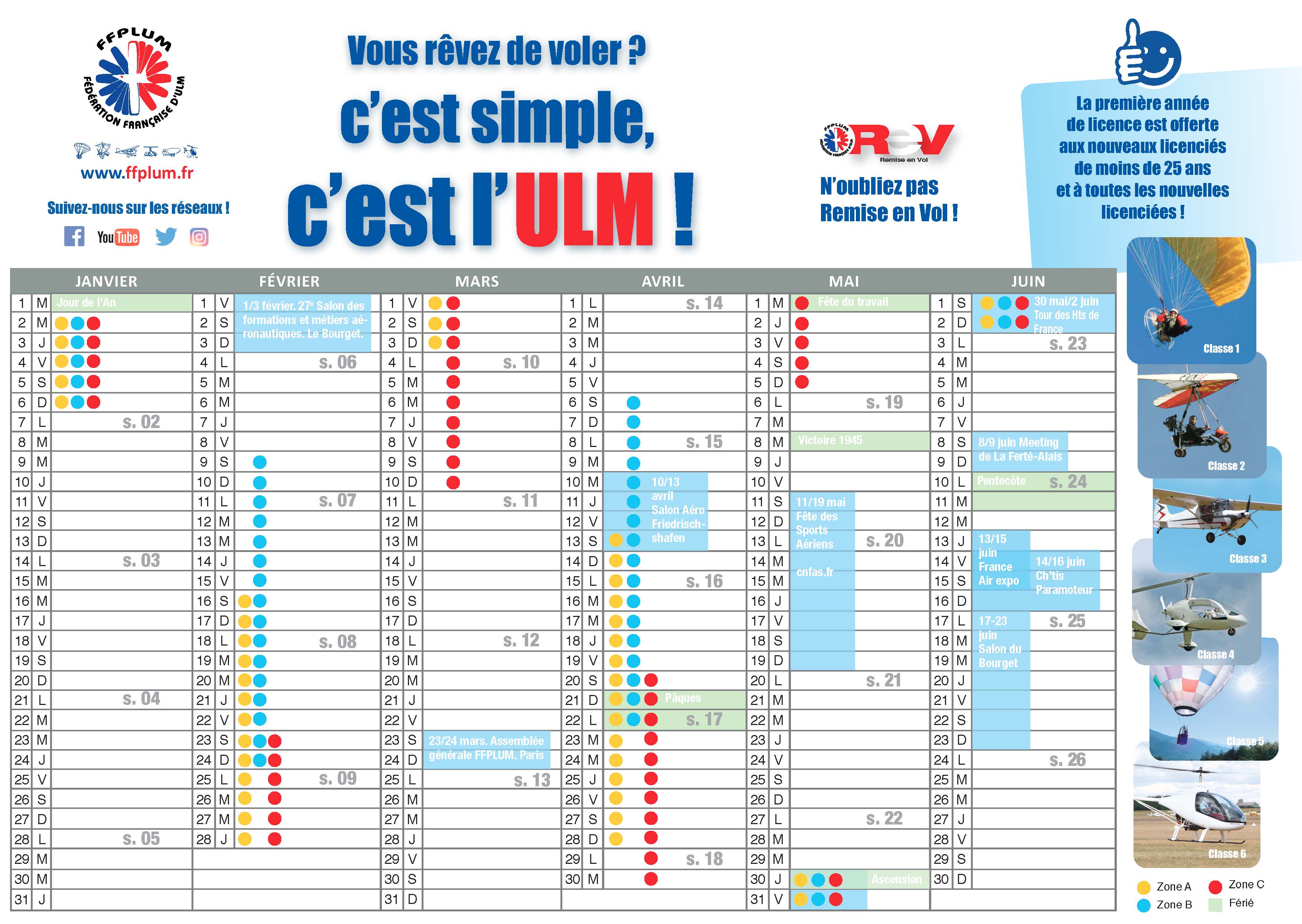
Download the FFPLUM 2019 calendar (A4 double-sided PDF, HD, 2,72 MB)
French-style microlighting
August 2018
The new text of the European regulation on basic rules in the field of civil aviation (to download below) will be published in the Official Journal of the European Union at the end of August, to apply during September. The text allows each Member State to opt for an exemption. In line with the guidelines of our term of office, our European battles within the EMF and the work carried out with the DGAC since then, the Director General, Mr Patrick Gandil, confirmed in a letter addressed to us (3 August 2018) (see below) that France would use this exemption to preserve the national microlight regulation. The main principles of our regulation for manufacturers and for pilots do not change. We are keeping the declaratory system in full. This exemption will give rise to a new national text on microlights, whose scope is known and which will shortly be finalised:

- Empty weight of 295 kg (or 320 kg with parachute), maximum take-off weight of 500 kg (525 kg) for two-seaters
- No change for paramotors and weight-shift microlights
- Maximum stall speed of 65 km/h
- Slight increase in power for gyroplanes and helicopters
This new regulation will make the control of empty weight and stall speed more effective. As in the current regulation, its scope is national and will give rise to bilateral agreements, or to recognition where foreign machines comply with these principles.
This is the end of a long journey that began in 2015 and gave rise to a great deal of controversy and discussion, with quite exceptional pressure from supporters of 600 kg. We held firm and we will come out of this sequence reinforced and strengthened. Beyond this scope, it is no longer microlighting but light certification. The limits are clear.
Our regulation has evolved roughly every 20 years, most recently in 1998. The whole challenge now is to improve our safety within this regulatory framework. This is where we must concentrate our efforts.
Have a good start to the new season
Happy flying, and long live French-style microlighting!
Sébastien Perrot
President of the French Microlight Federation
Download:
- Letter from the Director General of the DGAC, Mr Patrick Gandil
- New European Regulation (EU) 2018/1139 on common rules in the field of civil aviation
- Proposed table of regulatory microlight weights
Safety and Training : a good trend
June 2018
This month you will discover the first tutorial devoted to training (“Engine failure on take-off”), following a first series of “three mechanics tutorials” and the presentation of the “ 6 classes”. Coming next are “The emergency parachute”, then, after the summer, “Jack’s Lessons”, of which you have a foretaste in “The airspeed indicator is life! ”. There will also be another series of three “mechanics tutorials” before the end of the year.

Short films alone will not shift the lines, but the convergence of different actions will: the Flight Safety Bulletin at the start of the month with its four contributors (safety, training, RASU, and the analyst’s view), ULM Info, resources in clubs, the safety meetings held in the regions and above all the REV (Return to Flying) operation, which has had a fine start in conjunction with all our partners.
All with the same objective: to raise safety culture without touching our regulatory framework.
This start to the season is encouraging. The weather factor and statistical bias should not mislead us, but there is a clear decrease in serious and fatal accidents.
Over the long term, it is training that will change the balance: producing teaching resources, running our rich network of instructors, and the necessary reform of the federal theory syllabus. This is done over the long term, with a team and a programme, hard work and a pragmatic approach, but the trend is good, and it is up to each of us to support it.
Happy flying
Sébastien Perrot
President of the French Microlight Federation
>>> Discover all our videos on the FFPLUM YouTube channel

Microlighting to share!
May 2018

This month you will see in pictures the very good results of our teams at the paramotor world championship in Thailand, in difficult conditions (click HERE to see the results). There are the champions, and we congratulate them, but behind them there is also a whole team and the resources the federation provides to promote and support the momentum of paramotoring, which is fully, and more than ever, microlighting.
Microlighting is a big family with different forms of flying and budgets of every kind. We must never set the activities against one another, separating, opposing and compartmentalising them. We must take the best of each and share the tremendous energy of accessible, modern aviation. Sport is an extraordinary driving force and we encourage the development of regional competitions.
Outside the circle of those who fly, our activity is still poorly understood and is too often burdened with unfounded prejudice. To widen its audience, the federation has decided that next season, new members will be able to take out their licence from October (which amounts to three months free of licence and insurance). It is a small detail, but we must create the best conditions for people to discover our activity. We have also decided to offer the first year of the licence to young people under 25 and to women! It is therefore up to us to convince people and let them discover it. There are 11 500 young people sitting the BIA, 2 700 of them girls, at the end of this school year. They want to fly! We must go out and meet them, leaving the traditional paths of classic aviation.
This month we are releasing the last episode of the first series of mechanics tutorials (cleaning the carburettor) (click HERE to watch the video), which will resume after the summer with three new episodes. Next month we will talk about engine failure on take-off, again as a short film.
Let us share our passion in all its forms!
Safe and happy flying.
Sébastien Perrot
President of the French Microlight Federation
April 2018
The First Review of “Générations ULM”
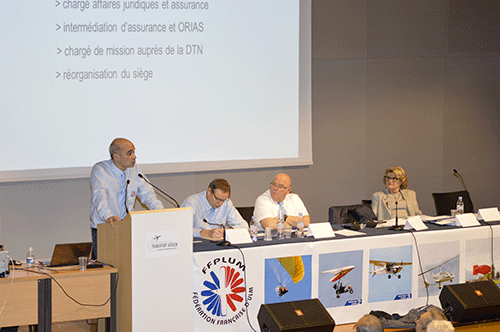
The last General Assembly approved, by a very large majority, the results of our first year in office. This “Générations ULM” term rests firmly on a close-knit team, a clear programme and a collective energy mobilised to defend and promote our activity. Everything, however, is a matter of rhythm and timing. To put it simply and schematically, things can be summed up as follows.
1. This first year was mainly devoted to reorganising how the federation works (insurance agent status, new employee posts for regulation, safety, legal affairs and communication), a joint Board of Directors with the Regional Committees and all our supporters, some 50 people in all, and a complete overhaul of our various contractual relationships within a controlled financial environment. On the regulatory front, we clarified and untangled the European issue concerning our regulation, together with the DGAC, and did the same on the medical side. We put in place an incentive-based safety and training policy including, among other things, the Return to Flying operation, which requires substantial resources, partly obtained through the federation’s first four-year agreement with the DGAC. Safety has a price, and we are paying it without touching our regulatory framework.
2. The coming season will bring major changes to the licence and insurance: new data-entry software, a season starting in October for new members, a free first year of licence for under-25s and women (new members), a personal area for each member, downloading of the certificate of no contraindication, and simplified insurance products closely matching the diversity of our activities. It is a big job to give our offers a fresh look.
3. From now on, though on a necessarily longer horizon given the time needed to implement it, we are investing in a Microlight Training plan whose aim is to energise our pool of instructors by helping them in their practice under the new regulation. In due course we would like the microlight theory exam to be taken in federal structures (as the FFVV does with the Wingu system). This requires the federation to take on a consistent teaching approach while respecting the specific nature of each class and of our declaratory system. We need institutional partners to support this move, and we are working on it.
Of course there is everything else (sport, airfields…) and above all the unexpected! But it is important to have a coherent roadmap so that we can report back and bring people together. That is what we have!
The fine weather is here! Safe flying, and do your REV!
Sébastien Perrot
President of the French Microlight Federation
Discover the “Générations ULM” programme

April 2018
Microlighting by microlighters
For about ten years now, most of what is new in sport and leisure aviation has come from microlighting and revolves around it. The Blois show is one of the few in France to show new models, traditional magazine covers feature microlights, and there are even advertisements referring to the “microlight spirit” on sites for fully certified flying. Electric aviation is being energised by our regulation, and the same regulation is rejuvenating seaplane flying, mountain flying and adapted flying. That is a good thing! Success must be shared.
It has therefore become common for aeroplane clubs to buy microlights, and for gliding clubs to buy microlights for towing (and only for that, we are told). It is a fact that amateur building is increasingly open to microlights. And free flight itself borders on paramotoring. This trend calls for a few remarks.
First of all, it is FFPLUM that defends and promotes microlighting. It is therefore natural, and very widely done, for microlight sections to open as themselves affiliated to the federation. This also gives access to all the support we provide to clubs, instructors and members. It is also up to us to offer ever better-suited services. But we must not forget that our movement is much less of a captive audience than traditional certified activities, where one invariably goes through the club! That is not the case for us, where a majority of pilots are owners. Bringing people together takes us more energy, with resources that are historically smaller.
Things become a little more problematic when microlights are used in a spirit that is no longer that of a microlight and, ironically, some people claim to explain to us what microlights are, how to use them or what should be done for the activity to evolve, sometimes even asking for specific regulatory arrangements. As regards flight safety, we must accompany our success by keeping our safety level much better in check; it has been at a high average for some years, but we also need help in this, because the shift towards our activity is widespread! We can clearly identify accidents that are linked to a use that has nothing to do with microlighting, and that until recently belonged to certified aviation.
Finally, it is a fact that aviation professionals have been brought up in a culture of certification, and we must redouble our efforts to explain what makes us different and how we strike our balance. It would be desirable for engineers, controllers and players in the certified world to take on board the declaratory culture early on, so as to respond as accurately as possible to our issues. The systematic training of first-information investigators with microlight modules at the BEA is an excellent practice, and we would be delighted to support the opening of microlight sections in the major aeronautical schools!
These remarks are made in a spirit of good understanding with our friends in the other federations. This is all the more so as we have never worked with so much solidarity within the CNFAS, whose role we would like to see
better known. That is the point of events such as the 50 years of the BIA, or the Air Sports Festival, which we are organising this year for the first time. Working closely together, even friendship, does not rule out frankness and clarity of intent.
In the long run, everyone gains!
Sébastien Perrot
President of the French Microlight Federation
Continue reading with our magazine ULM Info
March 2018
Return to flying, here we go!
The Return to Flying (REV) operation is now up and running. The application that lets pilots get in touch with our instructors is live on the federation website. This approach is incentive-based, preventive and original. It aims to make it easier to share flying experience, of which our instructors are the guarantors, by strengthening our safety culture. After the Return to Flying, the pilot receives a federal contribution of €40. This operation is here for the long term and we want it to be a success. It applies to all classes of microlight.
It requires substantial resources, which are provided by the federation and by support from the Directorate General for Civil Aviation. We will regularly review how it is being implemented, and our approach will be pragmatic if the arrangements need adjusting.
As every month now, we are releasing a short film about our activity. This month we start with a series of “mechanics tutorials” with Pierre Pouchès and Thomas Gadaud of the National Centre for Training, Technology and Testing (CNFTE). And of course, Return to Flying! In this case, on a paramotor!
Even if the temperatures are misleading, it is spring!
Enjoy your return to flying!
Sébastien Perrot
President of the French Microlight Federation
Return to Flying (REV) is a programme initiated by the French Microlight Federation in partnership with
 |
Ufega | Air Courtage |
23 January 2018
Microlight regulations: the timetable takes shape
On 11 January 2018, the European Parliament and Council adopted the proposed civil aviation regulations. The 271-page text is available on the Commission’s website (http://data.consilium.europa.eu) and also on the federation’s website (here). This is a very important step that brings to a close a very long process full of controversy.
Two pages in particular concern us: page 205, which defines Annex 1 excluding aircraft that do not fall within the competence of the European Agency, and page 39, paragraph 7a of Article 2, which defines the conditions under which a State may exclude certain aircraft from the Agency’s remit within an envelope different from that of Annex 1.
This complicated subject was covered in a long article in the latest ULM Info (“The EMF’s second life”), which is also online on the federation website and places our regulatory vision in its European context. Our position therefore remains unchanged and we are acting in perfect harmony with the DGAC.
This announcement gives a clearer view of the timetable. We still have to wait for this text (which will not be amended) to be applied. From that point, we will define with the DGAC the outline of the regulatory change, whose principles are known: the current declaratory system, broadly the same empty weight, and a maximum weight of 500 kg.
It is risky to announce a timetable, but the DGAC and the federation will soon be in control of the clock. It is therefore very good news for our movement.
Sébastien Perrot
President of the French Microlight Federation
10 December 2017
New IULM order
The orders on the training of microlight instructors have been published in the Official Journal. They are available at the following links:
https://www.legifrance.gouv.fr/eli/arrete/2017/11/24/TRAA1729550A/jo/texte
https://www.legifrance.gouv.fr/eli/arrete/2017/11/24/TRAA1729552A/jo/texte
These orders and their annexes are the fruit of long, complex and fruitful work with the Directorate General for Civil Aviation, particularly with the departments of the Directorate for Safety and Regulation, and those of the General and Helicopter Light Aviation Mission.
Our regulation was more than twenty years old, and it needed amending to take account of the evolution of both our activity and teaching methods.
The work, begun under the previous term of office, has preserved and promoted the spirit of our regulation, based on Responsibility and Freedom. It both ensures consistency in training and maintains the specific nature of our activities.
We worked very effectively with the SNPPAL, in a spirit of collegiality, on such an essential subject. We wish to thank its president, Serge Marolle.
Since March 2017, Jean Christophe Gibert (head of the Training committee) has taken responsibility on behalf of the federation for finalising the work, in close collaboration with Louis Collardeau (First Vice-President in charge of regulation). We also wish to highlight the work of Pierre-Henri Lopez (former President, now Second Vice-President), who had to steer this reform at the end of the previous term of office, as well as the role of the lead instructors for each class and of the instructor training centres.
The texts are only a beginning. Now we have to bring them to life.
From February 2018, the federation will launch a major Training and Safety campaign, Return to Flying. It will be incentive-based, not compulsory, and will make instructors the central pillar of our safety culture.
Sébastien Perrot
President of the French Microlight Federation
21 November 2017
Do a REV (Return to Flying)
The federation has decided to set up, from 2018 and to renew each year, the Return to Flying (REV) operation, which encourages a pilot who owns their machine to meet an instructor and fly for an hour in their microlight. This is entirely voluntary. It applies to all classes. The federation will provide €40 in support to the pilot who has done a Return to Flying.
This operation starts from the observation that we are all the product of what our instructor made of us. That in our flying experience we have encountered different machines between our beginnings and our current flying. That our fleet of machines is characterised by very great variety (unlike other forms of aviation). This, incidentally, is what makes our movement so rich. That these machines often have very wide, even surprising, flight envelopes for anyone coming from traditional aviation. It is therefore necessary, as Eric Galvagno puts it, to be an “expert on our own machine”. We find that most accidents are due to loss of control in flight, in every phase of flight. There are therefore inappropriate reactions in uncertain situations, explained by too little knowledge of the machine’s limits.
Our aim is to raise the general level of “our safety culture” by being incentive-based and not compulsory, in the spirit of our regulation: free and responsible.
Do a REV!
Sébastien Perrot
President of the French Microlight Federation
How it works
- The REV operation starts at the beginning of 2018 (February)
- All steps are done online (ffplum.fr): meeting, flight certificate, payment
- The pilot must register on the federation website
- They must own their machine, be insured for liability through the federal broker, and accept the terms
- They will have access to the contact details of instructors affiliated to the federation (whichever insurer they use), by class and by region
- The pilot and the instructor agree an appointment to complete one hour of Return to Flying in line with the programme issued by the federation; the price of the service is entirely free
- The instructor and the pilot each confirm separately, through the website, that the REV flight took place
- A certificate is issued
- Payment is made









