Save your lives with the rescue parachute!
By Louis Collardeau, FFPLUM vice-president · Didier Blachère, head of the Flight Safety division · Mathieu Farcy, head of the Training division
- 60 %of accidents: a lack of situational awareness is noted (up to 80 % depending on the source)
- 3levels of situational awareness: perception, comprehension, anticipation
- 4phases in the decision-making process
- 2lives saved by the parachute on 12 November 2022, over the Loiret
Our favourite activity, flying motorised ultralight aircraft, is a recreational and leisure activity. This activity is particularly demanding in terms of training, practice and keeping knowledge up to date, because it is the only way to guarantee a high level of safety in our flying. However, the accident record reminds us that our hobby carries risks. To improve microlight safety, and in effect reduce fatal risks, microlights were the source of a remarkable innovation with the development of rescue systems. This is the pyrotechnically deployed rescue parachute that now equips a good part of our microlights.
This safety device has proved itself by saving many human lives and also by significantly limiting the material damage from impact with the ground, and the crew’s decision to use it and the procedure should be considered sufficiently in advance, on every flight.
A very recent event that undoubtedly saved two lives deserves a closer look, to better understand the pilot’s decision to deploy the rescue parachute.
The overall situation
On the afternoon of Saturday 12 November 2022, the pilot and his passenger decided to make a flight in a 3-axis microlight to fly over the Loiret. The flight was proceeding normally at about 3000 ft, until he was surprised by abnormal behaviour of his machine that he could not control. Aware of the situation, the pilot decided to activate his rescue parachute system. The microlight fell into the trees and went through the canopy. The occupants were unhurt.
The pilot’s account:
- I had been mentally prepared for this action for a long time. My deciding argument is that in the compulsory training of new Cirrus pilots, they are told: “- Engine failure: don’t think, pull the parachute!”. My microlight had become uncontrollable, so I pulled without hesitation.
- The parachute saved 2 lives ...
- And saved the microlight, which in the end is barely damaged!
Let us try to understand: why and how did the pilot make this very good decision?
Situational awareness: what is happening and what will happen?
There are many contributing factors to safety events. Some factors come up more often than others. A lack of what is called Situational Awareness is noted in 60 % of accidents (up to 80 % depending on the source), and this lack often leads the pilot into conditions he can no longer control. Good Situational Awareness means always staying ahead of events, either to prepare for them or to avoid them.
Situational Awareness (SA) is divided into three levels, which allow:
- Perception by the pilot of information about his machine and his environment
- Comprehension, the meaning of this information.
- Anticipation of how it will evolve over time.
Situational Awareness is used to make decisions.
In this case, the pilot perceived a major anomaly, and so anticipated possible developments and consequences.
Decision-making: what should I do?
After perceiving and understanding the information, it is projecting it into the future course of events that must allow you to anticipate how the situation will develop and make the decisions that are needed.
The decision-making process breaks down into four phases:
- Situational awareness
- Reasoning (assessment, building options)
- Making the decision and applying the chosen option
- Checking the effectiveness of the chosen option
In this case, the pilot, aware of the situation and assessing the deterioration of a situation he no longer controlled, made a survival decision in a mental pattern he had prepared for, by deploying his parachute. This pre-established process, whose implementation was effective, had been prepared beforehand and saved the crew’s lives.
KEY POINTS
Deploying the rescue parachute is a decision the pilot must prepare for in advance, so that this solution can be built into a decision made in a few seconds. This means the pilot must have mentally absorbed and rehearsed this decision to be ready, without any hesitation, when it is carried out.
Knowing how to ANTICIPATE and DECIDE can be learned and maintained. These are the so-called “non-technical skills (NTS)”, which are essential in pilot training.
In short, NTS allow the pilot to improve flight management by identifying the most critical situations (foreseeable or not) resulting from errors and threats, so that he can make decisions to fly with safety as the priority.
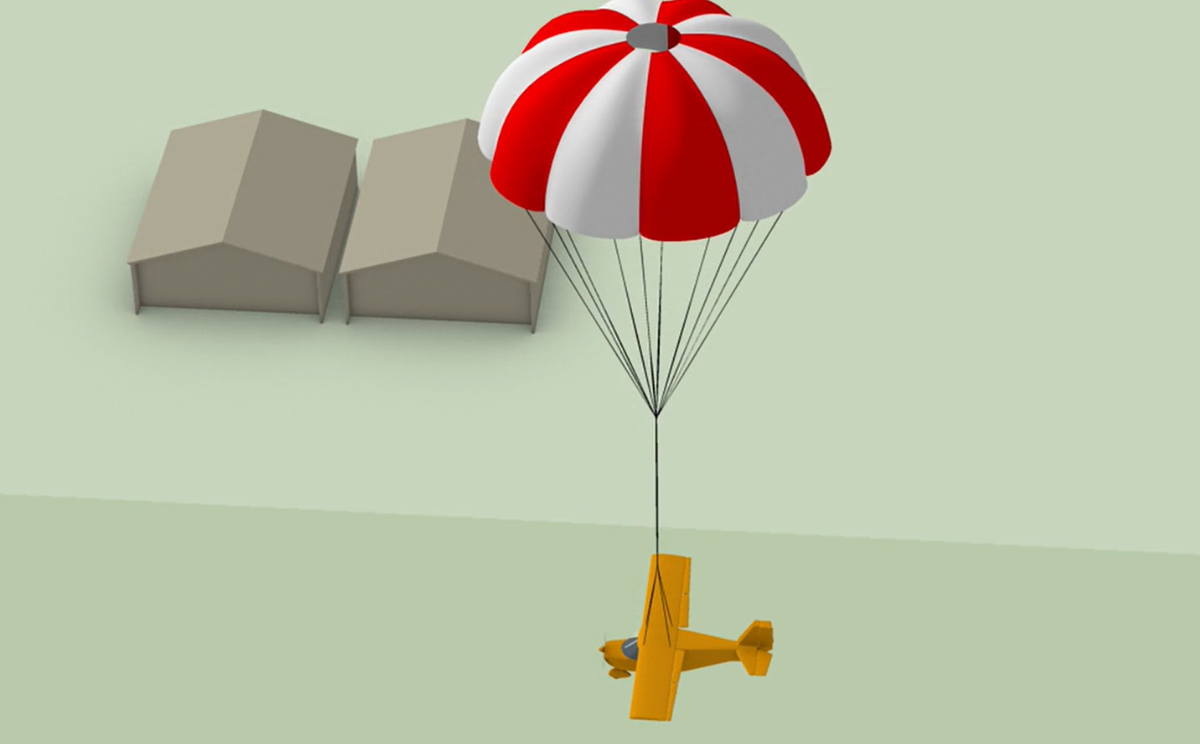
The parachute can be deployed:
- When the aircraft goes out of control in flight.
- If there is a mid-air or bird collision,
- If visual references are lost,
- If the engine fails and would force an emergency landing on unsuitable or hostile terrain: water, forests, mountains, high ground,…
- If the pilot loses consciousness or is incapacitated (a briefed passenger may activate the system). The new in-flight passenger training scheme (FAV) can usefully be put to use.
When in doubt, the option of deploying the parachute must be taken, because it will save lives.
You must know the parachute deployment sequence perfectly. Your instructor is there to explain it to you; during a ReV, remember to talk about it with them, and brief your passengers on how to use it: handle position, force and travel needed to deploy, engine cut-off,…
Simulate this sequence regularly before setting off. Do not hesitate to watch, or watch again, our video on the rescue parachute
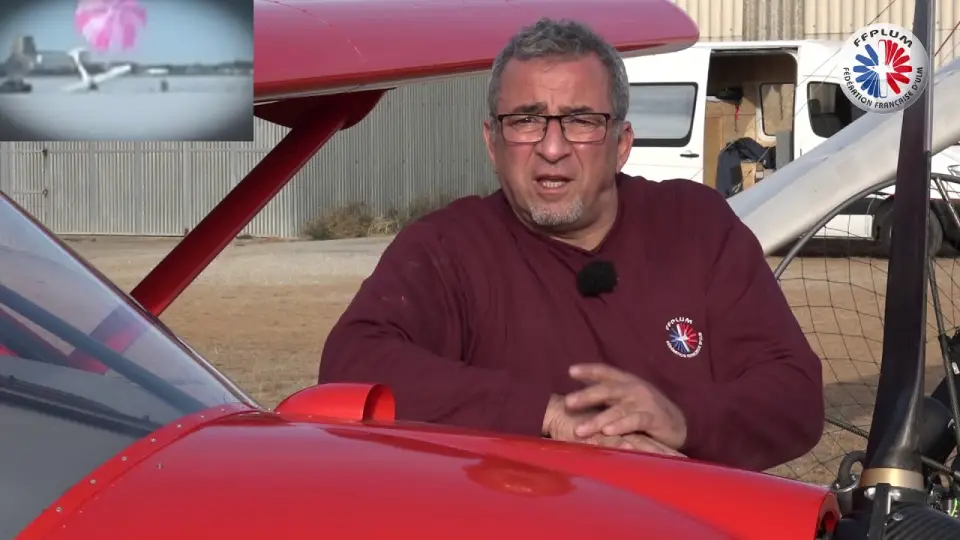
YouTube video: playing it loads it from YouTube (Google), which receives your IP address and sets its trackers. Your consent will apply to YouTube videos on this site for six months. Manage my cookies
Today the parachute’s effectiveness no longer needs proving, “everyone who has deployed it is still here to tell the tale…”.
The parachute does not prevent the accident, but it can greatly reduce its consequences.
As a reminder, the Federation encourages fitting the parachute to aircraft and gives financial help to clubs that use this device, particularly on aircraft dedicated to instruction.
- €1 200 towards purchase (paramotor with trike, weight-shift, three-axis, gyroplane).
- €300 towards purchase (paramotor without trike).
- €500 for refurbishment (paramotor with trike, weight-shift, three-axis).
Happy flying, and never forget that the parachute saves lives!
Louis Collardeau
Vice-President FFPLUM
Didier Blachère
Head of the Flight Safety Division
Mathieu Farcy